




It’s April 1992, and Carol Ryan has just welcomed her baby son Mathew into the world.
For all intents and purposes, the Ryans exist in an exceptionally normal pocket of the Australian experience.
The western Sydney suburb of Plumpton is rapidly developing from a semi-rural area to a bustling, diverse residential hub. It’s brick and mortar family homes. It’s rectangular areas of green space to kick around balls of varying shapes and denominations.
And it doesn’t know it yet, but it’s just become the home of a future Socceroos star, the first-choice goalkeeper for four World Cups, the captain of a team of young men with a shared hope for sporting glory.
But Australia has never been able to produce a World Cup squad entirely on its own.
The original 1974 squad included two Croatian players, and two years after Ryan’s arrival in Sydney, another Croatian recruit is welcomed to the world.
In April 1994, Miloš Degenek is born in the town of Knin in modern-day Croatia…
… before his family becomes one of thousands that flee during the Croatian War of Independence. It’s a harrowing journey to Serbia, but one that will eventually lead them to Sydney.
The Socceroos machine has traditionally been fed by players from across the European continent, particularly the UK.
While Degenek’s parents are trying to shield their kids from violence erupting around them on the other side of Europe, Cameron Burgess is born in Aberdeen to a footballing family that includes a former Scottish international player: his grandfather Campbell Forsyth.
Three years after Burgess makes his arrival in Aberdeen, little Harry Souttar — who fast becomes big Harry Souttar — is another Socceroo born in the Scottish city, to a Scottish father and an Australian mother.
Scottish representation is nothing new for Australian football. But the story of another continent is now starting to fill the pages of the Australian football memoirs.
In September 1995, Awer Mabil starts life in the Kakuma refugee camp in Kenya, after his parents fled unrest in South Sudan.
From the age of five, he spends his days kicking around makeshift footballs and dreaming of playing in big tournaments, before his family moves to Australia.
On the other side of the continent, Amara Touré has hiked north from the Salala district of central Liberia, through Sierra Leone towards Guinea to escape the horrors of the First Liberian Civil War.
After almost three weeks on foot, Amara decides to rest in a refugee camp in Conakry on a peninsula that juts out on the west coast of Guinea.
There he meets Mara, another Liberian refugee. They’re both young, both exhausted, both searching for a safer existence, and a place to raise a family and grow old.
A relationship ensues, and by 2000 they welcome their first of six children into the world, little Al Hassan.
Four years later, his brother Mohamed joins him, also in that refugee camp, before a discussion with an Australian aid worker convinces Amara that Australia — not Canada or the US as he had first thought — should be their new home.
… Gideon Irankunda is guiding his young family from their home in Burundi to a refugee camp in Tanzania to escape the escalating civil war.
In February 2006, it’s there in Kigoma that he and his wife, Dafroza, welcome the third of their eight children into the world, a little boy by the name of Nestory, a variation of the name Nestor, which means ‘one who returns home’.
Home, for Nestory, will become Perth at just three months old, before the family settles in Adelaide at the age of seven.
At Croydon FC and Parafield Gardens, both north of the Adelaide CBD, the Touré and Irankunda families will embrace the world game, developing their boys into world class attackers who now wear the green and gold with pride at arguably the biggest sporting tournament in the world.
Today, 26 Australians will band together in Canada with one goal in mind: victory at the World Cup.
Their tournament will take them from Vancouver to Seattle and down to San Francisco, with hopes that their path will see them into the knockout stage and on to Boston or New York.
This quest, though, started years ago, spread out across the globe in African refugee camps, Scottish suburbs and rectangles of green that dot our Australian cities.
Like many of the best footballing journeys, it started inconspicuously for Mat Ryan.
Before becoming one of the longest serving Socceroos players and captains, he was a kid from Western Sydney, where rugby league served as the beating heart of the Sydney sporting scene.
In the streets of Plumpton, lined with red-brick family homes and dead-end courts abuzz with kids playing cricket or footy, Ryan first picked up the gloves in the under-10s.
All who came across him knew greatness lay ahead.
When he joined the Central Coast Mariners as a 17-year-old, he was in the shadows of his boyhood hero, Danny Vukovic.
They’d attended the same high school, though didn’t overlap, and shared the same mentor, esteemed goalkeeping coach John Crawley.
Vukovic recalls returning to his alma mater for his first encounter with a teenage Ryan.
“I do remember John Crawley telling me, ‘this is the one, he’s got something’,” Vukovic says.
Phil Moss was the Mariners’ assistant coach at the time and has vivid memories of Ryan’s attributes.
“He was just so determined from day one that he walked in to show that he was a professional footballer,” Moss says.
“[That] he belonged there and he was going to go on and have a successful career.
“I think the other thing was his mindset around proving people wrong because there were some who certainly spoke about his size as a goalkeeper and that may be an inhibitor, but you could tell he was just so determined that nothing was going to hold him back.”
Ryan starred for the Mariners across three years in a golden era for the club. Graham Arnold was head coach, and the stable was full of young talent who were destined for higher honours.
“There were players like Maty Ryan, Bernie Abini, Anthony Caceres, who were living in a caravan when they were up the coast for the week training,” Moss says.
“That forged a really close bond between the players, but they also understood what it was like to do it a bit tough, even though being a professional athlete is supposed to be glamorous.”
And Moss remembers an early conversation Arnold had with players in the dressing room.
“[He said] our job as a staff is to make as many of you millionaires as we can and that means a lot of hard work and it means that you’ve got to aspire to be playing at a higher level,” he says.
They were words Ryan took to heart, as one of the most successful, and profitable, Australian exports in the post-Golden Generation era.
One of 18 Australian-born players in this World Cup squad, Ryan’s story is a familiar one, a well-worn sheep track from the Australian suburbs to the world stage.
Even that Golden Generation of 2006, with names like Viduka and Kewell and Cahill and Schwarzer, was one born under the Southern Cross, every player welcomed into the world in either Australia or New Zealand.
But this squad that gathers in Vancouver today; it tells a different story.
It treads a different path.
I love a sunburnt country
In a Kenyan refugee camp dotted with makeshift huts, Awer Mabil twists and skids across the orange dirt of Kakuma that stains everything it touches.
It’s around the same time that Harry Kewell is moving from Leeds United to Liverpool, signing a multi-million dollar deal in 2003 that secures him the biggest homes and the fastest cars, creating headlines that soccer had firmly arrived as a genuine path for Australian sporting greatness.
A continent away, little Awer is kicking around a rolled-up sock.
Or at worst, some plastic bags.
“They rolled [the plastic bags up] and they became hard,” Mabil’s uncle Peter Kuereng says.
“And that’s what they used as a football.”
Mabil’s parents were from South Sudan, and had left their home country in the midst of the ongoing terrors that plagued their lands. It was in that camp, more than 100km from the Sudanese border, that Awer first blinked into the burning sun that scorched the earth each day.
He would grow up with the simplest of possessions, but the loftiest of dreams.
“As a young boy he grew up in the refugee camp and that’s where he started dreaming of playing soccer and playing [in] a bigger tournament,” Kuereng says.
“He had a dream that one day … he would play at a World Cup.”
A year later, Mohamed Touré is born in a refugee camp in Guinea after his parents fled Liberia. Two years after that, Nestory Irankunda is born in a similar camp in Tanzania, after his parents left the bloodshed of the escalating civil war in Burundi.
All three would eventually find themselves growing up in the comparable safety of Adelaide, a trek of thousands of kilometres, a journey with eyes fixed firmly on the future, but hearts still beating for their home of old.
It was here, in the South Australian capital, that the dreams of green and gold began to sparkle.
“Since we were young, Mohammed has always shown potential. He’s always been physically ahead of his age,” Touré’s brother Al Hassan — who was also in the discussions for World Cup selection — tells ABC Sport.
“And I think because we’re so close, he used to come with me and play with my friends. I think that developed his understanding of the game and the love for the game.
“He always wants to win. You can tell. When we’re younger, when we go to the park and he’s losing, he’s never happy.”
That will to win, to be the best of the best, to prove everyone wrong, was on show when Irankunda was a junior as well.
Playing for the Adelaide Raiders underage team, Irankunda launched a rocket from outside of the box as impressed scouts looked on.
Moments later, he was subbed off, removing his shirt and throwing it on the ground in front of his coach.
He had a fire that made the talent spotters take notice, fuelled by the desire to give back to his parents for giving up so much.
“When the civil war broke out, they had no choice, they didn’t want to lose their lives,” Irankunda would go on to explain.
“Dad gets emotional talking about it and I try to understand what they went through but they’ve only shared small bits.”
For Touré’s father Amara, the fact his boy will run out for Australia at a World Cup in America is more than enough reward for the sacrifices he has made.
“I feel deeply proud, but also very grateful. I am proud because I know the work he has put in, the effort,” Amara says.
“As a parent, your dream of seeing your child play is important, but also to see that they use their gift in a positive way.
“That makes you proud as a parent.”
Amara will be there when his boy runs out on that lush green grass of the World Cup theatre, along with the extended Touré and Irankunda families, who have formed a bond that Mo talks about glowingly.
“It’s like going to work with a friend, you know,” Touré says of Irankunda, before speaking about his brothers.
“We’re a very tight family so when one of us is doing well, it’s like we’re all doing well.
“We try to better each other and help each other because football can be a hard sport, it’s a hard game.
“And that’s just life. Just having people in your corner always supporting you and putting you on the right track was important.”
Her beauty and her terror
It was under the quaint red-tiled roofs of Knin in the Dalmatian region of Croatia that Miloš Degenek was born.
And it was under the constant fear of bombing that he was raised.
“You flee one country and lose everything you ever had,” Degenek said in 2022.
“I was 18 months old when we fled to Serbia.
“Then in 1999 you have another war where we were getting bombed.
“But as a six-year-old I’m thinking, ‘this is normal’. You hear a siren, get into a building, down into the bunker 20-to-30 metres under the ground and think, ‘that’s alright, we’ll get out when the bombing is finished’.
“Even being told that if they hit the building you might never come out or wait three months for someone to dig you out. But you think ‘surely we’ll get out, go onto the street and play hide and seek again.'”
When Degenek and his family emigrated to Sydney in 2000, the six-year-old had been through more mental terror than the average Australian adult would experience in their entire life.
The sacrifice his parents made to create a new life Down Under is not something that is lost on the defender.
“Those things in life make me appreciate more what my parents have done for me,” Degenek says.
“The fact that my dad chose to go to Australia at the time.”
I love her far horizons
For every Socceroo who was proudly born into the green and gold, there is a story of those who took the risk to become an Australian.
This squad is a celebration of what it means to be represent our country in the biggest sporting stage in the world.
It’s Harry Souttar, born in Aberdeen to a Scottish dad and an Australian mum, choosing the Socceroos while his brother, John, represents Scotland at the same World Cup.
It’s Cameron Burgess, born in the same city as Souttar but raised in Western Australia from the age 11 after his mum took the risk to accept a job opportunity on the other side of the world.
It’s Alessandro Circati, born in Italy but raised in Perth when his professional footballer dad joined the Glory, and the inverse story of Paul Okon-Engstler, born in Belgium while his famous dad, Socceroos champ Paul Okon, played for Club Brugge.
And it’s the stories of the second generation Australians, born here after their parents journeyed via sky and sea to a new life and new opportunities.
There’s Aziz Behich, the son of Turkish Cypriots, and Tete Yengi, who spent part of his youth in South Sudan with his dad, Ben, a prominent refugee advocate.
There’s Jason Geria, whose father fled Uganda in the 1980s, and Nishan Velupillay, whose dad is Malaysian with Sri Lankan Tamil heritage.
When this team comes together in the locker room in Vancouver for its first match of this 2026 World Cup today, they will all pull on the same socks, the same jerseys.
But the feet in those socks have tread vastly different paths to this moment in time.
The hearts behind the emblem beat for Australia, but hold a special place for the homes, the friends, and the families elsewhere in the world.
The wide brown land for me
Midfielder Jackson Irvine was born in Melbourne. His dad is from Aberdeen. His mother has Dutch-Maltese heritage. He’s played for clubs in Australia, Scotland, England and Germany.
He describes himself as a “little bit of a blend”.
Famously outspoken on issues as varied as player advocacy, LGBTQIA+ rights, and most recently, his criticism of FIFA’s “peace prize” awarded to US president Donald Trump, Irvine is a deep thinker and deep talker.
He’s never been afraid to take on the complicated, the grey areas, the talking points that leave other players telling us all that they’re just focusing on what’s happening on the pitch.
But when it comes to these Australians, these teammates and friends that are forming an unbreakable bond in this historic moment, Irvine has a very simple message.
“The Socceroos aren’t just a team,” he says.
“We are a reflection of modern Australia.”
About this story:
- Map data was sourced from Australian Bureau of Statistics, Humanitarian Data Exchange, UK Data Service and Simple Maps.
- Socceroos 1974 World Cup squad photo supplied by the National Archives of Australia
- Mathew Ryan archive photos supplied by Mathew Ryan and Football Australia
- Penrith and Plumpton aerial archive photo supplied by NSW Spatial Services
- Harry Souttar archive photo courtesy of Brechin City Youths Football Club
- Touré brothers archive photo supplied by Mohamed Touré and Football Australia
- Nestory Irankunda archive photo courtesy of Adelaide Croatia Raiders
- Miloš Degenek archive photo supplied by Miloš Degenek
- Awer Mabil archive photo is from awermabil10 Instagram account
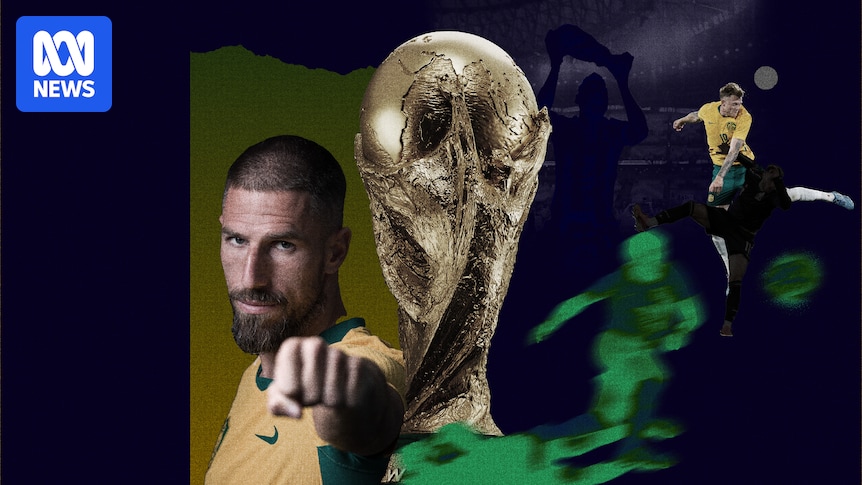
- Header collage photo credits – Getty: Joosep Martinson – FIFA, Getty: Mike Nowak, Getty: Morgan Hancock, Getty: Robert Cianflone, Los Angeles Times/Getty: Ronaldo Bolaños, Getty: Luiza Moraes, Getty: Orlando Ramirez.
Credits:
- Reporting: Kyle Pollard
- Additional reporting: Tom Wildie, Amanda Shalala, Daniel Keane
- Developer: Joshua Byrd
- Designer and photo research: Teresa Tan
- Editor: Cristen Tilley