







“My goodness, what have I got myself into?”
That was one of the first questions Graeme Pollett asked himself when he rolled into Balgo to take on the job of running one of Western Australia’s most isolated public swimming pools.
A tumbleweed blowing over the road was one of the first sights he remembers as he drove into the remote community, which sits more than 3,000 kilometres north of Perth, 800km north-west of Alice Springs, and 1,300km south-west of Darwin.
Graeme Pollett has been managing pools in some of WA’s most remote communities. (ABC Kimberley: Giulia Bertoglio)
But he wound up spending five years there, on the edge of the Great Sandy and the Tanami deserts, with the pool “quite literally an oasis” for residents.
Having made the 1,100km move to Kalumburu, WA’s northernmost community, for the same job, he can see the value the pools, administered by Royal Life Saving, bring to the remote towns.
“There’s very little else,” he said
“It brings lots of health benefits, from hygiene to social benefits to the mental health benefits.”
Remote pools bring many benefits to residents. (Supplied: Shaun Harris/Remote Pools Project)
A croc, conflict-free oasis
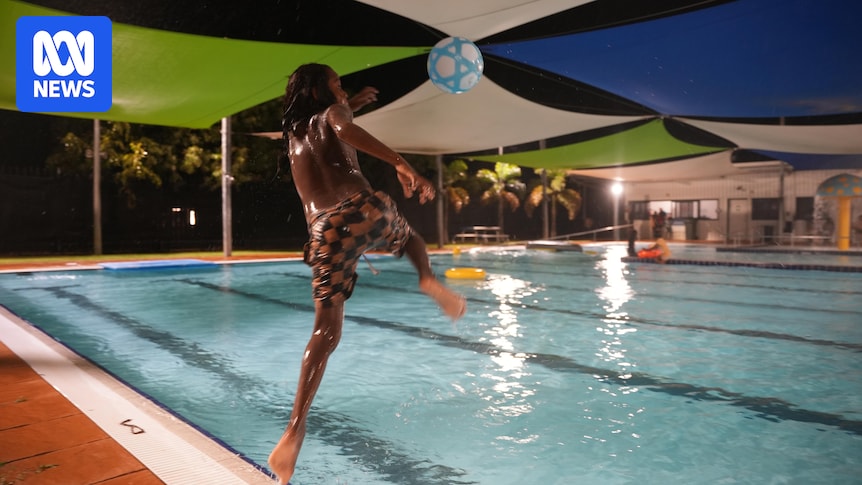
For Kalumburu’s 400 residents, the pool provides a “safe” space for children and families to unwind.
Children swim and play together with inflatables under their relatives’ watchful eyes.
“There’s a certain standard of behaviour that is expected as well,” Mr Pollett said.
Any tensions and problems must be left at the entrance gate, where school passes are also checked to ensure children who want to play at the pool have attended school that day.
Kalumburu parents say the pool helps keep children safe and in school. (ABC Kimberley: Giulia Bertoglio)
Parents, including Amanda Johnstone, like the system, which gives children extra motivation to attend school and a safe place to be on hot Kimberley afternoons.
“They are always humbugging me to get out of the house and bring them to the pool,” she said.
“During the wet season, we get floodwaters and all of that. I think it’s safer for them to be here instead of going to creeks and rivers.”
Mother Philomena Fredericks is glad the pool “stops the kids from going down to the river”, where resident saltwater crocodiles are a significant hazard.
Having a public pool helps keep children out of flood and croc-infested waters. (ABC Kimberley: Giulia Bertoglio)
The magic of chlorine
Mr Pollett said swimming pools had helped reduce the incidence of skin and infectious diseases in remote communities.
In Kimberley Aboriginal communities, currently experiencing a diphtheria outbreak, housing repairs and maintenance are ongoing issues.
“Housing standards are so poor that a lot of these places don’t even have functioning hot water systems, so hygiene becomes a bit of a problem,” Mr Pollett said.
Loading…
He said poor hygiene could cause infections and skin, eye and hearing issues, but having a public pool could help.
“As soon as the kids start getting back to the swimming pool and swimming regularly, those skin conditions pretty much disappear,” he said.
Proven health benefits
Perth Children’s Hospital paediatric infectious diseases specialist Asha Bowen said remote children were disproportionately affected by skin conditions and other transmissible diseases that had been completely eradicated in other Western countries.
“Inequity sits at the heart of why we see more infectious-disease-related presentations for Aboriginal children, particularly from remote communities, than non-Aboriginal peers,” she said.
“It’s around housing, it’s around access to health care, and it’s around systemic racism.”
Asha Bowen says regular swimming has been linked to lower presentations of infection at clinics. (Supplied: Telethon Kids Institute)
Professor Bowen said studies showed swimming in the pool regularly reduced the rate of children presenting to the clinic with skin and ear infections and the use of antibiotics.
“Low concentrations of chlorine that you would experience in a swimming pool are really good to help disinfect the skin,” she said.
“That can reduce any carriage of unwelcome bacteria, which could lead to a nasty skin infection.”