





When Lillian Rowsell was in her final year of school and unable to continue formal education, her parents started looking for a creative solution to bring all her sources of support together.
“All her friends were going to uni, so we thought: ‘Well, let’s make our own university,” Lillian’s mother, Andrea Rowsell, said.
“We called it university of life [UOL].”
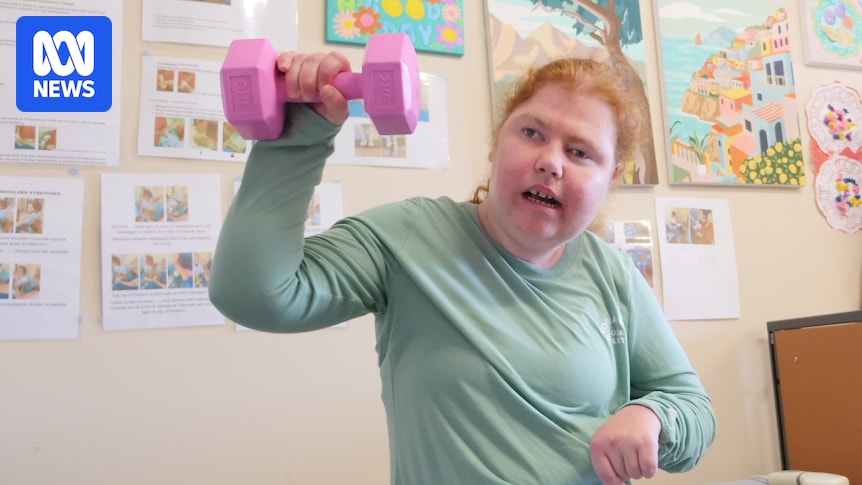
Lillian Rowsell spends her days with her support worker doing various activities of her choice within a routine that meets her daily goals. (ABC News: Wiriya Sati)
They set up a “campus” tailored to her complex needs in 2020, in her grandfather Keith Rowsell’s unused flat attached to his home, in their town of Old Bar on the New South Wales mid north coast.
The ability to create a separate learning space for Lillian was the best option. Andrea said they considered setting it up in their own home upstairs and putting in a lift.
“Lillian then got to leave our house every day with a purpose instead of everything being inside her house,” Andrea said.
“I think that was the healthiest and best solution moving forward.“
Living in hospital with Lillian for a year, Andrea Rowsell says they just want to give her the best life she deserves. (Supplied: Chris and Andrea Rowsell)
At two weeks old, Lillian had a rare brain condition called hemimegalencephaly that caused seizures, but after six months of trialling different medications, Andrea said their only option was to have half of her brain removed.
Lillian went through mainstream school with the support of her education department-funded aides Kellie Trezise and Debbie Bonds, who followed her through to high school.
Chris Rowsell says the school community was very supportive of Lillian, cheering her on in a race and embracing her participation. (Supplied: Chris and Andrea Rowsell)
Purpose beyond school
Andrea said none of the options available outside of school were suitable for Lillian’s complex needs or specialised care, such as knowing her non-verbal cues.
Her family devoted their own time and resources to setting up this specialised learning space in Keith’s self-contained flat.
The National Disability Insurance Scheme (NDIS) played a part, funding six hours of support per day, which meant Kellie and Debbie could continue supporting her through Uniting.
Kellie Trezise (left) says Lillian Rowsell is family and she will never lose contact. (ABC News: Wiriya Sati)
Iva Strnadova, lead researcher at the Disability Innovation Institute at the University of NSW, said the family’s approach to Lillian’s education beyond school was unique and beneficial for the now 25-year-old.
“What this family has built is remarkable, and individualised NDIS funding is what makes an approach like this possible,” she said.
“For someone with complex, high-support needs, it can be the difference between a full, active life and isolation.
“Young people with a disability want what any of us want after school: to keep growing, to stay connected, to belong somewhere.”
Professor Strnadova said for many families, the end of school for young people with disability “feels like falling off a cliff”.
“School holds everything together — routine, learning, therapy, relationships, then it ends, and there’s rarely anything waiting to take its place.”
She said “the problem isn’t the goal”, but that the options for education and disability support beyond school, “the system rarely offers a way to reach it”.
Lillian Rowsell uses visual cards to express what activities she’d like to do each day in the order she wants to do them. (ABC News: Wiriya Sati)
Kellie and Debbie helped set up the specialised learning plan and space for Lillian, who has limited speech, mobility and vision.
“The routine came with us from school. We used lots of visuals with Lillian. We used lots of choices. So we continued that here,” Kellie said.
Lillian points to visual cards with the activities she chooses for the day, whether that’s games, educational activities on the computer, or going bowling.
“It’s so important for somebody who’s non-verbal to be able to feel heard, to have autonomy to make choices.“
Chris and Andrea Rowsell invited Lillian’s community to the university of life open day and 50 people came. (Supplied: Chris and Andrea Rowsell)
The UOL had been operating since January 2020.
Lillian’s father, Chris, said they wanted to invite her community to see what they were doing and hosted an open day on December 6 that year.
“We had 50 people here that were all a part of Lillian’s life, and they all got to see and understand what Lillian was doing every day,” Chris said.
Seven years on, Lillian continues to attend UOL daily and Andrea said she had seen her daughter improve in small but significant ways.
“Responding to questions, it used to be a very long wait for her to understand and process what you had asked her; that has become much quicker,” Andrea said.
Lillian Rowsell’s day includes time at the computer doing interactive educational games with her touchscreen. (ABC News: Wiriya Sati)
As she walks on campus at her grandfather’s flat, Lillian slaps her leg to show her excitement for the day ahead.
“The fact that she can’t wait to get here every day is a sign that she’s loving it,” Andrea said.
Lillian’s family and support workers ensure the UOL enriches her socially by including group activities such as dance class, music with her pop, and bowling into her week.
While the program is designed specifically for Lillian, other NDIS participants have also accompanied her at the UOL for varying periods if they are the right fit for each other.
Lillian’s pop, Keith Rowsell, is head of the music faculty, and each day brings Lillian into the “school of rock”. (ABC News: Wiriya Sati)
Unique uni to inspire others, mum hopes
Andrea said she hoped their model could inspire others to find their own unique ways to support someone living with a disability.
“Every person deserves their choices, they deserve to be supported through their choices, and I feel this is what NDIS has given Lillian and other people.”
“Hopefully that promotes somebody else to say, ‘I could actually do something like that as well’, and open another door so that there is more access.”