




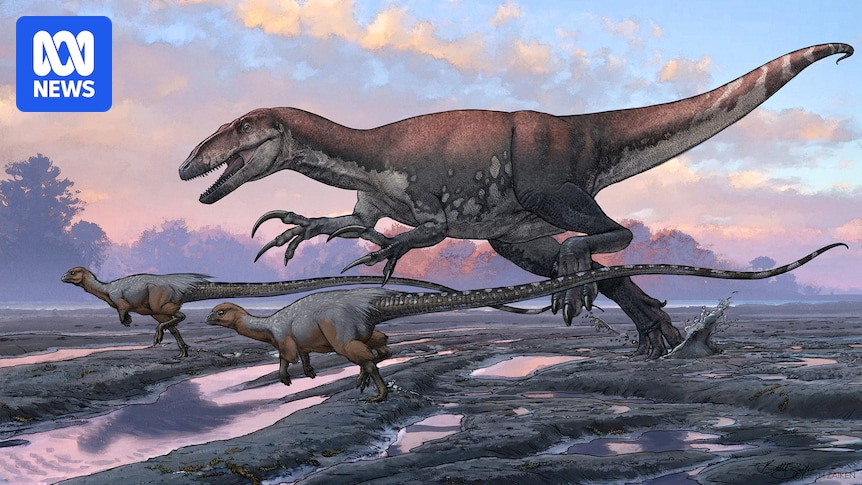
It is 100 million years ago, parts of Australia are in the Antarctic Circle and dinosaurs roam a polar world.
Swift, 5-metre-long predators like Australovenator hunted during months of darkness.
Meanwhile, herds of Leaellynasaura fed among ferns covered in frost.
That’s the picture painted by palaeontologists, who have found evidence of Australia’s dinosaur history dating back when the continent was still attached to Antarctica.
Where dinosaurs roam
Dinosaur Cove is west of Cape Otway. (Supplied: Tom Rich)
In the early Cretaceous Period, Australia was a very different place.
There was a vast river cutting through a rift valley and, along either bank, a temperate rainforest.
This forest would have been teeming with dinosaurs, Monash University palaeontologist Jake Kotevski said.
Monash University palaeontologist Jake Kotevski. (Supplied: Jake Kotevski)
“We find a lot of dinosaur material (around Australia),” Mr Kotevski explained.
“You don’t get a lot of complete individual animals, but we get lots of bits that hint at a substantial population of dinosaurs across a long period of time.
“We also get a ton of footprints across Victoria. The most common ones we see include ornithopods — these little bipedal herbivores which get to the size of a wallaby.”
Mr Kotevski compared dinosaur populations in south-eastern Australia to kangaroo mobs which mass across modern-day Victoria or emus that roam southern Queensland.
The evidence is gathered from sites like the “Dinosaur Dreaming” project near Inverloch on Victoria’s Bass Coast and Lightning Ridge in north central New South Wales.
Jake Kotevski says many fossils are found around coastal Victoria. (supplied: Jake Kotevski)
Despite popular dinosaur mythology, giant dinosaurs are comparatively rare finds.
“We had a dig in February (in Victoria) and pulled out a tiny jaw of barely a centimetre,” Mr Kotevski said.
“It’s a herbivorous dinosaur that’s whole skull was probably only a couple centimetres.
“The whole animal was maybe 30 centimetres or so in length and it’s probably a juvenile.”
Apart from the swift megaraptors, there would have been 3-metre long proto-Tyrannosauroids like Timimus (Tyrannosauroids did not grow huge until towards the end of the Cretaceous age), along with other large predatory animals that were not dinosaurs at all.
Cool, cool world
Earth’s polar regions during the Cretaceous Period, including the continental shard that would become Australia, did not resemble today’s frozen Antarctic wasteland.
There would have been areas of local ice, glaciers and mean temperatures as low as minus 6 degrees Celsius.
The dinosaurs which lived there would have had to deal with between three and four months of continuous darkness, according to Museums Victoria palaeontologist Dr Tom Rich.
Husband and wife palaeontologists Dr Tom Rich and Dr Patricia Vickers-Rich. (Supplied: Tom Rich)
“In Australia, we have a span in the Victorian sites of about 15 million years between the oldest and the youngest dinosaurs,” Dr Rich said.
“The oldest, which are along the Bass Coast, shows evidence of rather cold conditions, including permafrost.
“The younger deposits, which are in the Otways, the evidence of really cold conditions is no longer there.”
Animals which died out elsewhere in the world, as the climate warmed, persisted in polar Australia.
These included strange amphibians called temnospondyls, which look like crocodiles.
“They’re amphibians, not reptiles,” Dr Rich said.
“They appeared about 350 million years ago and flourished until about 200 million years ago. Then they dribble out for about another 10 or 20 million years and they’re gone, except in Victoria.
“That was one of the biggest surprises when we found them, this group that was thought to have gone extinct about 20 million years earlier. These amphibians may have been very happy in cold environments.”
Dinosaur dreaming
Evidence of Australia’s polar dinosaur past was first discovered in 1903.
However, it was not until the late 1970s that Australia became an international palaeontological hotspot.
The teams which excavated sites along the south-eastern coastline included Dr Rich and Patricia Vickers-Rich, who migrated from the United States to uncover these newly discovered dinosaurs, along with future palaeontology stars John Long and Tim Flannery.
Dr Rich and Dr Vickers-Rich ultimately dubbed a previously unnamed Otway Coast location “Dinosaur Cove” in 1984.
About 70 volunteers, aged between seven and 77, according to Dr Rich, found scores of fossilised dinosaur bones there.
Palaeontologists and volunteers digging for fossils at Dinosaur Cove. (Supplied: Tom Rich )
More than 700 volunteers have since been involved across multiple sites, Dr Rich said.
Compared with other dig sites around the world, Australian dinosaur fossils are especially difficult to uncover because much of the earth is hard as concrete.
“At Dinosaur Cove we had to do a lot of drilling and blasting,” he said.
“We had compressed air tools, while elsewhere we used petrol-driven jackhammers, hammers and chisels.
“Of the four major sites we worked, Dinosaur Cove was probably the most difficult logistically.”
Other dinosaur sites across Australia show a different climate.
Perth-based palaeontologist Adele Pentland, now with the Western Australian Museum, said exploration in Western Australia remained very much in its infancy with only a small selection of dinosaur bones found near Geraldton during construction of a railway cutting.
Dr Adele Pentland with a Ferrodraco lentoni fossil cast. (Supplied: Adele Pentland)
Dinosaur excavation in Queensland has centred on sites near Winton and Eromanga.
The work has been championed by landholder David Elliot, who found fossils on his own property, along with not-for-profit organisation Age of Dinosaurs.
Species uncovered include Australovenator Wintonensis, titanosaurs such as the 20-metre long Diamantinasaurus, and armoured dinosaurs like Ankylosaurus.
Meanwhile, the remains of giant marine reptiles, including the 13-metre long pliosaur Kronosaurus, have been discovered near Richmond in Queensland.
These lived in latitudes the equivalent of modern-day Victoria.
Australian dinosaurs
There have been about 50 individual dinosaur species identified across the landmass that now makes up Australia, although the final number may prove much higher.
These are 10 examples which could be found in Australia 100 million to 150 million years ago.
Australovenator
The Australovenator would grow to an estimated 6 metres in length. (Supplied: Museums Victoria)
A type of megaraptor (large hunter), growing to an estimated 6 metres in length. Discovered near Winton in Queensland, its lightweight skeleton suggests a swift animal that would have fed on smaller prey.
Austrosaurus
This artist’s impression of Austrosaurus shows its size compared with a human. (Wikimedia Commons: Austrosaurus McKillopi/Leoomas/CC BY-SA4.0)
Fossils of this giant sauropod (lizard-footed) dinosaur were discovered 90 years ago in Queensland. It was a 15m long titan weighing up to 15 tonnes.
Allosaurus
A cast of an Allosaurus skull. (Supplied: Museums Victoria)
Fossilised bones closely resembling this famous carnosaur (meat-eating dinosaur) have been unearthed in Western Australia and in Victoria.
Galleonosaurus
Artist’s impression of Galleonosaurus. (Supplied: James Kuether)
Named for its jawbone, found near Inverloch in Victoria, which resembles an upside-down galleon ship. A 2.5-metre-long plant eater that walked on two hind legs.
Leaellynasaura
Artist’s impression of Leaellynasaura. (Supplied: Museums Victoria)
A quick herbivore which likely fed on ferns and similar plants. While an adult may grow up to 2 metres in length, up to three quarters of that would be its tail. Named by Dr Rich and Dr Vickers-Rich after their daughter Leaellyn.
Atlascopcosaurus
An Atlascopcosaurus upper jaw fragment with seven teeth. (Supplied: Rodney Start, Museums Victoria)
Another bipedal herbivore growing to about 3 metres in length discovered at Dinosaur Cove. Named by Tom Rich after a company which provided excavation equipment.
Diluvicursor
A composite fossil of Diluvicursor. (Supplied: Stephen Poropat, Museums Victoria)
A small, bird-hipped (ornithischian) dinosaur. Similar in size to a wallaby, based on one specimen from the Otway Basin.
Qantassaurus
A fossilised Qantassaurus jaw bone. (Supplied: Benjamin Healley. Museums Victoria)
One of the smallest dinosaurs and likely a fast runner. Described by Patricia Vickers-Rich and Tom Rich near Inverloch and named after Qantas Airways.
Timimus
An artist’s impression of Timimus which measured up to 2.5m in length. (Supplied: Museums Victoria)
An early, small tyrannosauroid, measuring up to 2.5m in length and originally identified by two thighbones. Named by Dr Rich and Dr Vickers-Rich after their son Timothy.
Ferrodraco lentoni
The Ferrodraco lentoni was technically a pterosaur or winged lizard. (Supplied: Peter Trusiter)
Technically a pterosaur (winged lizard) rather than a dinosaur. With a 4-metre wingspan, its name translates as “iron dragon”. First described by Curtin University palaeontologist Adele Pentland.