







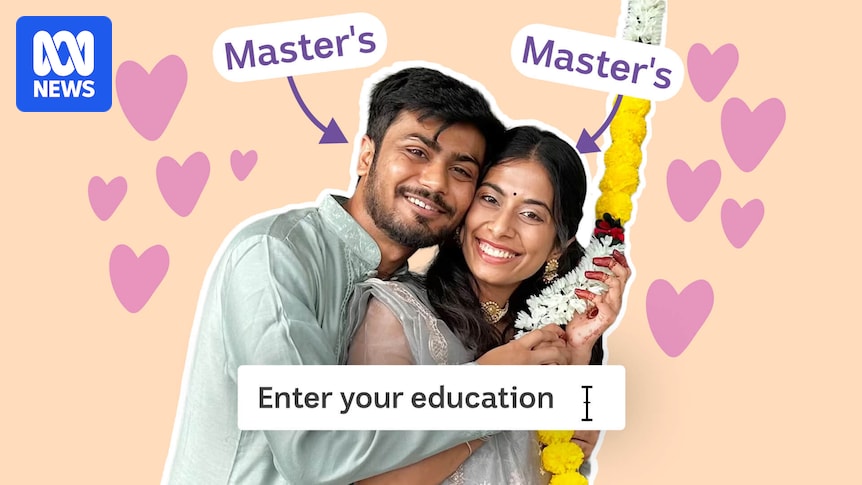
Two aspects stand out in Tanvi Patel’s recollection of her first date with the man who would eventually become her husband.
First, it was the longest social encounter she’d had with anyone, ever. “We spent almost 12 hours together,” the 30-year-old says.
And second, Darvin, who doesn’t drink coffee or milk, had a cappuccino.
Tanvi agrees he was probably trying to impress her but is adamant that a man drinking milk does not rank highly on her list of impressive feats. “I was slightly pissed that he didn’t communicate [his intolerance] properly,” says the marketing executive.
Darvin, a software engineer, admits the move was somewhat self-defeating. “I just didn’t want her to think I was some kind of weirdo.” Then, he adds: “That was weird on my part.” (He maintains it was “for sure” worth the stomach ache that followed.)
Darvin and Tanvi are among 1.14 million so-called power couples in Australia, in which both partners are university-educated, according to an ABC analysis of exclusive census data.
The ranks of these education power couples swelled nearly fourfold in the two decades to 2021, mirroring a trend across much of the developed world.
For sociologists and economists, power couples can be defined in terms of education, income or both. The ABC analysis considers only the level of education of each partner.
Darvin has a master’s degree in IT management. Tanvi has a master’s in urban planning. Neither specifically planned to marry a partner with the same level of education, but neither would have considered marrying someone who didn’t have a university degree.
“That would be a deal breaker for me, honestly … a bachelor’s degree would be a benchmark for me,” Darvin says.
“She could be studying arts or English or philosophy, whatever … but I feel that [a university education] at least shows that you are working towards a future self, that you have certain goals or certain things planned out in your life.”
Tanvi credits Darvin’s university education with equipping him with both “hard and soft skills”, from emotional maturity to doing household chores and navigating tricky social situations.
“Education comes with a lot of other experiences. It’s not just getting a degree. You are surviving through a lot of challenges … that can be emotionally torturous,” she laughs.
“You have to do things that you don’t like.”
I point out that plenty of people who didn’t go to university do things they don’t like, and lots of people without a degree have life goals and future plans.
Darvin thinks for a moment.
It comes down to power, the 29-year-old says, finally. “I feel like if we are both equal, then there are less power dynamics between us.”
It’s a sentiment shared by many couples across advanced economies, especially younger ones, research shows.
But it also raises uncomfortable questions about whether increased equality within marriages means greater inequality across society.
The modern desire to marry an equal
The top choice of partner at nearly every level of education is someone with the same level of education, the ABC analysis reveals. The trend has profound implications for social inequality, experts warn.
This preference to “marry within the group” is strongest at the top and bottom of the education ladder.
Those with no educational attainment are over 80 times as likely to partner with each other compared to the average, while those with doctoral degrees are nearly 15 times as likely to marry each other compared to the average. (The average is the rate of marriage to that group across the partnered population.)
“When people form marriages, they form intimate relationships, not just with each other, but with families as well,” says University of Wisconsin-Madison sociologist Christine Schwartz.
“And so it really can tell us something about the openness of societies in terms of forming intimate unions across different groups.”
(Throughout this story, we’ll use the terms “marriage” and “partnership” interchangeably to refer to a “couple relationship”. In the romantic language of the Australian Bureau of Statistics, this is defined as “two people usually residing in the same household who share a social, economic and emotional bond usually associated with marriage.”)
Across Australia, 1.76 million couples — that’s more than one third — comprise two partners with the same level of education.
The pink diagonal line running across both charts above shows people across the education spectrum marry within their group at above-average rates.
Those with a master’s degree are 3.8 times as likely to marry someone else with a master’s degree compared to the average. Those with a bachelor’s degree are 1.9 times as likely to marry someone else with a bachelor’s degree.
Those who finished senior high school (years 10–12) are 1.8 times as likely to marry within their group, while those who did not go beyond year 9 are 7.3 times as likely to marry within their group.
The ABC’s analysis compares the highest level of educational attainment for each partner in a married or de facto couple, then calculates the likelihood of marriage between each of these 10 education levels across five generations (gen Z, millennial, gen X, boomer and silent).
The data encompasses about 5 million couples in 2021 and 3.5 million couples in 2001, both opposite-sex and same-sex.
The rates given above adjust for group size; that is, they describe the chances of marrying a particular education group if all groups were the same size.
But in the real world, it’s far harder to meet someone with a doctoral degree than a bachelor’s degree (because far more people have bachelor’s degrees than doctoral degrees), so it’s also useful to look at percentages.
Based on percentages, the top choice of partner for every university-level group is someone with a bachelor’s degree. Within vocational education and training (VET), the top choice of partner is someone with a certificate III/IV. At the school level, it is someone who has completed years 10–12.
These patterns reflect two trends. First, that people’s choices are heavily influenced by who is available. (Years 10–12, bachelor and certificate III/IV are the three biggest groups, at 26 per cent, 23 per cent and 20 per cent, respectively.)
And second, even those partnered outside their specific education group still stick to their broad education sector (e.g. university, VET or school).
The rise of the ‘power couple’
Education consistently ranks among the most strongly matched couple traits. Marriages between people with the same level of education rose over the latter part of the 20th century, even after accounting for the huge rise of women in education.
A key question for experts studying marriage patterns is how much this tendency for romantic couples to resemble each other, known as “assortative mating” or social homogamy, reinforces inequality by making it harder to cross social barriers.
The effect can carry across generations, since parents tend to pass these advantages on to their children.
Darvin says the power imbalance between his own parents strongly influenced his preference for a marriage between equals.
“[Looking at] my parents and my grandparents, there is one breadwinner, the male in the family,” he says.
“At the end of the day, my dad is the one making all the final calls or the final decisions.”
As he grew older, Darvin realised this wasn’t because his father was always right, but perhaps because his mother was dependent on his father.
Their dynamic reflected an “inequality that rises from earnings, which in turn comes from [my mum having] lower education and having no job.”
Tanvi, too, remembers a time when her father, a mechanical engineer, had an accident that left him unable to work for a period. Her mother, who has less education, wasn’t in a position to take over as the breadwinner.
“From that experience, [I learned that] the other person should be strong enough to pick up the family responsibilities … it shouldn’t be one person handling the financial burden,” she says.
Research from the US shows this preference for marrying an equal is stronger among younger generations.
“When sociologists talk to young people about their relationships, they tend to have a preference for egalitarian arrangements,” Professor Schwartz says.
At a time when even dual-income families are struggling to make ends meet, it also makes economic sense, at least, for those who are higher up the ladder.
But the more we choose a marriage of equals — or perhaps, the more men choose wives who’ll potentially bring home a bigger pay cheque and vice versa — the higher the number of power couples, whether defined either by income or education.
This surge in power couples has outpaced the rise in higher education, both in Australia and other advanced economies.
In Australia, the percentage of power couples swelled 2.5-fold in the 20 years to 2021, from 9 to 23 per cent of the partnered population. Over the same period, the percentage of people (aged 15 and older) with a university qualification doubled.
In a paper examining six decades of marriage between different education groups in the US , Schwarz and her colleague Robert Mare found college graduates were increasingly likely to intermarry, while those with the least education were increasingly unlikely to marry up.
These trends “are consistent with a growing social divide” along educational lines, they wrote.
Going one step further, a Danish study from Aarhus University’s Gustaf Bruze found that about half of the expected financial gain from higher education came from the chance to marry a high-earning spouse, rather than improved job prospects.
Dating apps and the education ‘bubble’
When marriages between different education levels within the same sector are included among “mixed marriages” (eg master’s and bachelor’s degrees), the ABC’s analysis shows more Australians are crossing the education divide for love compared to 20 years ago.
About 36 per cent of partnered Australians are married to someone with the same level of education, down from 42 per cent two decades ago. This means nearly two-thirds of couples are in mixed-education marriages.
Digging deeper into the detail reveals that these overall figures mask two opposing trends: the percentage married within their group is increasing among the university-educated, but decreasing among those who didn’t go beyond high school.
Notably though, these trends are reversed when the figures are adjusted for group size, suggesting they’re largely driven by the rise in higher education.
The link between higher levels of education and marrying later in life is well established. Further, those who marry later in life are more likely to marry their educational equal.
This is partly because marrying later in life increases the chances of meeting prospective partners at university or work. It also means people are more likely to live apart from their parents, and to live and socialise in neighbourhoods that reflect their education and earnings.
ANU demographer Liz Allen says there is little research on the ascendancy of power couples in Australia, but notes that Australia has lower levels of wealth inequality than the US.
“What we do know from the data is that [the tendency to choose partners like ourselves], most particularly at the top end of town, may be increasing socio-economic inequality.”
The trend has thrown a spotlight on the role of dating apps. Traditionally, these have been credited with widening the pool of potential partners and boosting diversity within marriages. But some now warn that when it comes to education, many dating apps arguably do the opposite: create a “bubble” for the university-educated, so they never have to even see the dating profiles of those who aren’t.
In Australia, apps including Bumble and Hinge now allow users to filter by education or type of degree, such as bachelor’s, master’s or doctorate, while Tinder U and EliteSingles go one step further, marketing themselves exclusively to verified students (Tinder U) or people with university degrees (Elite Singles).
University of California Davis psychologist Paul Eastwick says it’s a classic case of the product creating the market.
Most people wouldn’t ask or even think about the education of a person they’d just met in real life. But give people a filter and “you’ll get gigantic effects”, he says.
It’s what we get for turning love and partnership into a consumer product.
“We didn’t evolve to have this kind of choice. We evolved in a context where you might have, I don’t know, 10 prospective partners during your partnerable years,” Professor Eastwick says.
“We’re in this very strange world now [where] if you’re dating, it’s just stranger after stranger … we get into this consumer mindset, but we were never really meant to evaluate people this way.”
The couples embracing diversity
Love bloomed for Brisbane couple Jason Russ and Damian Brunow in what Jason says is one of the least likely places for gay men to hook up.
“We met at a baby shower,” he says. “A park full of screaming children on a Sunday morning — really not my environment.”
Jason is a carpenter with “a few bits of paper”, more specifically, certificates III and IV, under his belt. Damian did a degree in business and works in human resources.
“Damo is always immaculately put-together, I can be a bit scruffy … he’s super-composed and organised. When we go for an overseas holiday, he’s packed a week before it. Damo would never have had a speeding ticket in his life … we’re like chalk and cheese,” Jason says.
“To sum us up: one’s probably naughty and one’s probably not, and I, possibly, am the naughty one.”
On this, Damian agrees. “[Jason’s] got the megawatt smile. It’s the first thing you notice … that smile gets him into and out of a lot of trouble.”
Their differences are part of the attraction, Jason says, but concedes it means putting more effort into finding the compromise. “There are plenty of things that we meet in the middle on, but we actually have to work on the middle ground, and I don’t mean that in a bad way.”
Damian says he had no issue “marrying down” the education ladder. (“God, you ask any gay man, they all want the hot tradie!”) But he admits he would struggle to marry someone who earned significantly less than he did.
“Just because I was burnt twice, where I was paying off [my partner’s] debts, always having to pay for holidays, paying more than they did … [before I met Jason], my mum said to me, ‘Can’t you just find an equal?'”
Male same-sex couples are the most likely to be in mixed-education marriages, while same-sex couples in general are more likely to be in mixed-education marriages than opposite-sex couples, according to the ABC’s analysis.
International research shows same-sex and opposite-sex couples follow this same pattern across a number of traits, including age, race and ethnicity, or education.
Professor Schwartz says the reasons aren’t well understood. “Some people point to ‘thinner’ partner markets, meaning there just aren’t as many options [for LGBTQI+ people].”
Professor Hewitt says being in a minority that experiences discrimination may mean many in the LGBTQI+ community are more likely to embrace difference when it comes to love and marriage.
“There’s probably a predisposition to being more open to diversity and accepting people for who they are.”
Cinderella, written by algorithm
For those who’ve read this far and are still holding out hope for the Cinderella fairytale, QUT behavioural economist Stephen Whyte is here to put the nail in that coffin.
“The more often I’m around a particular group, the more likely I am to find those people attractive,” Dr Whyte says.
“There’s no princess, there’s no glass slipper … we tend to stay in our little clique.”
This is the reason assortative mating hasn’t diminished over the past century, despite increased social mobility, mass migration, international travel, and “quasi-infinite choice on the internet”, Dr Whyte says.
“Even when we go to different cultures, we’re probably still more likely to choose someone who is in our demographic.”
But demography isn’t destiny, take it from a demographer. “We don’t need the Cinderella story,” says ANU’s Liz Allen.
Your clique isn’t set in stone, she says. If spending more time with a group of people increases the odds you’ll find them attractive, then it stands to reason that spending time with people who are different from you also increases your odds of finding a partner from that group.
And that can be life-changing. “People’s lives are really transformed by who they marry,” Professor Schwartz says.
“When they marry somebody who’s different from themselves, that can give them a window into different lives and different segments of the population … [it] brings families together.”
Perth academic Susan (not her real name) and her tradesman husband know all about this. Susan has a graduate certificate, a master’s degree and a PhD. Her husband’s highest level of education is a certificate IV.
“I used to love going out to fancy restaurants; he would feel really uncomfortable because he always felt like he wasn’t dressed appropriately or whatever.
“And I would always feel uncomfortable going to the things he would do, like parties out in the bush or in someone’s shed. And I’d be like, what do I wear to this thing? What do I talk about?” Susan says.
“At the start of the relationship, I’d say that those things were tricky … but I have done things [with him] that I would never have done if I were in a relationship with someone who was similar to me, and vice versa.”
And let’s not forget the other magic ingredient when it comes to love and partnership, says Dan Conroy-Beam, an evolutionary psychologist at the University of California Santa Barbara (UCSB): attraction itself.
“I might start by being super attracted to the person who has everything, but when they blow me off, that’s unattractive,” he says.
Dr Conroy-Beam’s team at UCSB builds large-scale computer simulations of dating markets that test how well different decision algorithms predict people’s actual partnerships.
He says the best dating decision algorithms mimic the interplay of market forces.
“The most desirable partners end up together,” he says.
But isn’t that depressing for the rest of us, who just have to settle for whoever’s left? “It depends on what you mean by ‘settle,'” he says.
“Attraction is attractive. I like the people who actually like me, because that’s a rational thing to do when you’re trying to find a partner,” Dr Conroy-Beam says.
It’s not exactly romantic, but that rationality is why “for the most part, people get what they’re looking for”.
It might not be Cinderella, but I’ll take it.
This is the fourth in a series of data stories looking at why and how we choose our partners. Our first story analysed who you’ll probably marry, based on your job. Our second story examined the most and least likely religions to marry. Our third story revealed how men “marrying up” became the norm.
Credits
Notes about this story
- The ABC analysed census data on a person’s overall highest level of educational attainment, whether it be a school or non-school qualification.
- Excludes people aged under 15 and people who did not report their highest level of educational attainment or did not adequately describe it for the purposes of classification.
- In the 2021 figures, about 8,200 women and 5,500 men whose highest level of education was “postgraduate degree, not further defined” have been included in “master’s degree”. This represents about 0.16 per cent of women and 0.13 per cent of men who stated their highest educated level. The ABS uses “not further defined (nfd)” when enough information exists to partially code a response, but not have enough to code it to the most detailed category.
- Low numbers means data for same-sex couples was not available for some education combinations. The ABC has included as much data as was considered reliable.
- The Australian Bureau of Statistics makes small random adjustments to cell values to protect data confidentiality. These adjustments may affect some totals and percentages.
- Love stories from the public have been edited for clarity and length. These were collected from responses to this ABC story.