








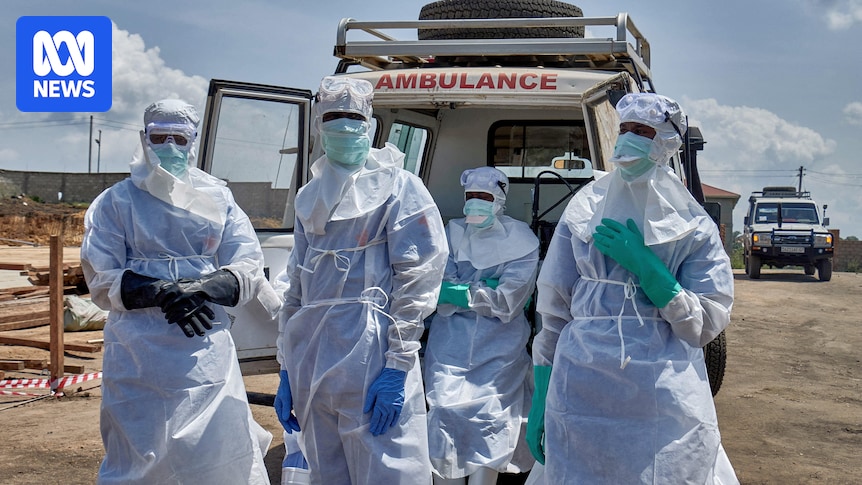
At least 100 people have died of Ebola virus in the Democratic Republic of Congo (DRC), and the fast-spreading outbreak is nearing 600 confirmed cases.
In just two weeks, the number of confirmed cases increased more than eightfold, with 25 health zones now affected.
Authorities have repeatedly expressed fears they are “playing catch-up” with the disease, which was not detected until potentially weeks into the outbreak.
Testing kits were designed to detect the more common Zaire Ebola virus, and not the rarer Bundibugyo virus currently spreading.
Contact tracing, according to an urgent media briefing overnight, is at just 64 per cent compared to the usual 80-90 per cent rate.
On that briefing was Jean-Jacque Muyembe Tamfum, who helped identify Ebola virus during the first known outbreak in 1976 and co-invented a treatment for the disease.
“The big challenge on the ground is to restore the trust of the communities,” he said.
“The second is the security situation in the field, because we have a lot of armed groups working in this region.
“At the beginning we lost a lot of time establishing the diagnosis and knowing the real situation of this outbreak.“
Much of the outbreak is concentrated in the Ituri and North Kivu regions of the DRC, with some cases recorded in neighbouring Uganda.
The area is one of the “most volatile” regions in the country, where conflict, instability, and climate shock have taken a severe toll.
Health officials have been left grappling with both supply shortages and security concerns involving militant and rebel groups.
In places like Ituri, hospitals and clinics were struggling to prevent infection while handling the backlog of cases, according to Marie Roseline Belizaire, the Ebola Response Team incident manager at the World Health Organization (WHO).
“There is no preparedness in the region where we are,” said Dr Belizaire, who is also acting emergency director for the WHO Regional Office for Africa.
“We are starting a response from scratch to put everything in place: a surveillance system, [infection prevention], clinical care.
“When you look at the prevention and control of infections … the average score of all the health infrastructure in Ituri province has been low, less than 30 per cent.
“The community has been exposed before to Ebola, but this one is a new strain, a new species for which there is no vaccine, there is no treatment.
“And we’ve already vaccinated [this community] in the past … so now we have to explain to them in order for them to understand.
“The first time they had Ebola, they didn’t know about the six species that exist, they just know Ebola.”
The WHO’s latest rapid risk assessment, published on June 9, said the outbreak had continued to expand “considerably”.
It raised concerns about increased mobility and patients “avoiding or leaving treatment facilities”.
“[These reports], together with evidence of ongoing community mistrust of Bundibugyo prevention and response measures, raise concerns about reduced healthcare-seeking behaviour and under-detection of cases,” the report said.
“As observed during previous Ebola disease outbreaks, community fear and misinformation have hindered case detection, contact tracing, and isolation efforts.
“Such challenges may facilitate ongoing spread within affected communities and complicate outbreak control measures.”
The Ebola outbreak continues to spread to new health zones in the Ituri region of the DRC. (Reuters: Gradel Muyisa Mumbere )
Since the WHO’s previous risk assessment on May 22, a Congolese national had travelled from the DRC to the United Arab Emirates (UAE) via Uganda.
The person later returned to Uganda.
Extensive contact tracing and investigation by UAE officials, according to the WHO, “to date have not identified any secondary cases … or evidence of onward spread in the country”.