




Carly Findlay has experienced a lifelong rare skin condition called ichthyosis since birth. As a child — teased, prayed for, studied, and offered harmful “cures” — Carly chose loving her body over “fixing” it.
Whether it’s romantic, platonic, heartbreaking or surprising, our Love Story series is about love in all its forms. Share yours with us.
When I was about six, I started to attend dermatology conferences.
The doctors would look at me, discuss me, and I wasn’t able to say anything because they had to diagnose me based on appearance alone.
I’d lay in a cubicle — sometimes with thin wooden walls, other times just with a sheet on a rail — and wait for doctors to come in and observe me.
I’d lay under a white hospital-issue cotton waffle blanket, wearing nothing but underwear and one sock. I was cold, a specimen, no more than a diagnosis. They didn’t even say my name.
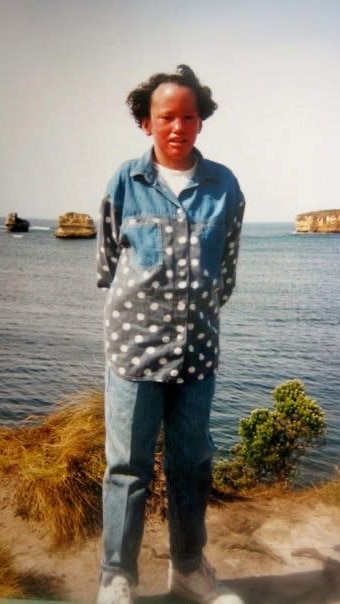
Carly Findlay pictured as a child. (Supplied: Carly Findlay)
I was alive, but I may as well have been a cadaver.
Sometimes I would charge money for a look — like a medical peepshow. I could never do this as an adult, but childhood cuteness and bravado made me a few dollars.
Outside of the conferences, I would participate in medical photography. We went down to the hospital’s basement and followed a long red line down sharp corridors to a cold photography room. I stood, near naked, shivering in front of the cameras.
The doctor instructed: “Just stand still for the photo. There’s no need to smile.”
It wasn’t until my breasts budded around 12-13 years old that I knew I didn’t want my body stared at in this way.
Once, a woman, much older than me, came to lunch with my mum and I after a conference. She too had ichthyosis. She was on some strong drugs — they took the redness away from her skin, but her internal organs were ruined. Liver failure, I think. Moon-faced from steroids. She couldn’t have children while on the drugs.
It was then that I realised I didn’t want that for me.
I’d take a cure for the pain, but I wouldn’t take a cure for my appearance. This is who I am and why should I change myself to make other people more comfortable?
I loved my body, even when it was expected I wouldn’t get to love another.
It was assumed my husband took me on when we fell in love. But he sees me, he loves me. And he loves my body too.
But finding love with another — and marriage — isn’t my greatest achievement. Loving my body despite all the shame I once felt is.
I loved my body at the scariest time of my life
When I was 42, I was shocked by a double cancer diagnosis — ovarian and endometrial.
I required surgery to remove tumours and my uterus, which then caused early menopause. Further treatment followed.
With the urgency of surgery and treatment It felt like my body autonomy had gone.
My body became unrecognisable to me. I lost muscle tone and weight. Sometimes I felt more like a teenage boy than a woman. I became so incredibly sick from chemotherapy — which took a toll on my skin condition in particular.
Sheets of skin peeled off in the shapes of my body parts. For a week or so, the pain in my skin was immense. I felt it every minute of the day.
In the lead-up to diagnosis, during treatment, and even post treatment, it feels like my bowel has turned against me. Diarrhoea, constipation and then diarrhoea. I never thought poo would be a main character in my cancer story but embarrassingly, it is.
But I am in awe of my body for surviving treatment that was so hard at times, I felt I would rather die than continue with chemotherapy because it made my skin so very sore.
Acceptance and self-love after treatment
On a happier note, I also felt very beautiful when I went bald. My skin condition has made me resilient, and I felt very prepared when I was faced with another visible difference. I have a nice-shaped head, and I loved how I stood taller when bald.
Throughout my life, people have excluded me, medicalised me, or told me I do not meet conventional beauty standards. But I continue to show up as I am.
It took a long time but as I matured, I realised it was easier to love myself than hate myself.
Connecting with others with ichthyosis and other types of disabilities and chronic illnesses has been a big part of my journey. I make an effort to be public. I wear bright clothes because it makes me feel happier.
It’s lovely to be stopped in the street by someone telling me they love my outfit, and they also love my writing.
Loving my body is also about accepting its limits. There are things it can’t do, like regulate its temperature, which makes it hard to do outdoor activities. But it’s strong in other ways.
I’m thankful and take care of it — speaking nicely about myself, and doing gentle movement every day. I want to live a long life with this body.
Carly Findlay OAM is a writer, speaker, appearance activist and arts worker, living in Melbourne/Naarm.