









MUMBAI: Tata Sons’ escape from an initial public offering hinges on convincing RBI that none of its activities require it to remain within the central bank’s regulatory framework. Its alternative of exiting the upper layer, which covers large NBFCs subject to enhanced regulation because of their size and systemic significance, has effectively been closed after RBI made the criteria for upper layer classification more objective and scale-based.Deregistration could allow Tata Sons to remain the holding company of the Tata group while avoiding the mandatory listing requirement that accompanies upper layer status. RBI retained Tata Sons in the NBFC upper layer list for FY27 on Aug 6, while making clear that the inclusion was without prejudice to its application for deregistration, which remains under examination.
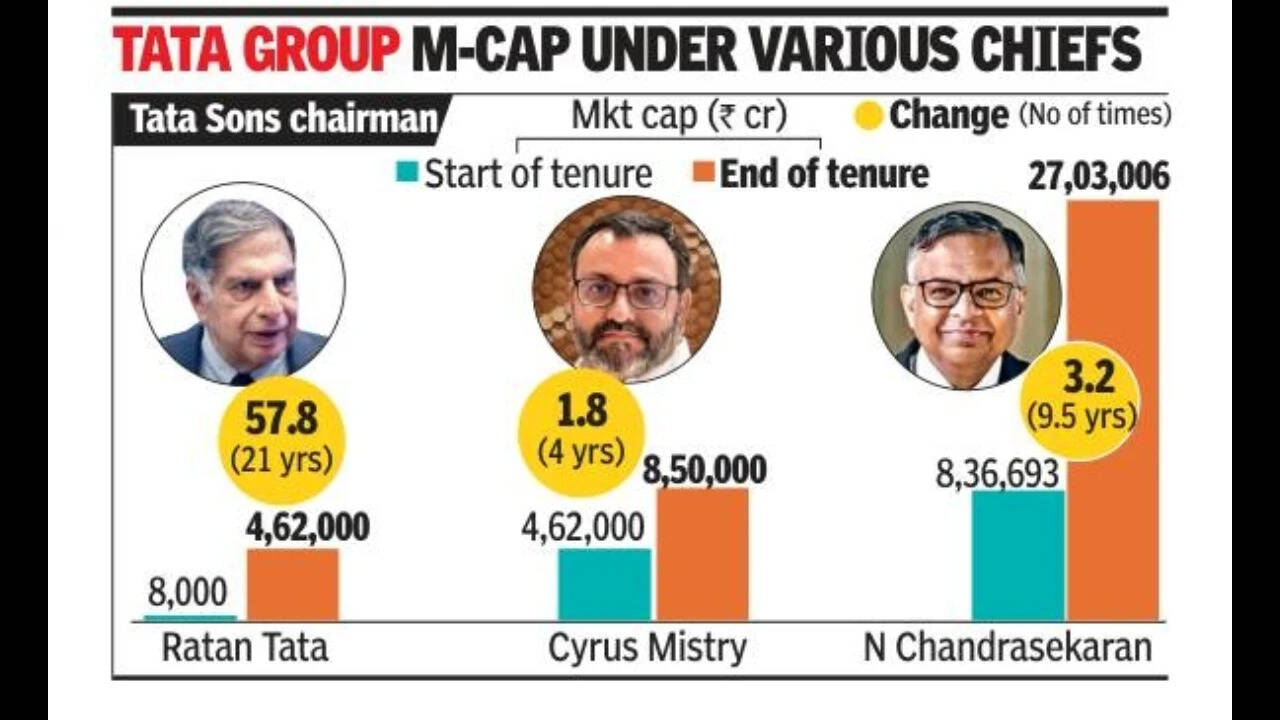
TATA Group M-cap under various chiefs
Among stakeholders, there is a split over the issue of listing. For the largest minority shareholder, the cash-strapped Shapoorji Pallonji Group, which holds an 18.4% stake, and Tata Trusts trustees Venu Srinivasan and Vijay Singh, a listing would offer a route to crystallise value, establish a transparent market valuation and provide shareholders with greater liquidity.For Noel Tata, the calculation is different. The Tata Trusts chairman has opposed a listing because of its potential implications for control and the group’s long-standing philanthropic purpose.A publicly listed Tata Sons would bring outside shareholders and greater market scrutiny to the apex of the conglomerate, potentially constraining the discretion that has allowed the group to pursue and implement long-term investments.Srinivasan and Singh, however, have argued that the Tata Group’s growing capital requirements and expansion into technology and other capital-intensive businesses warrant a reassessment of its long-standing decision to remain private.RBI framework sets objective tests for a core investment company. A CIC must have at least 90% of its net assets invested in group companies, with at least 60% in group-company equity. A CIC with assets of Rs 100 crore or more that does not access public funds can, subject to the applicable conditions, operate as an unregistered CIC rather than a registered NBFC. Tata Sons has repaid all its debt and limited its activities to investment in group companies.The crucial question for Tata Sons is whether it can demonstrate that its future activities will fall outside the NBFC regulatory perimeter. If RBI is satisfied, Tata Sons could continue as a holding company without remaining a registered NBFC.Shapoorji Pallonji (SP) Group’s urgent need for money is mainly a liquidity and debt-refinancing problem, rather than a lack of assets. Its stake in Tata Sons is estimated at roughly Rs 3 lakh crore, based on the value of Tata Sons’ holdings in group companies. But a stake in an unlisted company cannot be readily converted into cash. The group has accumulated substantial borrowings at the promoter and operating-company levels, a large chunk of which is backed by its holding in Tata Sons.