







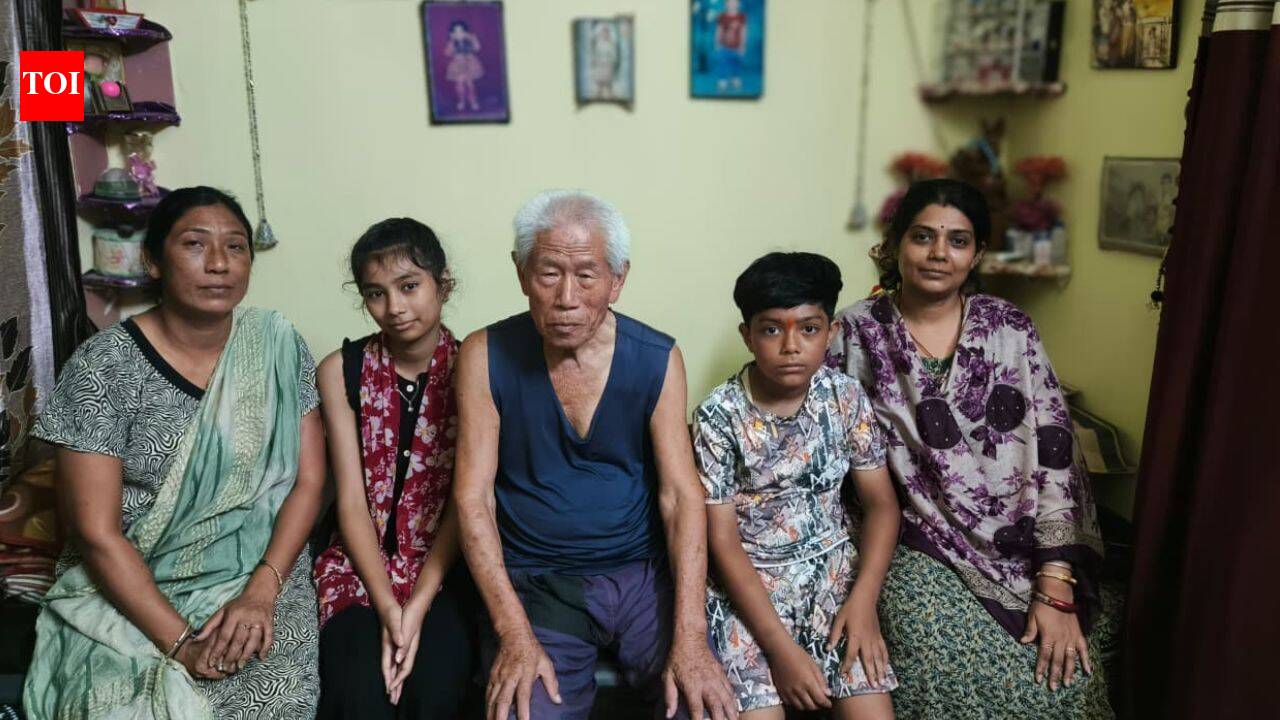
BHOPAL: Fourteen-year-old Kanak Wang and her eight-year-old brother Praneet Wang, who live in Tirodi village of Madhya Pradesh’s Balaghat district, have never been to China.Yet the Indian-born siblings say they have been denied caste certificates because their paternal lineage traces back to China.Their grandfather, 86-year-old Wang Qi, a former Chinese soldier captured during the 1962 India-China war, never made it back to his homeland after being released from Indian prisons and eventually settled in Madhya Pradesh.The siblings’ father, Vishnu Wang, has alleged that revenue officials refused caste certificates for his children because Wang Qi had no recognised caste identity under the Indian system. According to him, officials said caste can be determined only through the father’s lineage and not the mother’s, leaving the family without a way to establish the children’s caste status.Wang Qi was a soldier in the Chinese People’s Liberation Army (PLA). Captured near Tawang during the 1962 war and detained on suspicion of espionage, he spent nearly seven years in Indian prisons before being released. Instead of returning to China, he settled in Tirodi village, where he worked for local businessman Inderchand Jain, married Sushila, a woman from the Kunbi community, and raised four children.In a representation submitted to the Balaghat district administration, Vishnu said the family has remained trapped in an administrative vacuum despite living in India for more than six decades.“My father was not sent back to China after being released from jails here. The court allowed him to stay in India and promised all facilities, but till date no help or facilities of any kind have been provided by the Government of India,” he wrote.According to the representation, Wang Qi was moved through prisons in Delhi, Punjab, Bhopal, Jabalpur and Balaghat before being released in Tirodi following a court order. Unable to pronounce his Chinese name, villagers began calling him Raj Bahadur, a name by which he came to be known locally.Vishnu said he and his three siblings were born and educated in India, and all their school and government records were prepared using their mother’s documents.However, when he applied for caste certificates for Kanak and Praneet, the application was rejected. “Our entire education and all official work were completed on the basis of our mother’s documents. But when I applied for caste certificates for my children, I was told they cannot be issued because my father is a foreigner,” Vishnu said in his representation.Questioning the decision, he wrote: “My documents are Indian and I was born in India. Then why can’t my children’s documents be prepared on the basis of my documents? If my father is from China, what is the fault of us children? My father was kept in India by the Indian government. Should we now stop educating our children?”Vishnu also alleged that after he lodged a complaint on the government’s grievance portal, local officials asked him to withdraw it, saying there was no provision under the existing rules to issue the certificates.“If there is no provision under which my children can get these documents, then tell us what we should do. And if that is not possible, please send my entire family with my father to China, because we do not have the facilities we need in India.”The family argues that while all official records of Wang Qi’s children were prepared using their mother’s documents, the same approach has not been extended to the third generation.Wang Qi’s story drew international attention in 2017, when he was finally allowed to visit his hometown of Xiaozhainan in China’s Shaanxi province after spending more than five decades in India. The emotional reunion with his elder brother and other relatives, who had long believed he was dead, was widely covered by Chinese media.After reaching China, Wang Qi reportedly had to prove that he had indeed served in the PLA before becoming eligible for veterans’ benefits. Now 86, Wang Qi lives quietly in Tirodi village. But while his own journey across two countries has become part of history, his family’s struggle continues.