






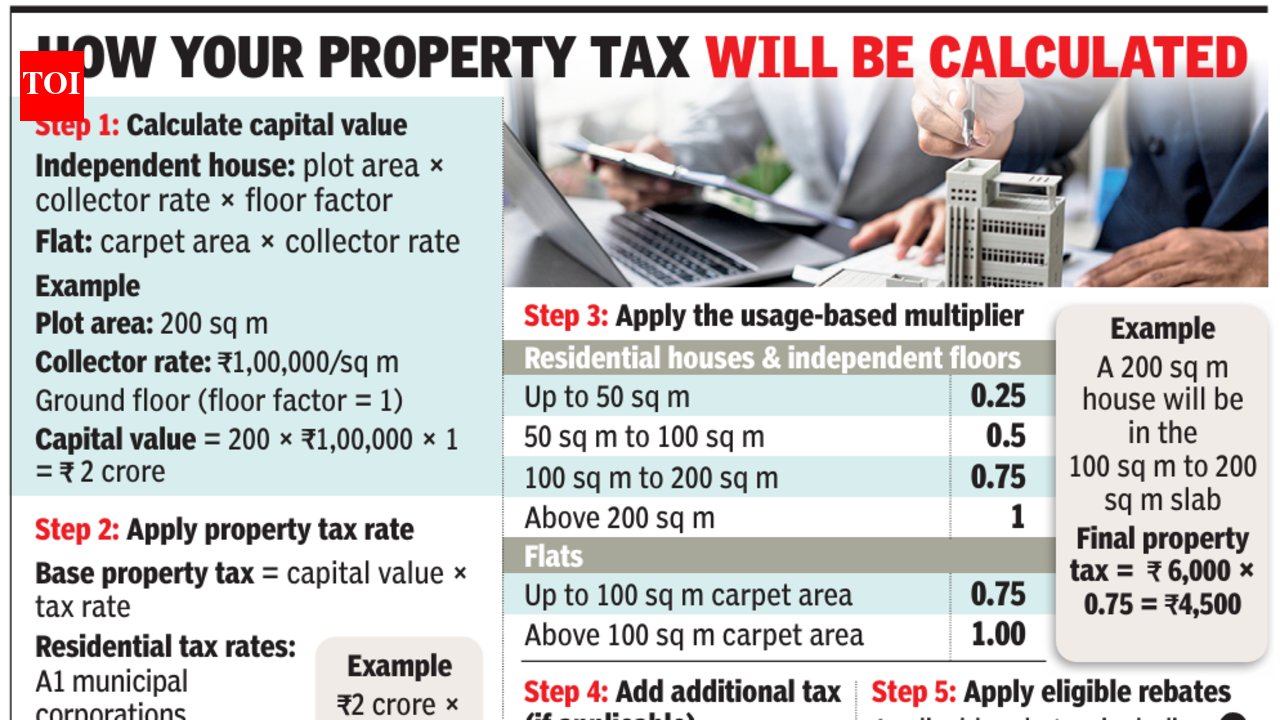
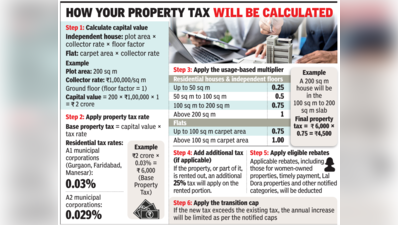
Gurgaon: Haryana govt has notified a new property tax methodology that shifts from the existing area-based assessment to a capital value-based system, applicable across all municipal corporations and municipalities in the state. The notification was issued by the urban local bodies department.Under the current system, tax is largely determined by a property’s size and category. Under the new system, tax will be calculated using the govt’s collector rate along with the property’s size and usage. This means two houses of identical size could now attract different taxes if they fall in areas with different collector rates. The govt said the change will make assessments simpler and more transparent, though the actual impact on taxpayers will vary by location, size and use.The new system works in three steps. First, for an independent house, capital value is calculated by multiplying plot area by the collector rate and a floor factor. The floor factor is one for the ground floor, rising by 0.25 for each additional floor, including basements. For apartments and flats, capital value is simply carpet area multiplied by the collector rate.The second step is based on the base tax rate, which will be applied to the capital value. Residential properties in the Gurgaon, Faridabad and Manesar (classified A1) will be taxed at 0.03%; residential properties in other municipal corporations (A2) at 0.029%. Commercial properties will pay 0.1% in A1 cities and 0.09% in A2 cities. For example, a house in the city with a capital value of Rs 2 crore would attract a base tax of Rs 6,000 annually at this stage.The third is usage-based multiplier, which will be applied last and has the biggest effect on the final bill. For residential houses and independent floors, the multiplier is 0.25 for plots up to 50 sqm, 0.5 for 50–100 sqm, 0.75 for 100–200 sqm, and one for larger plots. For flats, it is 0.75 up to 100 sqm carpet area and one above that. Applying this to the earlier example, a 200 sqm house in the city falls in the 100–200 sqm slab, bringing its final tax down to Rs 4,500 instead of Rs 6,000.The new system includes a 25% rebate on properties owned by women. Rented properties will attract an additional levy of 25% of the applicable tax on the rented portion.To prevent sharp increases, the notification caps annual hikes. Tax on residential houses up to 250 sqm and flats up to 100 sqm cannot exceed 1.25 times the existing tax, houses between 250–350 sqm are capped at 1.5 times, and larger residential properties at twice the existing tax. Industrial properties have graded caps of 1.5 to three times, while all other categories are capped at three times the current tax.The new methodology takes effect from Aug 1. Property owners have the option to pay tax under the old (2013) system for one month from that date. After that, only the new system will apply. Property owners who have already paid tax face no change until FY 2026–27, and arrears or interest pending till FY 2025–26 remain unaffected. From FY 2026–27, all properties will be assessed only under the new notification.MCG commissioner Pradeep Dahiya told TOI that the methodology follows the principle of progressive taxation, noting that Gurgaon alone requires an additional Rs 2,000 crore over the next five years to provide better civic services. He added that linking the tax system to circle rates is expected to improve collections, which are needed to fund infrastructure projects including 24×7 water supply, and to help municipal corporations across the state become financially self-reliant.The shift marks Haryana’s move from area-based to market-linked property valuation. Smaller residential houses and neighbourhood shops are likely to benefit from lower multipliers, while larger residential properties, malls and several commercial establishments could see higher liabilities over time — though the transitional caps are designed to prevent sudden jumps in annual tax.