








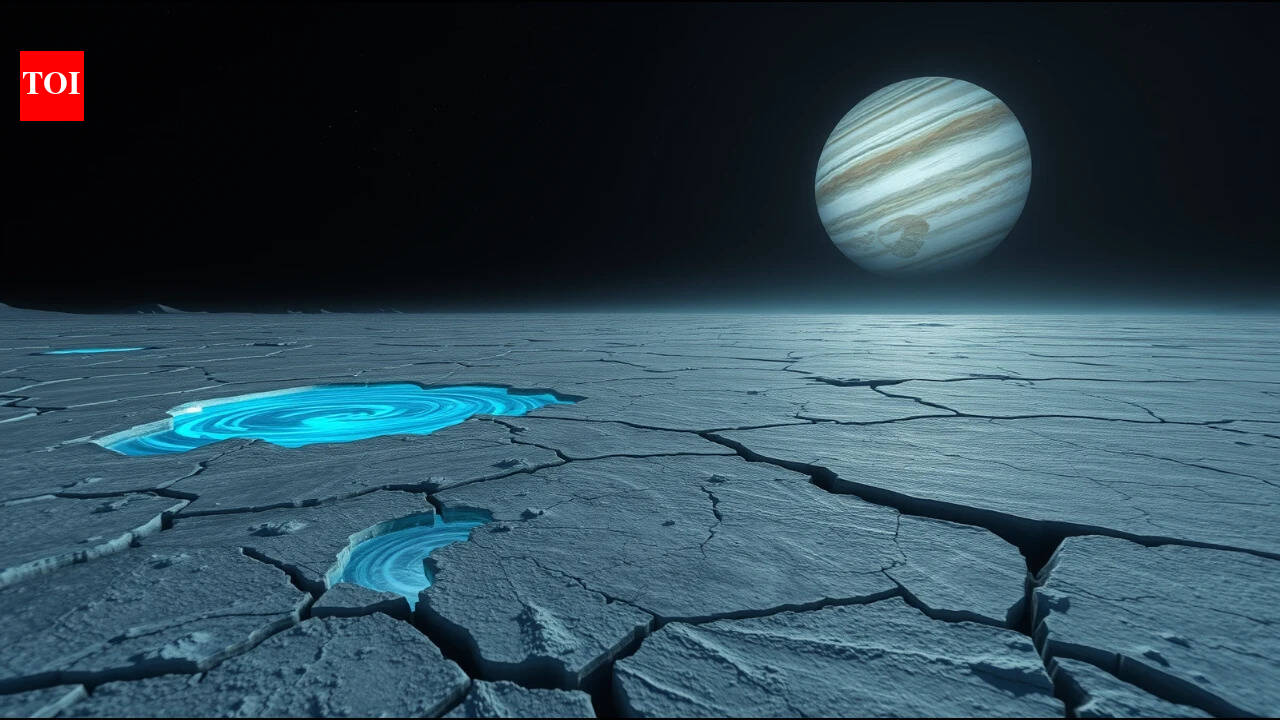
Europa, one of Jupiter’s icy moons, may hold more liquid water than all of Earth’s oceans combined, sealed beneath a thick shell of ice. For years, one of the most promising ideas for studying that hidden ocean was that water rising through cracks in the ice might collect in shallow pockets closer to the surface, giving spacecraft an easier target to sample than drilling miles down to the ocean itself. A new study led by Rutgers University planetary scientist Lujendra Ojha suggests that shortcut may not work the way scientists hoped. Computer simulations of water moving through narrow fractures in Europa’s ice found that the water loses heat so fast it likely freezes solid long before it ever reaches the surface.
What the new simulations actually tested
According to a Rutgers University press release, Ojha and his colleagues modelled how ocean water might travel upward through cracks in Europa’s ice shell, structures called dikes, the same term used for similar cracks that carry magma toward the surface in volcanic systems on Earth. The comparison to Earth’s volcanoes, known as cryovolcanism when applied to icy worlds, has shaped a lot of thinking about how material from Europa’s ocean might reach the surface. Ojha said that comparison breaks down quickly, since ice and liquid water behave very differently from rock and lava.The study, published in the journal Nature Astronomy, specifically built turbulence into the simulations, something earlier models had largely left out. Turbulence is the chaotic, swirling motion fluid takes on when it moves quickly through a narrow space, rather than flowing in a smooth, orderly line.
Why turbulence changes everything for water rising through ice
Earlier models generally assumed water moving up through Europa’s ice would flow in a fairly calm, steady stream, retaining enough heat to travel a good distance before freezing. Ojha’s simulations found the opposite. Water forced through a narrow fracture would surge and swirl violently, repeatedly slamming against the freezing walls of the crack and losing heat rapidly in the process.As the water cools, it can become supercooled, meaning it stays liquid even after dropping below its normal freezing point. Tiny ice crystals called frazil ice then begin forming inside the flow itself. These crystals build up, restrict the passage further and can eventually seal the crack shut entirely. According to the study, narrow fractures could freeze closed within a matter of hours. Wider fractures might carry more water in simplified models, but the researchers found that turbulence undercuts even these larger pathways significantly.
Why this matters for the search for life on Europa
Europa is widely considered one of the most promising places in the solar system to search for conditions that could support life, thanks to its salty subsurface ocean, likely chemical ingredients, and a source of internal heat generated as Jupiter’s gravity repeatedly flexes the moon. A shallow reservoir of water near the surface would be an especially valuable discovery for future missions, since it would be far easier to detect or sample than an ocean buried under miles of ice.But the new research complicates how scientists should interpret any shallow water they do find. If direct exchange between the deep ocean and near-surface pockets is as limited as the simulations suggest, then any water detected close to the surface may simply be the product of local melting within the ice shell itself, driven by heat from tidal flexing or friction, rather than a genuine sample of the ocean below. That distinction matters, since locally melted water would carry a very different chemical history than water that had actually risen from Europa’s deep ocean.
How upcoming missions will test these findings
Two spacecraft currently on their way to the Jupiter system are expected to help settle the question. NASA’s Europa Clipper launched on October 14, 2024, and is due to arrive in April 2030 after a journey of roughly 1.8 billion miles, where it will carry out 49 close flybys of Europa using nine scientific instruments, including ice-penetrating radar capable of identifying shallow water reservoirs and examining their depth and structure. The European Space Agency’s Jupiter Icy Moons Explorer, known as JUICE, launched in April 2023 and is scheduled to reach Jupiter in July 2031, where it will study Europa, Callisto and Ganymede before eventually settling into orbit around Ganymede.According to Ojha, a radar signal consistent with liquid water near Europa’s surface would still be an important find, but it would not automatically mean scientists had gained access to the moon’s global ocean. The research is intended to help these missions interpret whatever they detect more carefully, distinguishing a genuine sample of Europa’s buried sea from a smaller, locally formed pocket of meltwater trapped within the ice itself.