







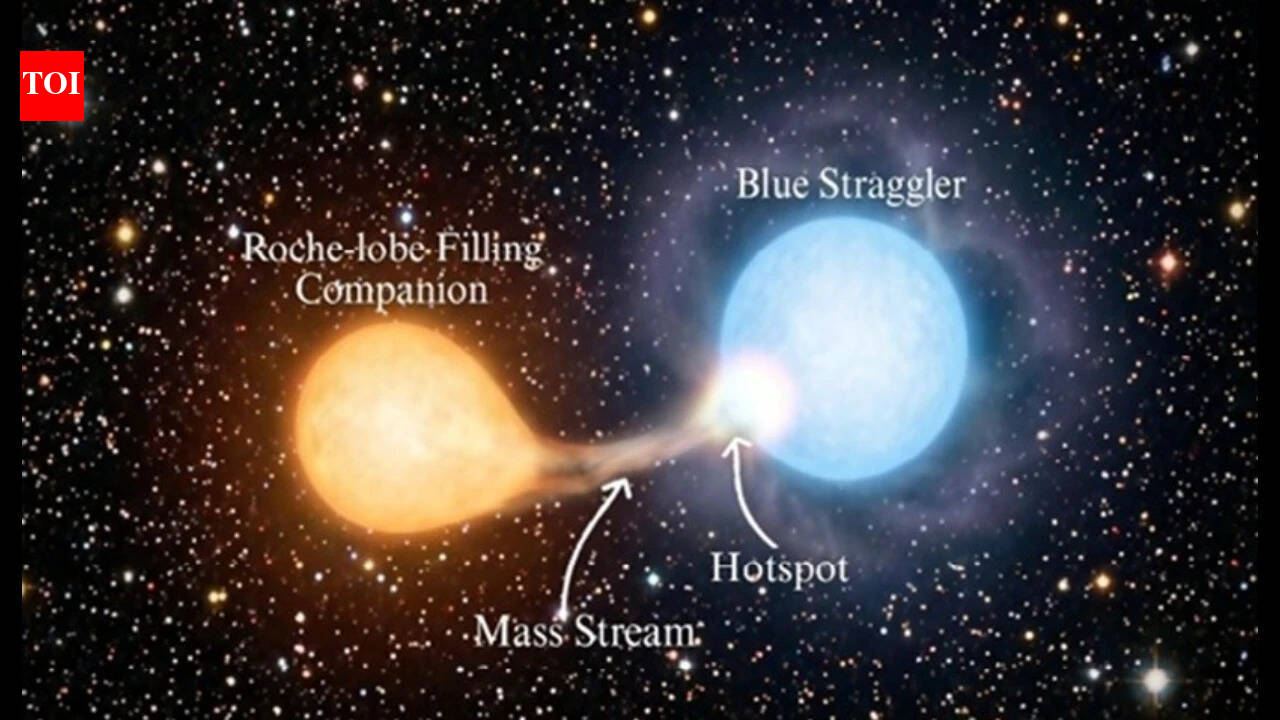
BENGALURU: For decades, astronomers have puzzled over a class of stars that seemed to defy nature’s rules by looking younger than they should. Now, an international team led by Indian researchers says it has caught one of these “age-defying” stars in the middle of its makeover, offering some of the strongest evidence yet for how these cosmic oddities are born.The discovery centres on a rare object known as a Blue Straggler Star (BSS. These stars are found in ancient star clusters, where most stars are expected to have aged in roughly the same way. Yet blue stragglers stand out by appearing hotter, brighter and heavier than their neighbours, almost as if they have somehow turned back the clock.Astronomers have long suspected that these stars achieve a second lease of life by stealing material from a companion star or by merging with another star. Until now, however, direct evidence of such a process has been extremely difficult to obtain.Researchers from the Indian Institute of Astrophysics (IIA), along with collaborators from India, Europe and the US, studied a pair of stars located about 9,500 light-years away in the star cluster Collinder 261. Using observations from Nasa’s TESS space telescope and the European Southern Observatory’s Very Large Telescope in Chile, they found one star actively drawing material from its companion.“We discovered that the Blue Straggler is actively gaining material from its companion star, providing a rare glimpse of a BSS caught in the act of formation,” Annapurni Subramaniam, director, IIA, and co-author of the study, said.She said the finding offers direct observational evidence for one of the leading explanations for the origin of these stars. The researchers found that the companion star had swollen enough for its outer layers to spill over towards the blue straggler, much like water overflowing from a full container. As this material falls onto the larger star, it becomes heavier and spins faster, making it appear younger and more energetic than it otherwise would.The team also detected strong X-ray emissions from the system, another sign that material is continuing to flow from one star to the other. Their analysis suggests this transfer began around 5.5 billion years ago and is still under way today.Beyond solving a decades-old puzzle, the discovery gives astronomers a rare natural laboratory to test theories about how stars evolve and interact over billions of years. The findings, published in The Astrophysical Journal Letters, could also improve scientists’ understanding of the history and evolution of star clusters across the universe.