








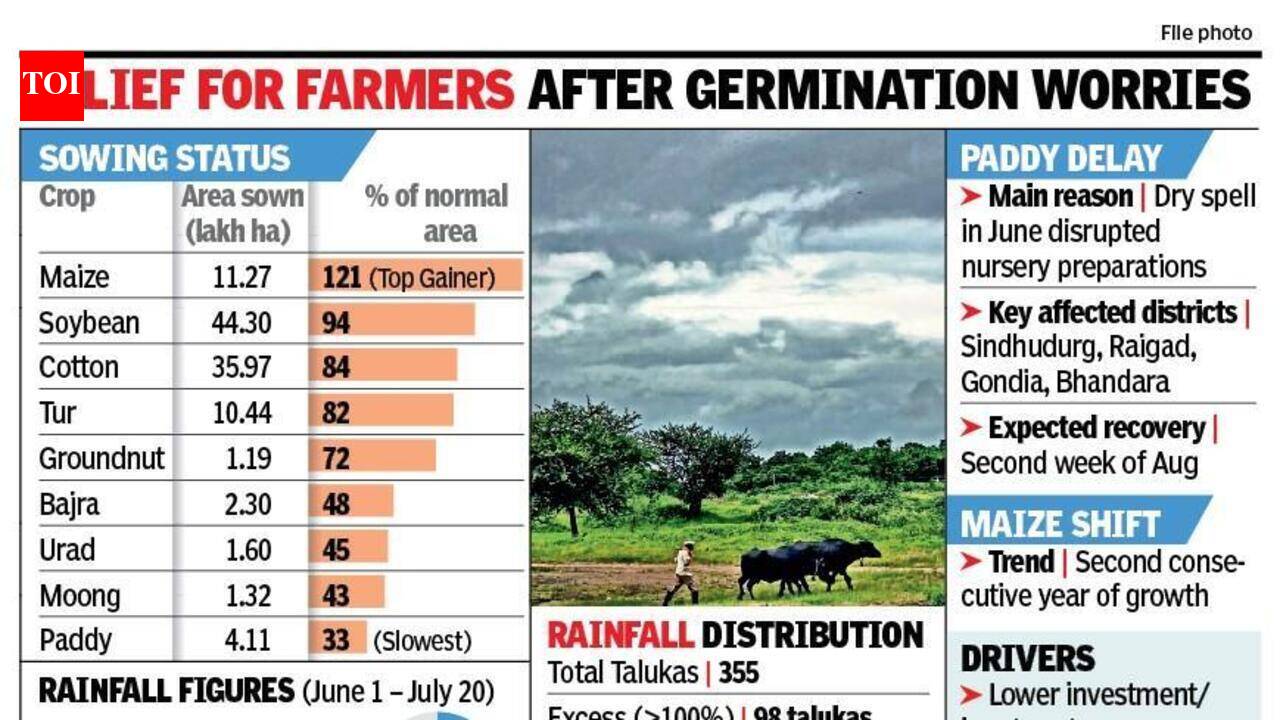
Pune: Maharashtra’s kharif season has staged a strong recovery despite early setbacks and complaints regarding poor soybean germination in Vidarbha and Marathwada. Driven by widespread rainfall in July, the state has now completed 80% of its normal sowing area.Soybean cultivation has reached 44.30 lakh hectares (94% of its average area), while cotton stands at 35.97 lakh hectares (84%). Both crops have entered the final phase of sowing, even though farmers in several districts were forced to replant after initial germination failures.“Sowing for both crops is expected to be completed within a week and may even surpass the state’s average acreage if favourable weather persists,” a senior official from the state agriculture department told TOI.
CJP Jantar Mantar Protest Updates
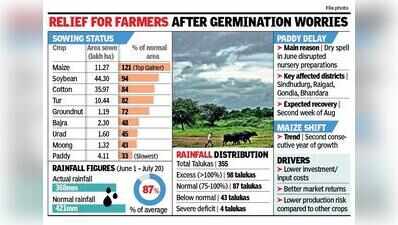
Overall kharif sowing across Maharashtra has gathered significant pace. Agriculture department officials noted that only about 20% of the total kharif area remains to be sown, with field operations likely to wrap up within the next week if the monsoon remains steady.“The turnaround follows an unusually dry June that delayed farm operations across the state. Timely and widespread rainfall throughout July restored soil moisture, allowing farmers to accelerate sowing across most regions,” the official added.Between June 1 and July 20, the state received 368 mm of rainfall against a normal of 421 mm—roughly 87% of the seasonal average. While the June deficit initially sparked concerns over production and acreage, the July showers allowed farmers to recover lost time. Even in pockets of Vidarbha and Marathwada where poor seed quality forced resowing, the overall acreage remained largely unaffected as farmers replanted immediately following fresh rains.For the second consecutive year, maize has emerged as a major winner. Farmers have cultivated the crop on 11.27 lakh hectares, reaching 121% of its normal area. This reflects a continuing shift toward maize, driven by its better market returns and lower production risks compared to traditional kharif crops.“Maize has become a favourite because it requires minimal investment and commands a good market price,” a senior official observed.Progress across other crops remains encouraging: Tur has been sown on 10.44 lakh hectares (82%), followed by bajra at 2.30 lakh hectares (48%), moong at 1.32 lakh hectares (43%), urad at 1.60 lakh hectares (45%), and groundnut at 1.19 lakh hectares (72%).The primary concern remains paddy. Transplantation has reached only 4.11 lakh hectares—just 33% of the normal area—making it the slowest-progressing major crop this season.Officials attribute the delay to the prolonged dry spell in June, which disrupted nursery preparation in key rice-growing belts such as Sindhudurg, Raigad, Gondia, and Bhandara. Because paddy requires mature seedlings and saturated fields, transplantation is expected to stretch into mid-Aug.“Except for paddy, conditions are favourable for completing sowing this month. The next fortnight will be critical for rice,” the official said. Vaibhav Tambe, the chief statistician at the state agriculture department, added, “The ongoing rainfall in the Konkan and other paddy-growing districts will provide a much-needed fillip. We expect to reach average cultivation levels by the second week of August.”Rainfall distribution has improved significantly. Of the state’s 355 talukas, 98 have received over 100% of their normal rainfall, while 87 have recorded between 75% and 100%. Only 43 talukas remain below normal, with just four tehsils facing severe deficits.Agricultural experts noted that while July rains rescued the kharif season from a delayed monsoon, August rainfall will now determine crop establishment and yields—particularly for soybean, cotton, and paddy.