






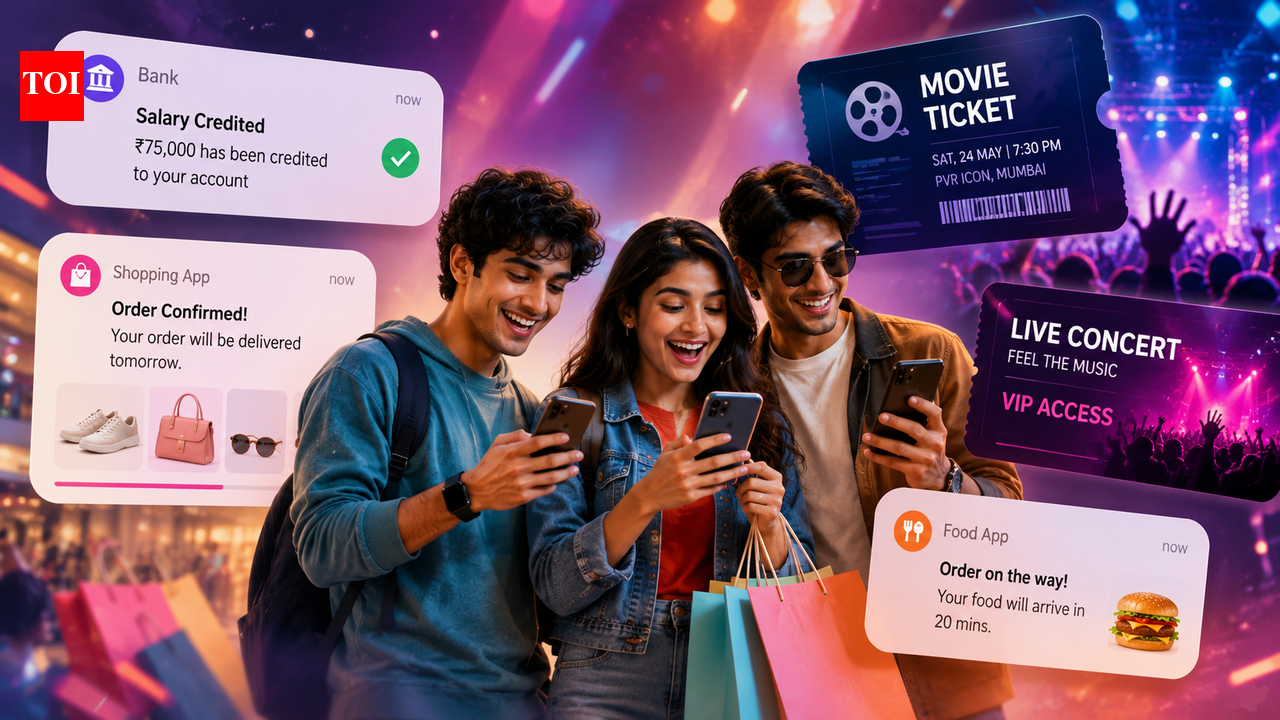
Once upon a time, it was just roti, kapda aur makaan.Today, it’s not about roti, kapda, makaan. It is skincare, concert tickets, latest OTT binge, gym memberships, cafe hopping, matcha cravings among other items waiting in your cart.For older generations, every big purchase meant months, sometimes even years, of careful saving. Today, however, payday follows a very different script. Once the salary lands, the plans begin: a weekend getaway, dinner with friends, a long-awaited purchase or simply treating yourself because… why not?Money has always promised comfort.Now, it also funds experiences, convenience and little indulgences. India isn’t just spending on needs anymore; it’s spending on experiences, trends and the joy of living in the moment.India’s consumption story has never looked stronger. Consumer spending now drives nearly 60% of the country’s GDP, businesses are booming and global brands are lining up to tap into one of the world’s fastest-growing consumer markets.But as Indians chase loyalty points, cashback deals and weekend getaways, a bigger question emerges: is money really buying happiness?Are we actually enjoying more, or are we simply spending more?
India is spending more than ever before
Crowded malls, packed cafés and endless delivery notifications are visual proof that Indians are spending more than ever.According to the Household Consumption Expenditure Survey (HCES) 2023-24, average monthly spending per person rose 9.3% in rural India and 8.3% in urban areas.And this isn’t just a metro phenomenon.From Odisha to Maharashtra, household spending increased across all 18 major states. Odisha recorded the sharpest rise in rural spending at around 14%, while Punjab topped urban India with nearly 13% growth. Even states such as Maharashtra and Karnataka, where growth was relatively slower, saw households opening their wallets more than they did a year ago.The changing consumption pattern is also visible in the narrowing gap between rural and urban India. In 2011-12, an average urban resident spent 84% more than someone in rural India. By 2022-23, this gap had narrowed to 71%, before falling further to 70% in 2023-24. When the value of welfare benefits is included, the difference shrinks to 67%.For many Indians, the numbers reflect more than rising incomes: they point to a shift in mindset. Spending is no longer just about meeting essential needs or saving for the future; it is increasingly about experiences, convenience and lifestyle choices.“My mother often tells me that people today spend much more than they did decades ago,” said Pooja Tirthani, a 25-year-old graphic designer from Delhi-NCR, speaking to TOI. “It’s not necessarily a bad thing, but the mindset has definitely changed.”She said that while earlier generations often prioritised saving and carefully planned purchases, younger consumers are more willing to spend on experiences.“Today, people are willing to spend on travelling, trying new restaurants, attending events or simply celebrating small moments. For many youngsters like me, creating memories has become just as important as building savings,” she said.Evidently, India’s consumption story is no longer limited to metros and big cities. From villages to smaller towns, more Indians are opening their wallets, driven not only by rising incomes, but also by changing aspirations and a growing desire to spend on better lifestyles and experiences.
Beyond roti, kapda, makaan
Perhaps the biggest sign that India is becoming wealthier is not how much people spend, but what they spend on.Economists often refer to Engel’s Law, named after 19th-century German statistician Ernst Engel. The principle is simple: as incomes rise, households spend a smaller share of their income on food and a larger share on everything else.India is now following that pattern.According to HCES, food accounts for just 47% of monthly household expenditure in rural India and 40% in urban India. In other words, more than half of urban household spending now goes towards non-food items, from transport and healthcare to travel, entertainment and lifestyle purchases.Even the food basket is changing. In rural India, processed food, beverages and refreshments account for the largest share of food spending at 9.84%, followed by milk and milk products (8.44%) and vegetables (6.03%). Cereals, once the backbone of household budgets, now account for just 4.99% of expenditure.Urban India tells a similar story. Processed food and beverages command an even larger 11.09% share of food spending, ahead of milk products (7.19%) and vegetables (4.12%).
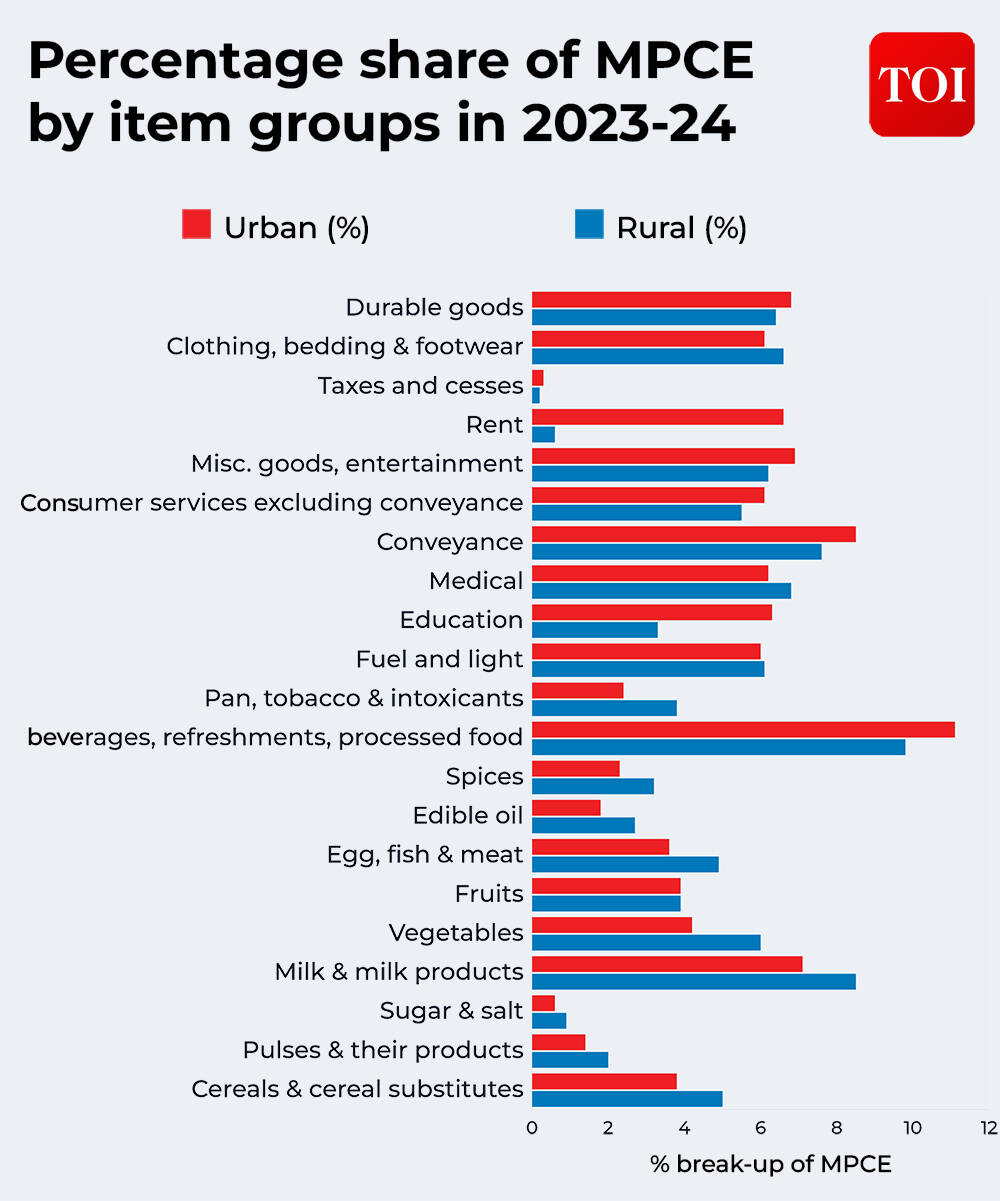
The Indian plate is becoming more diverse and convenience-driven. Ready-to-eat meals, packaged snacks, café culture and food delivery apps are quietly reshaping household budgets, reflecting a shift from simply eating to spending on choice, convenience and experience.Saumati, a 53-year-old homemaker, says the change is evident in everyday life. “When I was younger, we rarely thought of spending money on things like eating out, trying new cafés, ordering food online or celebrating small occasions outside the home.”“Today, people are more open to spending on things that make them happy, whether it’s enjoying a meal with family, trying different foods or even bringing new choices like almond milk and vegan pizzas into their homes. There are so many more options now, and people are finding more ways to enjoy life,” she told TOI.
New spending checklist
The biggest shift, however, is happening beyond the kitchen. As incomes rise, household budgets are increasingly making room for mobility, lifestyle and comfort, not just essentials.Charlie I believe the experience is worth the money. It also depends on the quality of the movie and the cost of the ticket. If the talk is good or if it’s a director i like, i will prefer watching it in the theatres.In rural India, conveyance has emerged as the largest non-food expense, accounting for 7.59% of total household expenditure. It is followed by medical expenses (6.83%), clothing and footwear (6.63%), and durable goods such as appliances and household items (6.48%).Urban India paints an even stronger picture of this lifestyle shift. Transport accounts for 8.46% of monthly expenditure, followed by miscellaneous goods and entertainment (6.92%), durable goods (6.87%) and rent (6.58%).Together, the numbers reveal a clear change in how Indians are using their money. Household budgets are no longer centred only on necessities; they are increasingly directed towards travel, healthcare, entertainment, convenience and products that make everyday life more comfortable, and, perhaps, a little more enjoyable.
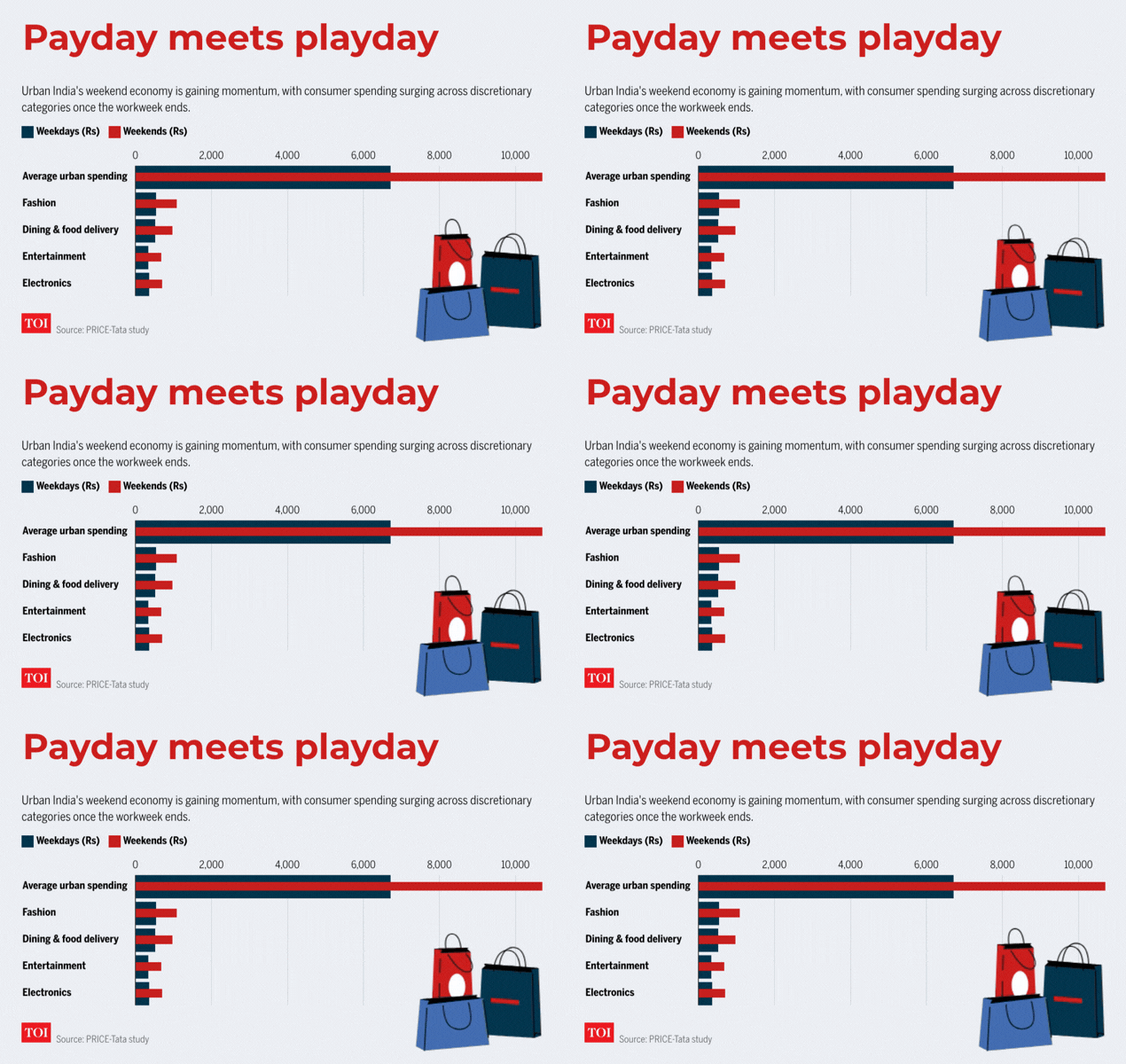
So, has money bought you happiness?
If spending more was the only measure of a better life, India’s young workforce should be among the happiest in the world. Instead, surveys paint a more complicated picture.The shift is visible in everyday choices. Even as the cost of leisure activities rises, many young consumers are still willing to pay more if they believe the experience is worth it. “I feel like going to the movies has become really expensive these days. Ticket prices have gone up a lot. Earlier, you could easily get tickets for Rs 100–Rs 200, but now they’re often Rs 400 – Rs 500,” Pooja said.She further added, “If you want better seats with great sound quality and the best view, you end up spending even more, even Rs 1,700 for some movies. And then there’s the overpriced food inside the theater. But I guess, for our generation, it still feels worth it because you’re paying for a much better experience. When the overall experience is great, you leave feeling like the money was well spent.”Young Indians are earning more than previous generations and have greater access to travel, technology, entertainment and lifestyle experiences. Yet, financial security remains elusive.According to the Deloitte Global 2026 Gen Z and Millennial Survey, 54% of Gen Z respondents and 44% of millennials in India have delayed major life decisions because of financial concerns.One of the biggest roadblocks is homeownership. Around 37% of Gen Z respondents and 20% of millennials said they cannot afford to buy a house.For many young professionals, the maths simply isn’t mathing.Property prices have risen sharply across major cities while salaries have struggled to keep pace. Saving enough for a down payment can take years, making a weekend getaway, concert ticket or the latest smartphone feel far more achievable than owning a home.At the same time, building financial security remains a challenge. Deloitte found that 47% of Gen Z respondents and 40% of millennials live paycheck to paycheck. Nearly 29% of Gen Z respondents feel financially insecure, while 34% struggle to meet their monthly living expenses.As Jatin Dixit, a part time content creator and a student puts it, “People think we’re wasting money on brunches, holidays or gadgets. The reality is that many of us have done the maths. Saving for a home could take years, even decades. So we try to strike a balance, save what we can, but also make time for experiences that make life feel worthwhile.”That balancing act has become easier and riskier thanks to easy credit.Big-ticket purchases that once required years of saving can now be financed through EMIs, Buy Now Pay Later (BNPL) schemes and instant personal loans. The question is no longer, “Can I afford this?” It’s increasingly, “Can I fit one more EMI into my monthly budget?”
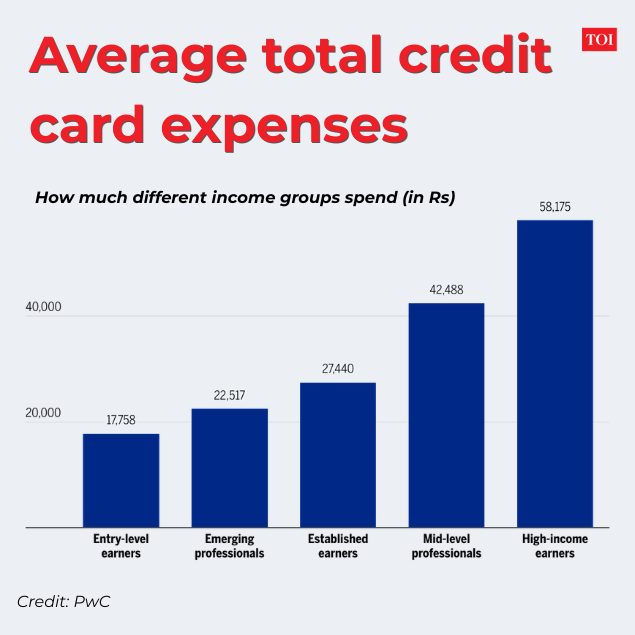
The Reserve Bank of India’s Financial Stability Report reflects this shift. Household debt has climbed to around 45.5% of GDP, almost double the level a decade ago. Non-housing loans now account for 58.4% of household debt, suggesting that a growing share of borrowing is funding consumption rather than long-term assets. Outstanding personal loans have also surged from Rs 5.53 lakh crore in 2019 to around Rs 17.32 lakh crore.None of this necessarily points to financial distress. Rising incomes and greater access to formal credit are natural signs of a growing economy. But they also reveal a subtle shift in consumer behaviour. Affordability is increasingly giving way to accessibility. Consumers are no longer asking whether they can buy something, they’re asking whether they can pay for it in installments.That is the paradox of modern India.Money has opened doors to more experiences, more convenience and more choices than ever before. But it hasn’t eliminated financial anxiety. A holiday, a shopping spree or the latest gadget may bring instant gratification, but lasting peace of mind still depends on something far harder to buy: financial security.