









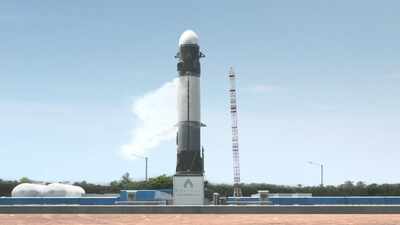
BENGALURU: India’s private space sector appears poised to beat Isro in one of the most significant technological milestones in modern rocketry: demonstrating the recovery and reuse of an orbital launch vehicle. While Isro is developing the much larger Next Generation Launch Vehicle (NGLV), capable of carrying up to 30 tonnes to low-Earth orbit, two startups are racing to prove the technology first, potentially giving India’s commercial space sector more than a symbolic first in reusable launch systems.Among them, Agnikul Cosmos appears to be in the lead. Its co-founder and CEO Srinath Ravichandran told TOI that the company’s next Agnibaan Orbital mission will attempt to recover its first-stage booster, making reusability a core objective alongside placing customer satellites into orbit. It’s next goal will be to make a fully reusable rocket.“Our primary objective will be to put customers in orbit. The secondary objective is to recover the rocket, and we will give it a full shot,” Ravichandran told TOI. While launch dates are still being firmed up, Agnikul is targeting a window in the current year.Ravidhandran said confidence gained from the company’s controlled sub-orbital mission prompted engineers to incorporate recovery immediately rather than pursue it later as a separate programme. “We realised we already had much of the guidance, navigation and control experience required. We didn’t want to waste the opportunity,” he said.The booster will attempt a powered vertical landing on a barge stationed in the Bay of Bengal, south of Sriharikota. Unlike conventional expendable boosters, it will carry landing legs, grid fins, an independent flight computer and navigation systems, allowing it to fly itself back after stage separation.Agnikul is also trying to extract value from the upper stage. Instead of allowing it to become orbital debris after satellite deployment, the company plans to convert it into an in-space platform capable of offering commercial services.“The idea is to not throw away anything… The lower stage we can bring back. The upper stage is too expensive to recover because of the payload penalty. So we thought: can we keep it in space and earn revenue?,” Ravichandran said. Recovery will come at the cost of payload capacity because additional fuel and hardware are needed. But Ravichandran said the economics favour reuse if it substantially cuts manufacturing costs and enables rapid launch turnaround. Skyroot Aerospace, meanwhile, has expanded its own ambitions. In 2022 after its sub-orbital flight, Skyroot had made public plans for reusable booster stages for its ‘Vikram’ series of rockets. As of Saturday, it claimed that it’s working on a fully reusable launch vehicle — booster and upper stage both engineered for recovery.Neither firms is attempting anything close to the scale of NGLV. Their vehicles are designed for much smaller payloads and commercial missions, whereas NGLV is intended to lift up to 30 tonnes to LEO, placing it in an entirely different class. Yet, if either company demonstrates successful recovery first, it would mark a significant technological milestone, validating capabilities that can later be scaled up for larger launch vehicles.Although NGLV has moved beyond the conceptual stage, it’s yet to enter full-scale design validation and flight testing. Initial timelines had targeted a demonstration between 2028 and 2030, a schedule that now appears likely to slip. NGLV is also being developed with industry participation from the outset, reflecting the govt’s broader vision of building a stronger commercial space ecosystem.Globally, reusable launch systems are gathering pace. On July 10, China recovered the first-stage booster of its Long March-10B after a powered vertical descent off the coast of Hainan. A day later, Japan’s Jaxa successfully flew, hovered and landed its experimental RV-X reusable rocket prototype. While Japan’s demonstration involved a much smaller experimental vehicle, China’s test represented progress towards reusable orbital-class launch systems.