







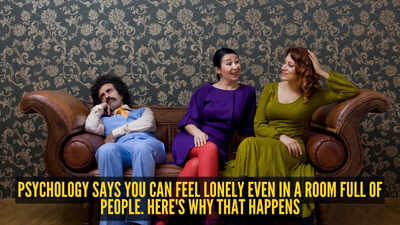
When someone says they’re lonely, we almost automatically imagine a person who’s by themselves.Maybe they live alone. Maybe they don’t have many friends. Maybe they spend weekends with nothing much to do.But loneliness doesn’t always look like that.Sometimes, it looks like someone who’s constantly surrounded by people. They’re at office lunches, family get-togethers and birthday parties. Their phone never stops buzzing. They always have someone to message or meet. And yet, when they finally get home, there’s this strange feeling that refuses to go away. It feels as though they’ve spent the entire day talking, but not really being heard.If that sounds familiar, you’re not the only one.Psychologists have been studying loneliness for years, and one of the biggest takeaways is that it isn’t simply about being physically alone. What really matters is whether you feel emotionally connected to the people around you. You can have a full social life and still carry around a quiet feeling that nobody actually knows who you are beneath the polite conversations and everyday smiles.One of the people who helped change the way we understand loneliness was psychologist John Cacioppo. His research found that what affects our wellbeing isn’t always physical isolation but something called perceived social isolation – the feeling that the relationships in our lives aren’t giving us the emotional closeness we need. In simple words, it’s possible to spend every day around people and still feel completely disconnected inside. His work also found that prolonged loneliness can affect both mental and physical health.Another study by psychologists Dale Larson and Robert Chastain looked at self-concealment, which is the habit of constantly hiding your real thoughts and emotions from others. They found that people who regularly kept important parts of themselves hidden were more likely to experience anxiety, emotional distress and even physical symptoms. Interestingly, many of them weren’t lacking friends or social support. The issue wasn’t the number of people in their lives – it was that nobody really knew what they were going through.If you think about your own life, it starts making sense.Most of us have different versions of ourselves.There’s the version that goes to work and politely smiles through meetings. The version that chats with neighbours. The version that jokes around with college friends. Then there’s the version that exists at home on a lazy Sunday afternoon – hair tied up, wearing an old T-shirt, binge-watching a series, worrying about bills, career decisions or family responsibilities.Now ask yourself something.How many people actually know that version of you?Not the one who always says, “I’m good.”

The real one.For a lot of people, the answer is surprisingly small.And that’s where this feeling often begins.The funny thing is that none of us start hiding parts of ourselves on purpose. Life teaches us to do it. Maybe you learnt as a child that crying made people uncomfortable. Maybe you’ve always been the responsible sibling, so you stopped talking about your own struggles. Maybe everyone thinks you’re the funny one, and now admitting you’re having a difficult time feels almost out of character.Little by little, we edit ourselves.Not because we’re pretending.Simply because it feels easier.After a while, you get so used to saying, “Everything’s fine,” that even when it isn’t, those words come out automatically.That’s probably why people with huge social circles can still feel lonely.Real connection isn’t measured by how many people wish you on your birthday or how many contacts you have saved on your phone. It’s measured by whether there’s someone you can call when life falls apart and you don’t feel the need to pretend you’re okay.The good news is that meaningful relationships don’t usually appear overnight. They grow through small conversations.Maybe instead of saying, “All good,” you tell a close friend that work has been exhausting lately.Maybe you admit you’ve been feeling anxious.Maybe you simply tell someone you’re not having the best week.These aren’t dramatic confessions. They’re ordinary moments of honesty. But they’re often the moments that make relationships stronger.Something interesting happens when one person opens up first. The other person usually feels comfortable enough to do the same. Suddenly, the conversation becomes real instead of polite.As we get older, many of us become experts at staying connected without actually feeling close. We send birthday wishes, react to Instagram stories, forward memes and keep up with everyone’s life online. Yet we rarely stop to ask someone, “How are you really doing?” And even when someone asks us that question, we often give the quickest answer instead of the honest one.Maybe that’s why emotional loneliness feels so common today.Not because we have fewer people in our lives.But because we have fewer conversations where we can simply be ourselves.At the end of the day, most people don’t need a bigger friend circle. They don’t need another group chat or another social event.They just need one or two people with whom they don’t have to perform.Sometimes, that’s all it takes to make the world feel a little less lonely.