





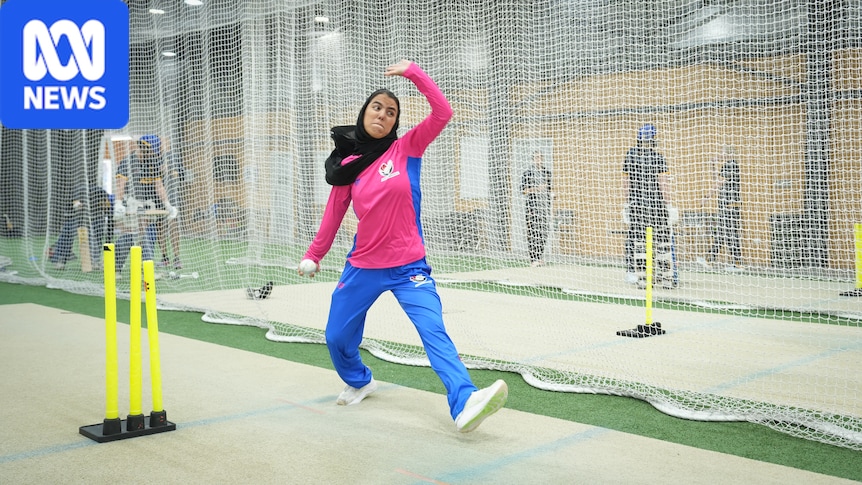
In 2021, Afghanistan cricketer Benafsha Hashimi’s life was under threat just for playing the sport she loves.
The Taliban’s brutal regime had returned to power; women who played sport were being hunted down and murdered.
Five years after fleeing their homeland Hashimi and the rest of the Afghan women’s team have earned the respect of the international sporting community, secured their playing future, and met the King.
“It was a magical day,” Hashimi said.
“Who would believe the girl who was starving for days, [whose] family had nothing, no money, no power … today she’s meeting the King?”
The Afghan refugee women’s cricket team met King Charles in London in June this year. (Reuters: Yui Mok/Pool)
The royal audience came during the team’s recent playing tour of England, the latest of victory during a hard-fought campaign for recognition that extends beyond the pitch.
The team first wrote to the International Cricket Council (ICC) appealing for help in December 2022.
“We want to show the world that even though war, insecurity, inequality and injustice the hopes [of] our team and representing our country remain alive,” they wrote.
This week the ICC announced continued funding for the team alongside a promise to play in qualification events by 2030.
‘We can represent our country’
The announcement represents a massive victory for the team and a significant moment in the sport’s history.
“When we hear about this news, we feel very emotional because we really did work hard for this day,”
Canberra-based Afghan player Shafiqa Khan said.
Shafiqa Khan and Benafsha Hashimi settled in Australia, while their teammates live in Canada and the UK. (ABC News: Matt Roberts)
Cricket Australia is one of the members of a “Special Taskforce” that will oversee the players’ development.
The England and Wales Cricket Board (ECB) and the Board of Control for Cricket in India (BCCI) are also members.
The group will seek to “balance to the imperatives of exposure, representation and enhanced competitive standards for the women,” the ICC said in a statement.
Pathway to compete in qualification events
Cricket Australia CEO Todd Greenberg says details of the “collaborative effort” to fund the team are still being worked on with the ICC.
“Money needs to be ploughed in at the base of this program to ensure its longevity and success over a period of time,” he said.
Cricket Australia boss Todd Greenberg says details of how the team will be funded are still being worked out. (AAP: James Ross)
“Ideally to 2030, even as far as 2032 to the Olympics in Brisbane.“
This week’s announcement includes a promise for a “pathway” to compete in as yet unspecified ICC qualification events in the next five years.
The T20 format will feature at the 2028 Olympics in Los Angeles and there’s an expectation within the sport this will extend to Brisbane in 2032.
The Afghan refugee women’s cricket team at the renowned Lord’s Cricket Ground in London. (ABC News: Supplied)
Team unrecognised back home
The Taliban-controlled Afghanistan Cricket Board does not recognise the team, creating an administrative barrier for the ICC in the past.
ECB Deputy CEO Clare Connor told the ABC the decision was an “excellent outcome” for the team.
“The players first wrote a letter to ICC asking for leadership and a solution,” the former England captain said.
“To be able to continue to play as a team in recognised pathway events, despite their displacement from Afghanistan … three and a half years on they finally have their answer.“
Shafiqa Khan says the team worked hard to secure the recognition of the ICC. (ABC News: Matt Roberts)
Their first letter received no response, so they kept writing.
Cricket itself would provide a turning point; an exhibition match in Melbourne at the start of last year drew international media attention.
The tenacity and strength of the women combined with the power of their stories drew the admiration of the sporting world.
“These women are nothing short of phenomenal,” Cricket Australia CEO Todd Greenberg said.
“I see them as leaders, as incredible human beings who’ve been through some very difficult moments in their life, some that are very hard for people in our country to comprehend.
“Some of the stories that I heard first-hand will stay with me forever.“
Funding for more coaching
In the months that followed the inaugural fixture, the ICC announced an ‘Afghanistan women’s cricket initiative’ to provide monetary support to the players and fund a high-performance sporting program.
This new taskforce will oversee a continuation of that program, with Independent ICC director Dr Ros Rivaz and Cricket Ireland CEO Sarah Keane at the helm.
Benafsha Hashimi and her team have secured additional funding for a coaching and development program. (ABC News: Matt Roberts)
The program will deliver “structured coaching, meaningful competitive opportunities and appropriate high-performance pathways,” Dr Rivas said in the ICC’s statement.
“This programme reflects the ICC’s commitment to fostering opportunity through cricket … [it will be] delivered with purpose, integrity and long-term sustainability.”
The team’s recent tour of England, plus training camps in Australia and India, were funded by the previous iteration of the elite pathways program.
While the players are still waiting on details on how the program will work, bowler Shafiqa Khan says they are as determined as ever.
“It’s been a long journey and with many challenges, but the most important point is that we didn’t give up,”
she said
“That’s why today we are here, and we play together.”