







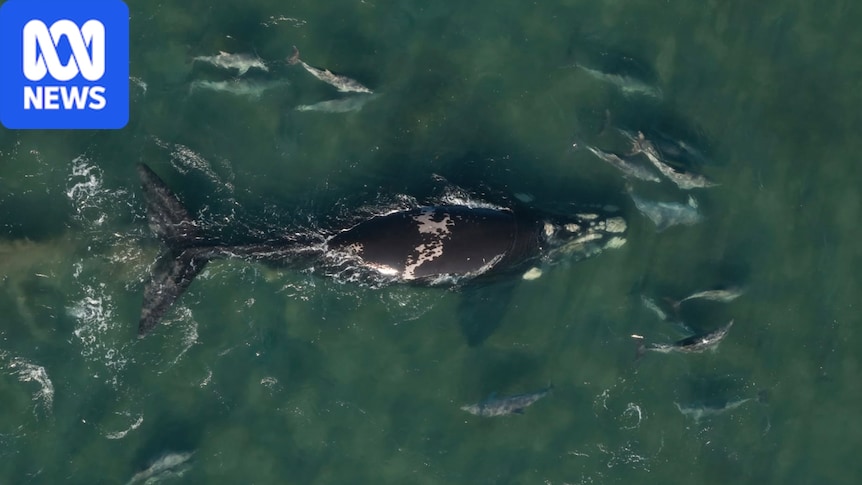
Marine researchers are celebrating after a juvenile southern right whale made its way back into the ocean after being stranded in the Peel-Harvey Estuary for more than two weeks.
The endangered whale measured 10.6 metres long and about 1.8 metres deep, making it difficult to swim through the estuary’s shallow waters.
Locals kept a close eye on the whale, affectionately dubbed by some as ‘Gail the Whale’, for almost three weeks.
The whale managed to enter deeper waters on Thursday afternoon with the assistance of a helpful pod of dolphins, according to onlookers.
“When the whale got across the sandbar, it appears a pod of coastal dolphins has turned up and possibly may have led it back out to safety,” Geographe Marine Research director Rodney Peterson said.
The juvenile whale was stranded in the estuary for more than two weeks. (Supplied: Callum Craig)
Return to the big blue
Mr Peterson said the whale needed a combination of factors for it to successfully make its way to the open ocean.
“Yesterday on a high tide with a falling barometer as well, it was able to swim across that sandy section and make its way into the cut, and after a couple of failed attempts it finally swam free,” he said.
The gentle giant entered the estuary on June 28, and couldn’t find its way back out.
Mr Peterson said there were concerns about how long the animal could have survived in the estuary.
“It’s just not it’s normal environment and the longer it was in there, the less chance it would have of getting back to where it needed to be,”
he said.
It is not known what caused the young whale to make its way into the estuary, but Mr Peterson said there were a number of theories.
“We’ll probably never know, but probably the best thing is that the whales are curious,” he said.
“Being a huge tide, it hasn’t recognised that it’s a dangerous area for it to be in and it’s wandered in there and the tide’s gone out.“
During its time in the estuary, the whale mingled with the local dolphin population, and onlookers believed dolphins helped to guide the animal into deeper waters yesterday afternoon.
Friendly phenomena
Emily Ehlers from Dolphin Discovery Centre has observed dolphin pods guiding whales out of shallow waters before.
She said last year a humpback whale found itself stranded in Koombana Bay in Bunbury, 170 kilometres south of Perth.
“We also observed the same behaviour where they kind of have a formation about them,” she said.
“They try to guide the whale with vocalisations and all sorts.
“It’s pretty amazing.”
Emily Ehlers says dolphins guiding whales into deeper waters is a known phenomena. (ABC South West: Madigan Landry)
Ms Ehlers said the cooperative nature of dolphins meant they were often observed engaging with whales.
“You see [whales] turn, and they expose their belly, so they kind of invite the dolphins to play,” she said.
“The dolphins ride along the bow of the whale as they’re moving through the water.
“It’s just a really beautiful interaction to observe.”
Ms Ehlers said relationships between the two species were not always playful.
“It is open to interpretation, so some of it can be competitive and territorial,” she said.
A pod of dolphins surrounding a young southern right whale. (Supplied: Callum Craig)
A spokesperson for the Department of Biodiversity, Conservation and Attractions said if the whale re-enters the waterway, there was less concern for its safety.
“It has demonstrated that it can pass safely between the estuary and the ocean through the cut,” they said.