







South Korea is cashing in on AI’s appetite for memory, and its chip makers plan to spend hundreds of billions of dollars to maintain their advantage.
The Asian industrial powerhouse supplies most of the advanced memory chips helping power AI.
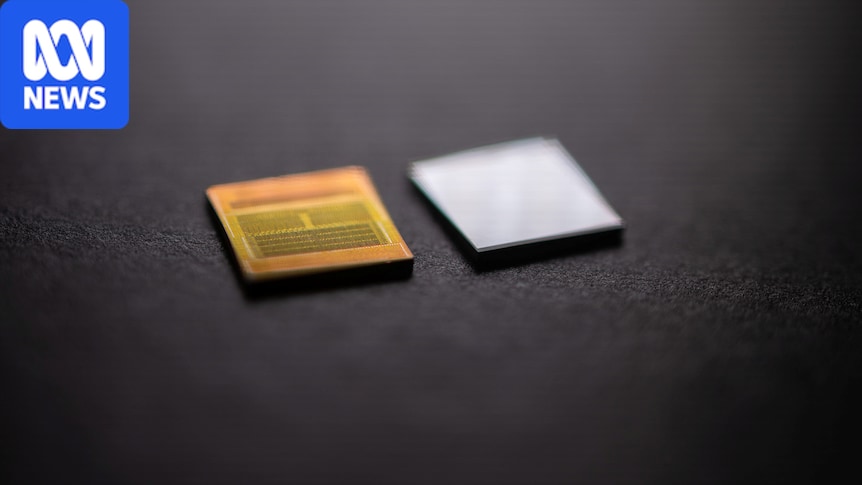
They are small, expensive items that require specialised, extremely precise manufacturing that two South Korean firms have invested heavily to build.
SK Hynix and Samsung Electronics are leading makers of high-bandwidth memory chips. (Reuters: Carlos Barria)
“Samsung Electronics and SK Hynix are exceptionally well-positioned to maintain their leadership,” said Peter Kim, global investment strategist at South Korean financial group KB Securities.
“They possess an enviable advantage in the memory chip space, outperforming competitors.“
Demand for the chips heavily outweighs supply, and it is firmly a “sellers’ market” for manufacturers, Mr Kim said.
South Korea is doubling down on its bid to lead in the technology, unveiling plans last month to spend hundreds of billions on developing its chip manufacturing.
It is an initiative the country’s president has called a “great leap forward”, signalling its seriousness about securing its place as one of the world’s top-three AI superpowers.
So how will South Korea’s ambitions impact the global AI race? Why are its memory chips so important, who is buying them, and will they get any cheaper?
What are memory chips?
AI needs memory to store information and perform its calculations.
One AI company alone, OpenAI, says its application ChatGPT has a billion weekly users — in other words, one in eight people in the world.
“Because the models are getting bigger and bigger, we’re needing more and more memory to run all of these AI workloads,” said Toby Walsh, a professor of AI at the University of New South Wales.
AI companies use it to train their models, and later, to let them answer questions from users.
“That’s where you need all those memory chips,” Professor Walsh said.
South Korea leads the world in making HBM (high bandwidth memory), one of two important components housed in data centres that help AI to think.
HBM stores information that AI draws upon to make calculations, including past questions from users, which chatbots such as Claude or ChatGPT use to form their answers.
“These days, the prompt isn’t just what you’ve typed. It’s all the history,” Professor Walsh said.
SK Hynix recently made its debut on the Nasdaq share market. (Reuters: Angelina Katsanis)
AI also makes its calculations using another component called GPUs (graphics processing units), which were originally developed for 3D graphics in computer games.
“They can perform enormous numbers of operations in parallel,” said Craig Jin, an associate professor at the University of Sydney’s School of Electrical and Computer Engineering.
While Samsung’s foundry fabricates some GPUs, Taiwanese company TSMC is the leading manufacturer.
Loading…
Why is South Korea good at making chips?
Making memory chips requires equipment costing billions of dollars to build, and South Korea is one of the few places that has invested.
The factories are so expensive because they are making items with incredibly high levels of precision, down to billionths of a metre.
They need to be clean, with so little room for error that even dust would destroy a chip, Professor Walsh said.
“You’re building at the microscopic level,” he said.
“We can’t actually manufacture any smaller. We’re pretty much running into the physical limits of what you can build.“
That requires a collection of sophisticated machines that takes decades to build, as well as vast quantities of water and uninterrupted electrical power.
Experts say Samsung and SK Hynix spent years refining this highly complex manufacturing process, while South Korea has built its technological expertise over 60 years.
“Korea has advanced from manufacturing the chips for foreign companies to being the world leader in [memory chips],” said Sofiya Sayankina, senior researcher at Hankuk University of Foreign Studies.
“Technology is deeply integrated into the Korean economy and society and largely viewed as essential to prosperity due to the country’s recent history of post-Korean War industrialisation, which facilitated its economic recovery and growth.”
How is South Korea profiting?
South Korea is reaping the benefits of decades spent building its chip manufacturing, as the AI boom increases demand.
Samsung last week forecast 1,800 per cent growth in second-quarter operating profit from a year earlier, powered by sustained AI-driven demand for memory chips.
Both Samsung and SK Hynix have surpassed $US1 trillion ($1.42 trillion) in market capitalisation, joining an exclusive club of mostly American companies.
“The companies are currently experiencing historic operating profit margins,” Mr Kim said.
MS Hwang, research director at Counterpoint Research, said the companies excelled at mass producing high-performance memory chips “at the lowest cost while delivering exactly what the market demands”.
“In terms of AI memory, Samsung and SK Hynix are expected to maintain an 80 per cent global market share through to 2028.”
South Korea is cashing in too, raising its 2026 economic growth forecast by one percentage point to 3 per cent this week, buoyed by strong performances from its memory chipmakers.
What is South Korea planning next?
South Korea does not want to stop there.
Samsung and SK Hynix announced last month they would spend $US518 billion ($740 billion) in building a new chip-making hub in the country’s south-west.
South Korean President Lee Jae Myung, speaking at the same event, pledged to cement the nation’s industry leadership.
“We must secure the core elements of AI faster than any other country,” Mr Lee said.
“Semiconductors, physical AI, and AI data centres are the triple axis for a great leap forward.“
There are risks for South Korea, not least being power supply.
“Because it is a smaller country with its industry being overwhelmingly power-consuming, it needs to make contingency plans,” Dr Sayankina, from Hankuk University of Foreign Studies, said.
“The energy policies need to be implemented in parallel with the development of its recently announced mega projects.”
South Korean President Lee Jae Myung with SK Group chairman Chey Tae-won and Samsung Electronics chairman Lee Jae-yong in Seoul. (Reuters: Kim Min-Hee/Kyodonews)
China was also making a state-backed push into the industry to secure its own supply, posing a long-term risk to the global supply-demand balance, Mr Kim said.
“There is also a significant risk of talent poaching; in 2018, it was discovered that 1,300 former engineers from Samsung and SK Hynix were working at tech startups in mainland China.”
Customers may also push back on the price of memory chips.
Apple’s CEO had complained about “unaffordable semiconductor chip prices” and the company had begun testing chips from China’s state-backed CXMT, Mr Kim said.
How will this affect the AI ‘race’?
Observers expect South Korea to maintain its dominance for some time, despite efforts by the United States and China to build their own domestic industries.
Dr Sayankina said US export controls — on foreign-made goods that use US technology or equipment — meant China could only import South Korea’s older chip models.
“Korea’s semiconductor exports to China have been rapidly increasing in the past year as China is building its AI industry,” she said.
“Because China cannot acquire the most advanced technology, they need to compensate for it by sheer volume of deployed memory.”
South Korea, a US military ally, could find itself caught between the great powers, she said.
“The geopolitical rivalry is a point of concern … and we have seen many examples when South Korea’s companies find themselves at the centre of it.”
Meanwhile, demand was too high for memory chips to become cheaper in the foreseeable future, Mr Kim said.
“The explosion of AI demand has skewed dynamics so heavily in favour of the sellers that the overall supply shortage for memory chips is expected to take at least two to three years to ease,” he said.
“Until then, customers are likely to continue facing what they describe as ‘unaffordable’ prices.”
Loading…
ABC with Wires