






There are few more heated rivalries in world sport than England against Argentina.
When the two teams meet in Atlanta in the World Cup semifinal on Thursday (AEST) it will be just the latest chapter of a furious battle that has ebbed and flowed since their first official meeting on a football pitch in the 1950s.
At previous World Cups inflammatory incidents were par for the course, skulduggery a near certainty and outright cheating prevalent.
This is as heated as sport can get.
Some may even call it hatred.
- Check out the full World Cup schedule here in Australian times
- ABC Sport podcast: Check out the latest episode here
‘Animals’
Alf Ramsey called Argentina’s team “animals” and stopped his team from swapping shirts. (Getty Images: Central Press)
The animosity goes back all the way to 1966.
After a furiously bad-tempted quarterfinal between the two sides at Wembley, Alf Ramsey refused to let his side swap shirts with their Argentine compatriots.
It was after several players were warned in the match, on both sides, while Argentine skipper Antonio Rattín was sent off.
He was initially verbally cautioned for a foul on Bobby Charlton, but then was dismissed for “violence of the tongue,” or dissent.
“Rattín said nothing I could understand, I could see in his face what he was saying,” German referee Rudolf Kreitlein would say.
Incredibly, Rattín took over five minutes to leave the pitch, and once he did so, he scrunched up a corner flag and plonked himself down on the red carpet.
English referee Ken Aston had to intervene after Antonio Rattín (centre) was sent off by Rudolf Kreitlein. (Getty Images: Mirrorpix)
His actions meant that at the next World Cup in 1970 red and yellow cards were introduced for the first time to avoid any further ambiguity.
Ramsey was not impressed by the way Argentina played after Geoff Hurst’s late goal gave England a 1-0 win.
“It seemed a pity so much Argentinian talent is wasted,” he said.
“Our best football will come against the right type of opposition — a team who comes to play football and not act as animals.”
Talk about red rag to a bunch of bulls.
Las Malvinas and the Hand of God
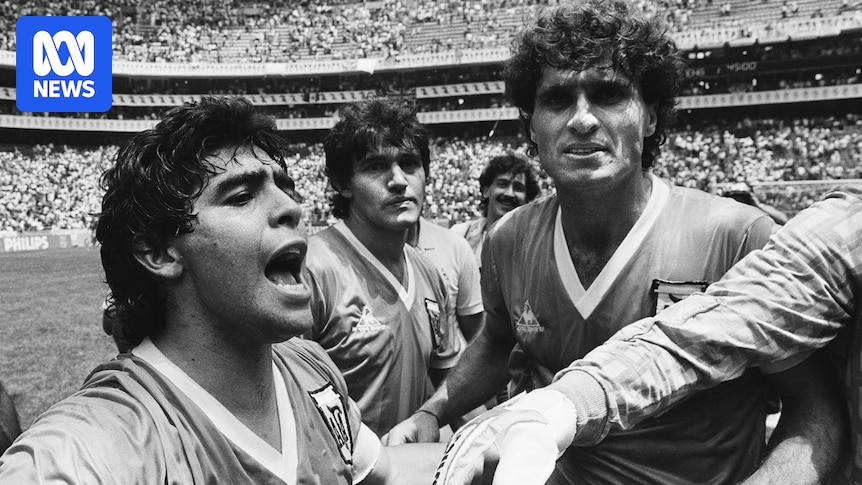
Diego Maradona made the most controversial impact to a match in history. (Getty Images: Allsport/Mike King//Hulton Archive)
By the time to two sides met again in 1986 far more serious matters had taken place between the two nations.
After Argentina’s 3-2 extra time victory over Egypt, its English language X feed posted a video of the Albiceleste players singing in celebration.
“For the Malvinas, for Diego, for Leo’s last one,” they sang.
No conversation about England and Argentina can be completed without reference to the 1982 conflict in the South Atlantic.
The small collection of islands, known as the Falkland Islands by England and Las Islas Malvinas by Argentina, has been and continues to be the subject of a territorial dispute between the two nations.
Argentina had invaded the islands, which it has claimed sovereignty over since the early 19th century, in April.
By June it had surrendered, the 74-day war costing the lives of 649 Argentine military personnel, 255 British military personnel, and 3 Falkland Islanders.
Argentina did not forget.
In one of Argentine great Diego Maradona’s autobiographies, Yo Soy El Diego, he said that when Argentina was drawn to play England in the quarterfinals of the 1986 World Cup “somehow we blamed the English players for everything that had happened, for everything that the Argentinian people had suffered”.
“I know that it sounds crazy but that’s the way we felt,” he wrote.
“The feeling was stronger than us. We were defending our flag, the dead kids, the survivors.”
England does not have a healthy relationship with Maradona. (Getty Images: EMPICS/Peter Robinson)
In a complex world and at a politically complex World Cup, keeping sport and politics separate is a hot topic.
Back then, Argentina used the ill-feeling against British imperialism to fuel one of the most controversial victories of all time.
Comprehensively defeated in the conflict by the British, a defeat that arguably helped end Argentina’s failing military junta, the nation was avenged via the surrogacy of sport as a proxy for war — minus the shooting, that is.
Although the way at which England’s defenders sniped at Maradona’s shins repeatedly in that match may lead some to beg to differ.
Despite the attention Maradona received that day, everyone knows the infamous moment at the Azteca in Mexico City.
Diego Maradona punched the ball past Peter Shilton. (Getty Images: Allsport UK)
Steve Hodge’s sliced attempted clearance.
Maradona racing through towards Peter Shilton in the England goal.
Maradona leaping, Shilton reaching, Maradona punching.
The Argentine later claimed the infamous goal was scored “a little with the head of Maradona and a little with the hand of God”.
His blatant, bald-faced, unpunished cheating went down in history as one of the most talked about moments in sporting history.
England’s mental scarring, caused by that moment, has never truly gone away.
Although the cardiac-strained yet cathartic win at the Azteca in the round of 16 may have done so.
Beckham and Simeone
David Beckham (left) was sent off for a petulant kick-out at Diego Simeone at France 98. (Getty Images: PA Images/Adam Butler)
Fast forward 22 years and the two teams met again, this time in the last 16 in St Etienne.
Once again a moment of controversy clouded what had been a sensational contest.
With England leading 2-1 after a teenage Michael Owen scored one of the all-time great England World Cup goals, David Beckham petulantly flicked up his boot and caught the calf of Diego Simeone.
Simeone collapsed theatrically to the ground, and Beckham became a byword for English failure and its scapegoat.
Beckham would only be unshackled from it when he scored the winner from the penalty spot against the Argentines just four years later in Sapporo.
It has been 24 years since the two teams last met at a World Cup.
But absence of on-field combat has hardly softened feelings between the two nations, their fans, or their players.
Veterans groups have urged fans to keep politics and sport separate.
“Sovereignty is defended in international forums through diplomacy, historical truth and the peaceful, non-negotiable claim enshrined in our national constitution,” the 2 April War Veterans Federation said in a statement.
It is conveniently forgetting, perhaps, that Argentina’s own players regularly sing about the conflict.
Nevertheless, Atlanta police are adding extra officers and resources to the streets in the lead up to the match.
Argentina, in a nod to their past clashes, will wear their dark blue change strip in Atlanta — the same strip they wore in 1986 and 1998.
This is a sporting rivalry like no other.
The latest chapter is ready to be written.