








For many decades now, researchers have wondered if the same underwater sensors that detect earthquakes could also be used to listen to whales, monitor passing ships and even improve ocean forecasts. Researchers in Canada have demonstrated that this question is no longer hypothetical or theoretical, as a newly developed underwater sensor network deployed in the Lower St. Lawrence estuary successfully monitored seismic activity, marine mammals, and vessel traffic simultaneously. This successful experiment offered a powerful new tool for protecting endangered whales while improving understanding of underwater environments. Multiple windows into the ocean operated by one networkThe experimental system was developed by researchers from McGill University, Natural Resources Canada, Université du Québec à Montréal, and Dalhousie University, where they combined ocean-bottom seismic stations to create a continuous monitoring network capable of recording activities both beneath the seabed and throughout the surrounding marine environment. Installed in the Lower St. Lawrence estuary between 2023 and 2025, the network detected roughly twice as many earthquakes as Canada’s National Earthquake Monitoring System while also recording whale vocalisations, ship noise, tidal movements and mining blasts.Notably, one of the study’s most significant findings was the ability to separate different underwater sounds by analysing their frequencies, because of which scientists could identify whale calls occurring at the same time and location as commercial ship traffic. This provided direct evidence that vessel noise overlaps with acoustic space that whales rely on for communications. It is worth noting that shipping noise is already recognised as a major threat to several whale species, especially the endangered North Atlantic right whale. As per NOAA and the International Whaling Commission, underwater noise can interfere with feeding, mating, navigating, and communication, thus making it harder for the whales to survive naturally in busy shipping corridors.
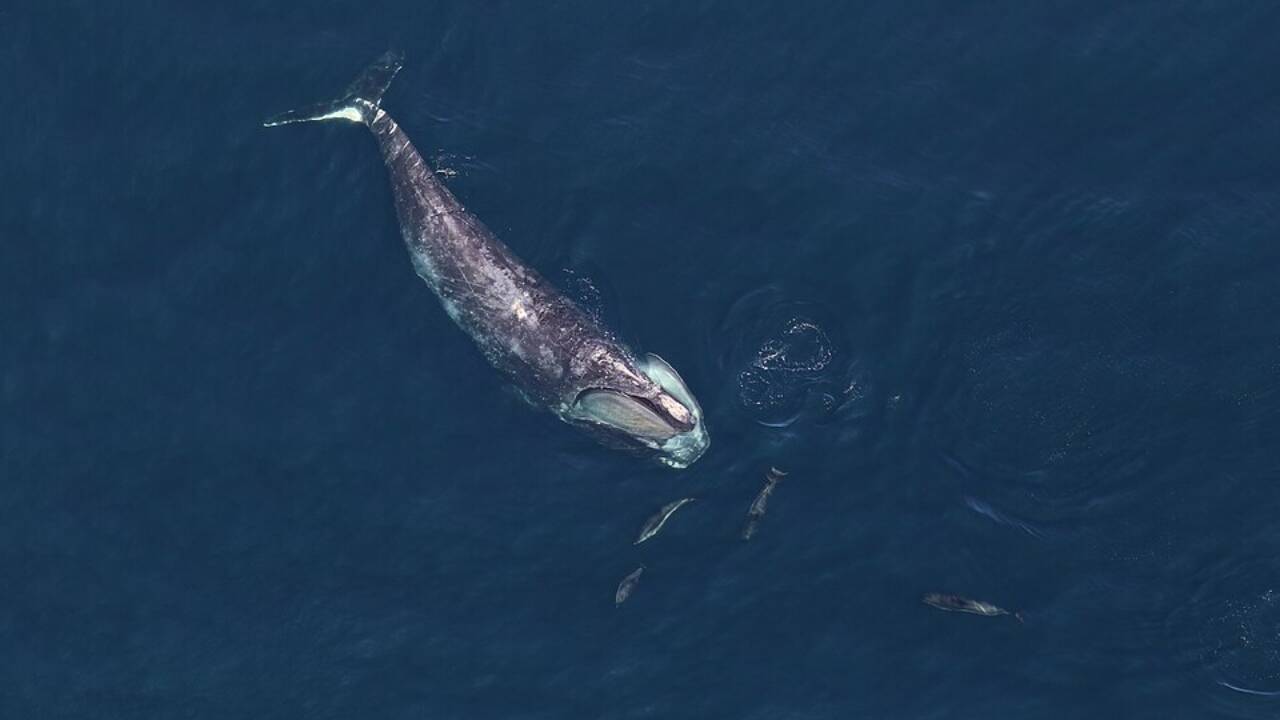
Representative image of a right whale. Image credits: Wikimedia Commons
Interestingly, while ocean-bottom seismometers were originally designed to study earthquakes beneath the seafloor, researchers found that underwater water movement and tidal cycles can also be captured through these seismometers. These observations could improve ocean circulation models, which often rely primarily on measurements taken near the surface. Furthermore, the study suggests that understanding conditions in the deeper water column might also help explain whale behaviours, as nutrient-rich currents strongly influence feeding grounds and migration routes. Therefore, a better understanding of these underwater processes could strengthen conservation planning in ecologically important marine belts. Efficient information from a single stream of dataThe researchers believe that one of the greatest strengths of this system is its efficiency, as instead of maintaining separate monitoring programmes for earthquakes, marine mammals, shipping activity, and ocean conditions, a single integrated sensor network could generate all this information, which can be useful across multiple scientific disciplines. Moreover, the deployment addressed an old limitation faced by the previous land-based monitoring systems, that is, whale calls recorded from the shore usually failed to provide complete coverage. However, placing this instrument directly on the riverbed significantly improved the detection across the estuary. With the continuous growth of global shipping and an increase in pressure due to climate change and human activity, marine ecosystems face growing stress. To combat these challenges efficiently, scientists believe integrated monitoring systems like the Lower St. Lawrence network could become an important tool for future management.