







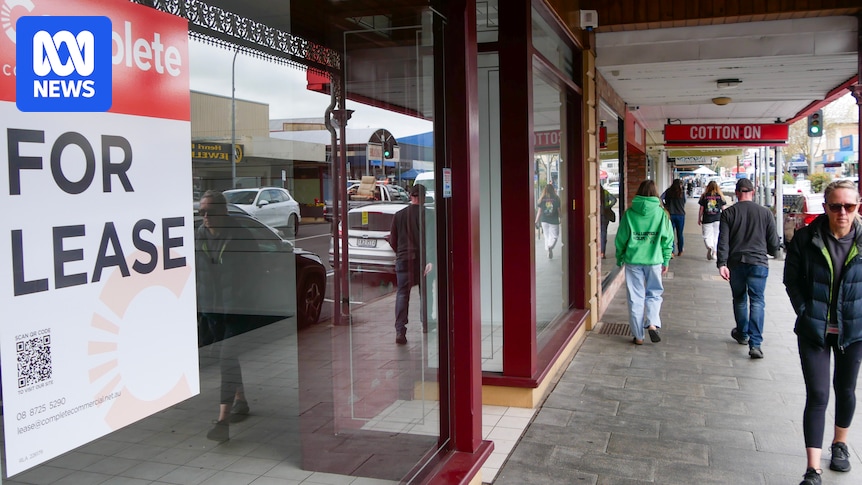
As small businesses along regional main streets close, there are calls to turn empty CBD premises into living spaces to ease pressure and diversify housing markets.
In Mount Gambier, on SA’s Limestone Coast, a number of shops have left the city’s main street in recent years, but a new regional plan has suggested “adaptive re-use of existing buildings for new housing”.
Melissa Amin and her partner bought a disused building on Commercial Street East, turning the top floor into a living space they make available as short-stay accommodation on Airbnb.
The space used to function as a dance hall. (ABC South East SA: Josh Brine)
“It was originally built as a social club/dance hall and photography studio,” she said.
“There’s been maybe a health food store downstairs, a sewing shop, potentially shoes.
“It was a jack-of-all-trades this building in its previous life … As soon as we walked upstairs and saw the view, we knew that we wanted to make it accommodation.”
Transforming the space took about 18 months. (ABC South East SA: Josh Brine)
While Ms Amin and her family live on a rural property, she said there was plenty of appeal to regional CBD living.
“I’d be quite happy to live here; that seems to be everyone’s consensus when they’re up here,” she said.
“That central living, there is something about it that you can fall in love with too.“
Ms Amin’s Airbnb overlooks Mount Gambier’s Commercial Street. (ABC South East SA: Josh Brine)
Changing housing needs
As part of the Limestone Coast Regional Plan, the state government has flagged investigating opportunities for infill in towns across the region to provide higher-density housing options.
The Adelaide University School of Management Dean, Andrew Beer, said there was not enough supply to meet current housing demands across regional Australia, let alone into the future.
Professor Andrew Beer says infill will improve regional communities. (Supplied)
Professor Beer said more urban forms of housing, or housing based around main streets, were needed as the population ages.
“You can actually generate more vibrant communities that provide both more housing, but also housing that is more fit for purpose for that particular stage of life,” Professor Beer said.
He said many different people were moving to the country, and not all of them wanted a big house and block.
“Increasingly there’ll be people coming out of inner urban environments, who very much want the peace and quiet of a country town, but don’t necessarily want to take on the challenge of a large property,” he said.
Like many country towns, Mount Gambier has seen a number of businesses leave the main street. (ABC South East SA: Sam Bradbook)
“By looking to diversify housing stock … you will see growth because new types of migrants will be attracted.“
Professor Beer said while there were challenges involved with retrofitting older commercial buildings for housing, it could save money and work.
“You’re probably going to save $200,000 just in infrastructure costs alone by not building on the fringe of a country town,” he said.
Challenges to overcome
One of the challenges with infill efforts was often community sentiment.
“There’s pushback by some members of the community who are worried about relatively minor issues like car parking or change in land use or what it might mean for their rates,” Professor Beer said.
“These communities need to see that infill-type developments strengthen their country town, rather than weaken it.
Historic regional CBDs, like Mount Gambier’s, were more dense before the invention of cars. (ABC South East SA: Josh Brine)
“Many old country towns were built at quite high density around railway lines.
“This is just returning to a different way of living and a different way in which we organise our towns and cities.”
Ms Amin said she thought attitudes around higher-density housing were shifting.
“It’s not always everyone’s dream to have the house and the block,” she said.
“They may want the low maintenance and the energy you can get from living in the middle of the city, and Mount Gambier’s not any different.”
SA Housing Minister Nick Champion said the push for more infill came out of public consultation, as more people looked to “age in place”.
Nick Champion says increasing regional housing supply is vital. (ABC News: Briana Fiore)
“We’re not forcing it on anybody, but it’s something that’s come out of the feedback that people need and want this housing,” he said.
“We just have to adopt a case-by-case scenario for each town as we go forward.”