







Software engineer Benjamynn Weber has always struggled whether to disclose his autism to potential employers.
“It’s always a question like, ‘Oh, should I tell them that I have autism?'” he said.
“I’m always aware of the stigma against people with autism.”
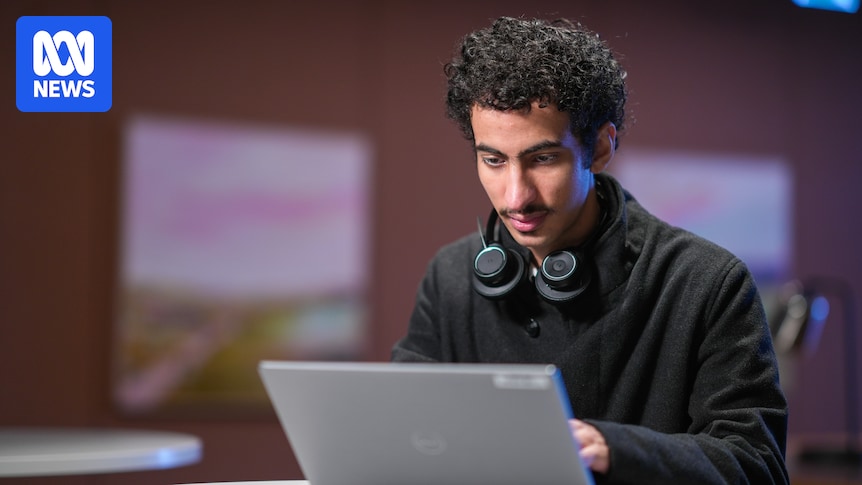
Ben Weber feels more confident in his industry after being a part of the initiative. (ABC News: Nicholas Martyr)
But it’s not something he has had to grapple with since he completed a program at Perth’s Curtin University aimed at preparing young autistic people for a career in one of Australia’s most critical industries.
The Autism Academy for Software Quality Assurance (AASQA) program provides training and pathways for autistic people aged over 18 to pursue careers in a variety of tech industries such as robotics, automation, cyber security, data science and artificial intelligence.
The program helps people with autism find work in tech sectors. (ABC News: Nicholas Martyr)
Program founder Tele Tan says autistic people well-suited to cyber security jobs because they are systematic, logical thinkers.
“They like rules and cybersecurity software testing is a rule‑based process, and they definitely are very good at that at a cognitive level,” he said.
“In terms of technical skills, they are very curious about how things work and are very comfortable with a very structured environment. And software testing is one of them.”
Professor Tele Tan sees a lot of valuable qualities in the people who go through the program. (Supplied)
Internships and more
In addition to highlighting the strengths to its students to employers, the program helps participants build confidence in the workplace.
Graduates gain industry recognised-certification and students can pursue tertiary study if they wish.
“The certification also provides a pathway into university for students who have been told they can’t do ATAR,” Dr Tan said.
The program also includes access to a specialist internship program created in conjunction with the Australian Computer Society Foundation, as well as personal support.
“We want to take special care in the internship program for the individuals and we work with the Autism Association of WA to provide that layer of support for both the interns and the organisation that’s hosting them,” Dr Tan said.
“So far, we have close to about 110 people that we actually put through to various organisations, banks, mining companies, government agencies, and consultancy firms in WA.
“These are all paid internships.”
Leveraging the skills shortage
The academy’s graduates are entering the workforce at a time when Australia is facing a long-term cyber security skills shortage.
The Cyber Security Sector Competitiveness Plan 2023 forecasts that the nation will need to fill an additional 4,813 dedicated cyber security roles each year to meet demand by 2030.
By then, the sector is projected to require about 85,000 specialised positions, representing a 66 per cent increase from 2023 levels.
That demand was part of what attracted Mr Weber to the industry, but he knew he would face barriers to getting a job.
The academy helped Ben Weber get an internship at BHP. (ABC News: Keane Bourke)
“Currently in cybersecurity it’s hard to get a job because interviewers have high expectations or they are risk-averse,” he said.
But Mr Weber said the academy program had been hugely beneficial and helped him access an internship at BHP.
“AASQA gives a lot of help for people with autism,” he said.
“They made it easier for me to feel comfortable because the companies are aware of the benefits people with autism can bring.”
Ben Weber says the course “made a huge change” in his life. (ABC News: Nicholas Martyr)
Mr Weber said he was very meticulous with technical details.
“I have a different perspective than other people, so I come up with new ideas, mainly because I have autism,” he said.
Mr Weber said the program had given him something he had never experienced in high school — a sense of belonging.
He is now employed as a junior software and security engineer at BHP.
Ben says he has a sense of belonging he has not always felt. (ABC News: Nicholas Martyr)
Mr Weber attributes his career success to his decision to look for opportunities and sign up for the certificate course.
“It made a huge change to my to my life,” he said.