







On any given day in the township of Naracoorte, the main street echoes with different accents, sporting clubs unite families from different cultural backgrounds, and local businesses reflect journeys that began across the globe.
The rural town of just 6,300 in South Australia’s South East has become an unexpected hub for those moving to Australia, with many getting their first taste of life Down Under here.
New arrivals have helped fill gaps in industries, opened up businesses in the heart of the town and boosted volunteer ranks.
New businesses have opened up in Naracoorte over the years. (ABC South East SA: Samuel O’Brien)
While the town struggles with a housing shortfall, locals believe the migrant inflow continues to benefit Naracoorte.
A stronger community and economy
Naracoorte Lions Club member Malcom McEachern said the town would be worse off in all other aspects if migrants were not encouraged to move there.
“It doesn’t matter where you go to now in rural Australia, housing can be an issue,”
he said.
“Things like the school, even the local churches … people now attend church on a regular basis and participate in those activities.”
Naracoorte resident Malcom McEachern says migration has been positive for the township. (ABC South East SA: Samuel O’Brien)
Mr McEachern said migrant settlement had boosted the town’s vibrancy.
“After the work day finishes, probably from about 4pm onwards [the energy changes],” Mr McEachern said.
“The town is actually really thriving because of all the people who have been able to come here.“
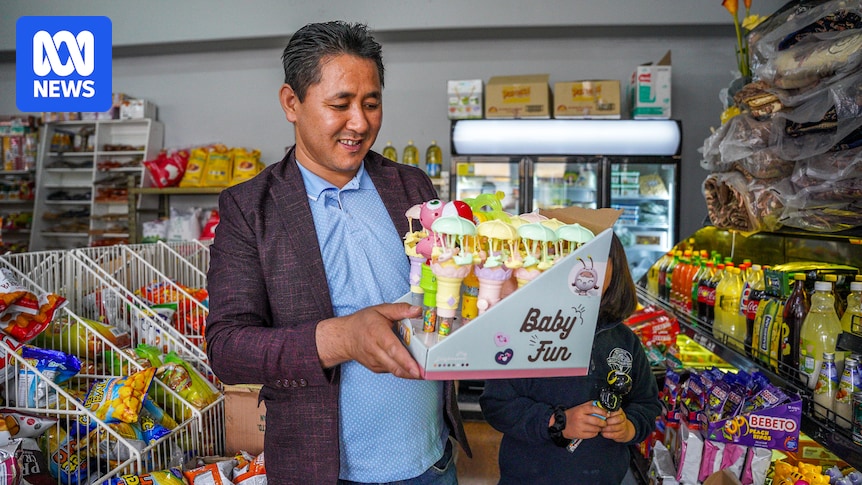
Afghan migrant Didar Ali runs The Daily Market in Naracoorte’s CBD.
The aisles are full of a variety of staples alongside specialty ingredients, catering for the different migrant groups who live in the area.
Didar Ali has been running his store The Daily Market in Naracoorte’s CBD for many years. (ABC South East SA: Samuel O’Brien)
Between a steady stream of customers, Mr Ali said many migrants have been encouraged to start businesses in the town.
“When we came here [in 2011], there were fewer migrants in this town, but now the population is growing more,” he said.
“There’s more businesses coming to the town as it grows.
“[People] like to see different food and they’re happy to come here.”
Didar Ali says the population of Naracoorte is growing. (ABC South East SA: Bec Whetham)
Part of the community
Further out of Naracoorte, Totiria Ngatau is unbothered by wet conditions as she keeps an eye out for invasive boneseed shoots she can pull out of the ground.
Ms Ngatau is one of many Kiribati migrants who volunteer on their days off to help clear the damaging South African species from the Bool Lagoon, about half an hour away from town.
Totiria Ngatau has learnt the best techniques for removing weeds without disturbing the soil. (ABC South East SA: Samuel O’Brien)
“When I first came to Naracoorte, the president of our Kiribati community was approaching me with anything happening around in Naracoorte,” she said.
“I [was] very interested with that because I can see that the nature is very different.“
Totiria Ngatau says she has developed an understanding of the Australian environment. (ABC South East SA: Samuel O’Brien)
Hundreds of migrants like Ms Ngatau have kept unique initiatives and events in the community running, but not without help.
Frances Kirby manages Naracoorte’s branch office of the Australian Migrant Resource Centre, which supports people who have recently moved to the country.
“We’re trying to help our new arrivals understand what life is like here in Australia as well as prepare the wider community to welcome them and to understand their particular needs,” she said.
Frances Kirby works closely with a variety of support services to help migrants settle in Australia. (ABC South East SA: Samuel O’Brien)
The work Ms Kirby undertook involved working with groups, making opportunities to get involved in community life accessible for all.
“We can see that a lot of our [migrants] don’t want to just wake up, go to work, go to bed — they want to be more involved in the community, and that includes volunteering,” she said.
“Volunteering is very much part of the Australian psyche, but it is for them back home as well — it just takes a different format.“
Tokateti Totoki, who works at the Teys Meatworks, has made new connections through his volunteering experience.
Tokateti Totoki has noticed his English improving as he makes new friends in Naracoorte. (ABC South East SA: Sam Bradbrook)
“I meet a lot of people here, different people, and also just to learn things that I haven’t learnt before,” Mr Totoki said.
“I’ve made a lot of friends; when I make friends, I learn things from them.”
The leader of the Naracoorte Kiribati community has helped many groups who would otherwise struggle with volunteer numbers, including the State Emergency Service, Country Fire Service and Lions Club.
“I’ve felt confident, and I’m no longer a stranger in Naracoorte,” he said.
A team made up of Pacific workers at Teys meatworks at Naracoorte’s multicultural soccer carnival. (ABC South East SA: Bec Whetham)
Migration levels debated
In March’s South Australian election, the town elected one of four lower house members for One Nation, who campaigned on a platform of cutting migration.
Federal Liberal MP Tony Pasin, whose electorate covers Naracoorte, has advocated for his party to cut deals with the minor party, saying migration needed to be reduced.
“I meet employers across my electorate who say to me, ‘we’re desperate for staff, and [finding] a place to house them [is] the handbrake’,”
he said.
“It’s not a controversial statement to say we should only open our arms and welcome people to this nation in line with the number of people that we can house.
“There can only be one Australian culture; you need to accept the fundamental tenements [sic] of Australian values and of society.”
Community leader Erica Vickery supports migration to the Naracoorte district. (ABC South East SA: Samuel O’Brien)
Local leaders tell a different story.
Former Naracoorte Lucindale Council mayor Erica Vickery pushed for an increase in migration to the town 10 years ago, creating opportunities for locals and migrants to connect.
“In my time, we found that we had a big influx of particularly the Afghan community, particularly men,” she said.
“People were a little suspicious of them because they were from a different country and certainly because they couldn’t speak the language, so communication was really difficult.
“We connected with their leaders and worked with them to see how we could help each other understand the cultural differences and to communicate.”
Locals say Naracoorte’s main street is a vibrant place to be because of migrant contributions to the town. (ABC South East SA: Samuel O’Brien)
Ms Vickery has continued the work after her role on the council wrapped up, helping coordinate resources for the migrant community as it grew.
“I’m a migrant myself, and I can still remember my parents saying that the kindness of people really made it so welcoming,” she said.
“I think that now I’m just sort of trying to give her back to the goodness that has happened to us.“