







An unfortunate side effect of the incompetent and erratic negotiating tactics of the Trump administration — not to mention the regular apparent gaming of financial markets — is that some of the underlying stories in the global economy can get overlooked.
People are kept perpetually on their toes about whether a deal with Iran has, or hasn’t been reached; whether the Strait of Hormuz is, or isn’t, open; or whether Donald Trump thinks the Iranians are “terrible people” or “good people”.
This can obscure facts such as that the world economy has not actually collapsed as had been feared.
The global oil price fell back to around $US70 a barrel this week: much better than all the hovering it was doing for months around, and above, $US100 a barrel.
It’s still above the $US50 to $US60 a barrel prevalent before the whole Iran thing started — and that continues to have inflationary effects around the world.
But whatever happens in talks between Iran and the United States, the sorts of prices now being quoted for oil reflect the fact that the global economy has somehow managed to shuffle itself around so that the 20 per cent cut in oil supply often quoted to be a result of the closure of the Strait of Hormuz has not had the heart-stopping impact that was once feared by economists and governments around the world in March.
Just why that has happened provides a fascinating insight into the way the world economy works these days.
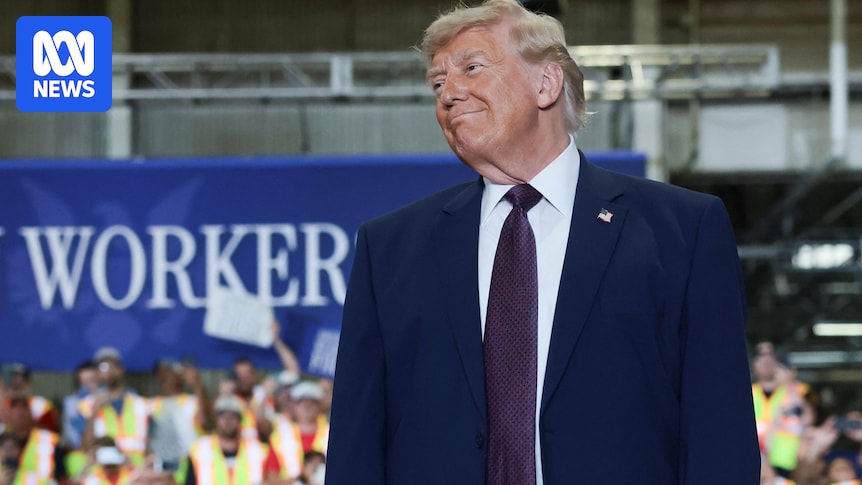
An unfortunate side effect of the incompetent and erratic negotiating tactics of the Trump administration is that some of the underlying stories in the global economy can get overlooked. (Reuters: Evelyn Hockstein)
China had oil in storage
For starters, a much-overlooked factor may be that China — one of the biggest customers for oil from the Persian Gulf — simply cut its purchases in response to the crisis by a jaw-dropping 40 per cent.
This was on top of the fact that, according to an analysis released by the International Energy Agency this week, the global oil market “went into this crisis with significant buffers”.
“In February, before the outbreak of hostilities, the IEA’s market balances indicated a surplus of 3.7 million barrels a day for 2026 as a whole,” the agency says.
“Global oil supply had been running ahead of demand for 12 months, with the amount of oil in storage reaching 8.2 billion barrels.
“China, notably, had for many months been hoovering up huge amounts of oil imports and putting them in storage.
“This, combined with demand reductions both by refiners and end-users enabled China to slash crude oil imports by 40 per cent — or 4.6 million barrels per day — between February and May, helping significantly to ease wider pressures in the global market.”
There have been other big changes, including by Australia, which started buying oil from the US and Africa, among other less previously frequented markets.
Everyone quickly diversified
Countries have quickly diversified their markets. The United States increased its crude and petroleum product exports by nearly 25 per cent compared to the previous year.
Oil exports from the now earthquake-shattered Venezuela have jumped by over 40 per cent and Brazil’s by a third.
Singapore is one of the world’s biggest oil refiners. It is now importing over 10 per cent of its crude from the United States, compared to zero previously.
Those changes are on top of the shifts that producers in the Gulf rapidly implemented to avoid the Strait of Hormuz, such as the big increase in oil that Saudi Arabia started pumping through its East West pipeline to the Red Sea, and the UAE increasing its shipments to Fujairah — a port outside the strait.
This rapid capacity to adjust away from reliance on particular suppliers seems to have been a feature of many recent crises caused by global conflicts.
The German economy appeared to be on its knees after the Russian invasion of Ukraine in 2022, with the simultaneous closing down of oil and gas exports from Russia upon which Germany, and much of the rest of Western Europe, relied.
Within months, Germany had three floating LNG platforms in place. It had five processing centres operational within 12 months.
Crises like that one in 2022 seem to have made many countries much more focused on a diversity of energy supply options.
Analysts say the switch to renewables, electric power and vehicles also had a huge impact in stopping China being too hard hit by the sudden cut in oil supply.
But beyond basic shifts in supply and demand, the crisis seems to have underscored a lower overall global reliance on oil and oil products as the world economy transforms what it actually produces.
The Wall Street Journal noted last week that “advanced economies have shifted to less energy-intensive services such as finance and healthcare from more energy-hungry manufacturing”.
“Consumer appliances have been re-engineered to use less electricity and firms have squeezed out improvements in industrial processes to save energy, a lesson Europe in particular took to heart after the Russian invasion of Ukraine in 2022. “
There has also been fuel rationing, cutbacks in things like flight schedules, shorter working days and restrictions on air conditioning
The WSJ says one way to gauge how effectively economies are using energy is to calculate the amount of energy burned to generate a dollar of gross domestic product.
“Adjusted for inflation, energy intensity has fallen by about a third since 2000 in the US and Europe and by about 40 per cent in China, according to World Bank data, a shift that helps economies weather supply disruptions.”
Loading
Meanwhile in Australia
All these developments raise interesting questions about where the global economy goes from here, and about geopolitics for that matter.
Poorer countries — like some of those in our region — did not have the buffers of oil and gas reserves and have been harder hit.
Treasury secretary Jenny Wilkinson told a Senate Estimates hearing earlier this month that “some of Australia’s largest trading partners, such as China, Japan and Korea, possess large energy stockpiles and are relatively better positioned to navigate oil and fuel shortages”.
“However, other South-East Asian economies with lower energy reserves and slimmer fiscal buffers are vulnerable to shortfalls, with many already imposing measures to manage energy demand,” Wilkinson said.
There’s also the question at home about how nimble Australia has proved to be, or needs to be in the future. It was certainly able to get new supply lines opened up pretty quickly.
Relationships in the region were both tested and improved in some cases by having to deal with the shock.
That might be good cause to review how a shared interest in energy security can work for all of us in the future.
Other parts of the world will certainly have learnt another lesson.
And one of those lessons must surely be about the value of diversification — not just in actual supplies but in exposure to geo-strategic risk.
That will hold big implications for the Gulf region. As those IEA numbers show, the world was already heading towards an oversupply of oil in the period immediately before the US attacked Iran on February 28.
The pressure would seem to be for world energy buyers to be wanting to diversify away from the Gulf, rather than towards it, in the future, no matter how much Gulf countries are able to find alternative transport routes.
Loading…
Not without its economic costs
Things may never quite go back to the way they were, in other words, particularly given renewables are providing new energy sources.
The Atlantic noted this week that “although Yemen’s Houthi rebels formally halted their two-year rocket campaign against Western ships in the area last November, just half as many oil tankers are making the passage compared with 2023”.
Overall even if we have managed to avoid a global recession, higher inflation and slower growth is not a good backdrop for any society.
Of course, it is not just trade in oil that has been hit by the closure of the Strait of Hormuz.
In Australia, that can be seen by the broadening out from the oil price shock rising prices in areas like home building — just what you don’t need in a housing affordability crisis.
It will therefore help stoke the flames of frustration and anger already felt in so many countries around the world, including Australia, where people are confronted by cost of living pressures, and the apparent in ability of governments to do much about them.
Laura Tingle is the ABC’s Global Affairs Editor.