








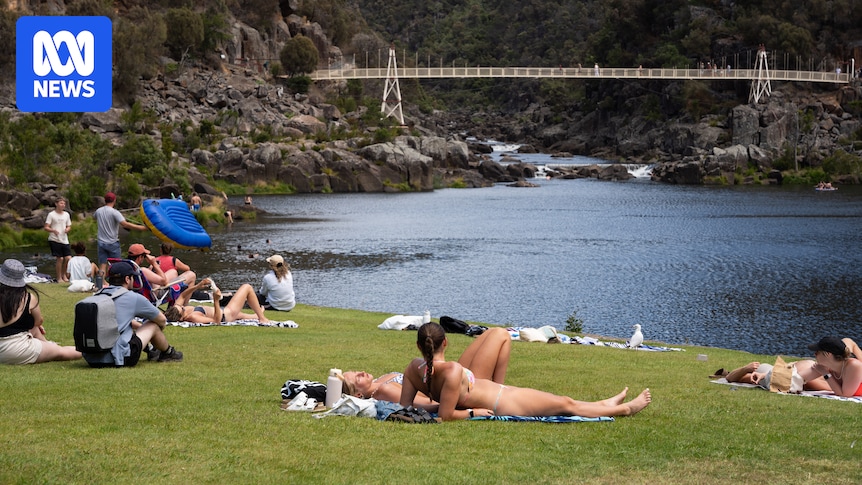
Millions of litres of improperly treated sewage were released upstream from one of Tasmania’s most famous outdoor swimming spots in a single year, recently compiled data shows.
Environment Tasmania has pulled together records from the state’s water utility, TasWater, on the amount of “untreated or partially treated” effluent released from its sewage treatment plants in the 2024 to 2025 financial year.
These “bypass events” are designed to protect sewage plant infrastructure, usually during heavy rainfall or due to power or mechanical issues.
But Environment Tasmania’s freshwater campaigner, Lucy Tremain, said they were happening at a staggering frequency, with 635,793,000 litres of improperly treated sewage released into the state’s waterways in 2024-2025.
“The amount of the volume of sewage that’s been going through this process is unacceptable,” she said.
“This is a crisis across the state, both for human health and for aquatic health.“
Lucy Tremain is concerned by the amount of sewage being released into the state’s waterways. (ABC News: Andrew Cunningham)
The data, which the ABC has verified, showed more than 27 million litres of improperly treated sewage were released from the Prospect Vale plant, upstream from Cataract Gorge, a popular swimming spot in Launceston.
Ms Tremain said even when the Prospect Vale plant treated waste properly, it was only compliant with the Environment Protection Authority’s (EPA’s) maximum recommended levels for E.coli — a bacterial strain that can be harmful to humans — half the time.
“I think anyone who’s swimming in this kind of wastewater should be concerned,” she said.
Swimming after bypass events ‘risky’, experts say
University of Sydney professor Stuart Khan, whose expertise is in water quality and treatment, said the risks associated with bypass events depended on where they occurred, how diluted the water was and how much treatment it received before being discharged.
“But raw sewage or poorly treated sewage, partially treated sewage, certainly does carry risks both to public health and to ecosystems,” he said.
“And so, yes, it’s always a concern.”
Associate professor Ian Wright, a water scientist, agreed, saying bypass events should be a “very, very rare and occasional occurrence”.
“If it’s into freshwater and there’s swimming downstream, that’s risky,”
he said.
Water scientist Ian Wright says bypass events should be minimised. (Supplied: Fleur Connick)
He said the figures around E.coli were concerning, as it indicated the presence of human or animal waste.
“[Addressing] that would be something that would be right up my priority list,” he said.
Only 16 of the state’s 77 sewage treatment plants had “bypass events” in 2024-2025, but Prospect Vale was not the only plant to release improperly treated waste near popular areas.
Ms Tremain said eight million litres of under-treated sewage was released at Rosny Point, near Kangaroo Bay, and Bellerive’s beaches on the River Derwent.
She said 10 million litres was released from Sheffield’s sewage treatment plant, which “could choke the Dodder Rivulet”, while more than 338 million litres was released from the Ti Tree Bend Plant, upstream from the Tamar Conservation Area.
She also pointed out the Riverside sewage treatment plant, also upstream from the Tamar Conservation Area, released “fully-treated” wastewater that exceeded maximum e. coli levels 93 per cent of the time.
Plans for water infrastructure upgrades worth $1.2b
Andrew Truscott, TasWater’s head of major projects, said he swam regularly at Cataract Gorge in summer.
While he said he avoided going after heavy rainfall, he would happily put his head under unless a notification from the council specifically warned not to.
“I understand how the treatment plant process works and I understand the risks associated with it,” he said.
He pointed out sewage released during bypass events had generally received some form of treatment.
“We work with the Department of Health, the local council health officers and the EPA if we ever have any occurrences where we have bypasses or non-compliant discharges,” he said.
Andrew Truscott says he is comfortable swimming at Cataract Gorge. (ABC News: Emily Smith)
But TasWater is aware its sewerage network is in “terrible shape”, with 90 per cent falling short of environmental requirements.
“And that’s why we’re undertaking this significant capital investment over the next four years, $1.2 billion, which will help improve our assets,” Mr Truscott said.
He said while Tasmania was home to only two per cent of Australia’s population, it had 38 per cent of its sewerage treatment plants, many of which were aging.
Last year, TasWater attempted to hike fees and charges 8.8 per cent each year for four years, partly to fund investment in sewage infrastructure.
But the regulator knocked it back, instead agreeing to average annual increases of up to 5.7 per cent for the next four years.
Mr Truscott said this would delay some of its improvement plans.
The customer price increase TasWater requested, in part to fund sewage infrastructure, was rejected by the regulator. (ABC News: Luke Bowden)
Upgrades to the Prospect Vale Sewage Treatment Plant are underway, although they are not due to be finished until the end of 2028.
Call for real-time alerts
Water scientist Dr Wright acknowledged upgrading any sewage treatment plants was “insanely expensive”.
“[But] Cataract Gorge, the Esk River, Tamar River, they’re amazing gifts of nature,”
he said.
“They’re some of the most beautiful waterways in Australia and they deserve the best possible treatment.”
Ms Tremain believes, in the interim, Tasmanians should at least be warned about bypass events, and suggested a real-time alert system used in other parts of the world.
“In the UK, they have apps available which will notify the public … within one hour of a bypass event occurring or starting to occur, so people can make informed decisions about whether they swim that day or not,” she said.
She said Environment Tasmania was launching a petition, calling on Tasmanian Health Minister Bridget Archer to commit funding for a real-time monitoring program.
She said it had also launched an interactive map, showing areas where bypass events had occurred, to help water users.
“This will not only show where these sewage pollution events are occurring, but we’ve also created a traffic light system to rank sewage treatment plants based on their compliance across three measures,” she said.
A government spokesperson said TasWater’s incident response procedures required notification of significant spills to local councils.
They said local councils monitored water quality at popular swimming sites, and Cataract Gorge (First Basin) was monitored weekly by the City of Launceston from November to March.
Where water quality was found unsuitable, warning signs were installed and updates published on the council website.
The spokesperson said the EPA may notify the health department of significant spill events where there was a potential risk to public health.
The Launceston City Council and Environment Protection Authority Tasmania have been contacted for comment.