




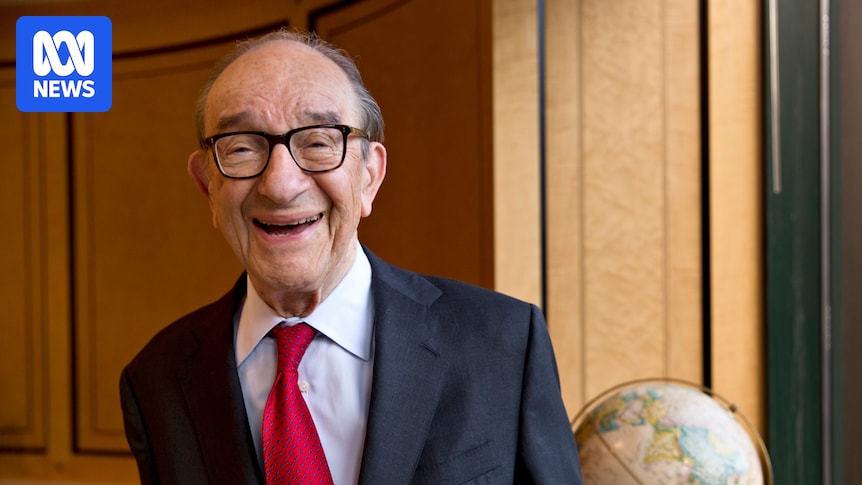
Alan Greenspan, the jazz-playing US Federal Reserve chair, who was celebrated for engineering a decade of prosperity but later shared the blame for a devastating financial crisis, has died aged 100.
Greenspan died from complications of Parkinson’s disease, said his wife of 29 years, NBC News correspondent Andrea Mitchell.
“To me, he was my husband, who shaped my life from our very first date in 1984,” Ms Mitchell wrote.
“He had ‘irrational exuberance’ for baseball, the Washington Commanders, tennis, golf, and music, especially jazz. He will be remembered for his brilliance and his kindness. Being his life partner was the joy of my life.”
Ronald Reagan and Alan Greenspan in 1987. (AP: Barry Thumma)
The Fed (Federal Reserve) said Greenspan helped to cement trust in the Fed during a time of economic uncertainty.
“Under his leadership, the Federal Reserve achieved a sustained era of price stability that supported economic growth and helped anchor the public’s confidence in the institution,” the central bank said in a statement on Monday, local time.
Greenspan hailed as ‘Maestro’ before crisis hit
Greenspan presided over a breathtaking surge in stock prices and a 10-year economic boom that started in March 1991 in his 18 and a half years at the Fed.
He was celebrated as “Maestro” and “Oracle”, an economic virtuoso whose every utterance was dissected for clues on where interest rates and the economy were headed.
The intense scrutiny of Greenspan’s intentions gave birth to new Fed folklore: the “Briefcase Indicator”.
A stuffed briefcase carried into Fed meetings implied changes might be afoot because Greenspan carried with him charts and research to make his point.
Alan Greenspan in 2010, before the Financial Crisis Inquiry Commission (FCIC) hearing examining the causes of the collapse of major financial institutions. (AP: J Scott Applewhite)
But his reputation began to suffer almost as soon as he left the Fed in 2006. American housing prices tumbled rapidly, causing huge losses for banks that had repackaged mortgage loans into a dizzying array of complex securities.
The growing financial crisis pushed the US economy into the Great Recession of 2007-2009, the deepest downturn since the 1930s.
Critics blamed the devastation on Greenspan’s easy money policies and his support for deregulated financial markets.
Greenspan himself later acknowledged “I made a mistake” in assuming that banks could essentially regulate themselves.
Greenspan became authoritative voice on US economy
For almost two decades, it seemed that Greenspan could do no wrong. Not only in the United States but across the world, he was regarded with a mixture of reverence and awe. Many openly dreaded the day when he would leave the Fed.
Investors hung on his sometimes inscrutable observations. In the most well-known such remark, Greenspan sent financial markets reeling on December 5, 1996, when he suggested with just two words — “irrational exuberance” — that stock prices were too high.
Mindful of his power to move markets, Greenspan typically resorted to obfuscation.
At times, he even joked about his habit of doing so. “I know you believe you understand what you think I said, but I am not sure you realise that what you heard is not what I meant,” Greenspan once told a befuddled congressional committee.
Greenspan was one of the few Fed chairs who Kevin Warsh, chosen by US President Donald Trump to lead the Fed, praised at his swearing-in last month.
Before Greenspan, investors had to divine the Fed’s intentions from market changes. Greenspan also began to release minutes and even full transcripts of meetings, though those changes were in response to pressure from Congress.
A protégé is born
Born in the Washington Heights neighbourhood of Manhattan, the young Greenspan was a maths whiz who was trotted out by his mother to show off for visitors.
“I was a prop at parties,” he said in a 2007 interview with PBS NewsHour.
A Juilliard School dropout, he worked as a professional musician in his teens, playing clarinet and saxophone alongside the future jazz great Stan Getz.
It was a humbling experience that persuaded the young Greenspan to seek another line of work.
He pursued undergraduate and graduate studies in economics at New York University, eventually earning a doctorate there.
For most of three decades, he ran an economic consulting firm.
During the 1950s, he became a disciple of the libertarian philosopher Ayn Rand, who stuck him with the nickname the “Undertaker” for his dark clothes and quiet bearing.
When Greenspan was sworn in as then-US president Gerald Ford’s chief economic adviser in 1974, Mr Rand stood beside him.
An early trial for a new Fed chair
Former US president Ronald Reagan tapped Greenspan to run the Fed in 1987. He was tested almost immediately.
On October 19, 1987, which came to be known as “Black Monday”, the stock market suffered the worst one-day percentage loss in American history just two months into his term. The Dow Jones Industrial Average plunged 22.6 per cent for reasons that remain opaque to this day.
Greenspan was credited with helping restore stability. He assured Wall Street that the Fed would supply as much money to the financial system as was needed to restore calm. Stocks recovered, and the American economy emerged unscathed by the market crash.
During his tenure at the Fed, Greenspan drew praise for presiding over what was at the time the longest economic expansion in American history. (It was later surpassed by a 128-month expansion that ran from June 2009 through February 2020.)
Alan Greenspan (middle) with George Bush and John Sununu in the Cabinet Room of the White House in 1991. (AP: Doug Mills)
During Greenspan’s tenure at the Fed, the nation’s unemployment rate briefly dropped below 4 per cent for the first time since 1970.
And inflation, which had bedevilled the United States and much of the global economy during the 1970s, was remarkably dormant during Greenspan’s chairmanship, something many economists thought impossible for so long a period.
During the long boom, Greenspan argued that improvements in technology had made the economy so efficient that it could run faster and at lower rates of unemployment without unleashing inflation.
As a consequence, the theory went, the Fed could keep interest rates low even when the economy was roaring.
The economy soared in the late 1990s, expanding by 4 per cent or more for four straight years, and Greenspan was credited with holding off on rate hikes and allowing the boom to run.
A passion for numbers and life
As Fed chair, Greenspan relished poring over obscure economic data, from monthly boxcar loadings to steel production, all in a bid to assess where the economy was going.
He would often phone economists at other government agencies to discuss details. He would rise early each morning for a two-hour soak in his bathtub, a time that he used to review statistics and Fed staff memos.
Alan Greenspan escorts Andrea Mitchell as they arrive at a social event in 1995. (Reuters)
Improbably, Greenspan also made the gossip pages as an unlikely ladies’ man. He dated the television journalist Barbara Walters and later married Ms Mitchell after a 12-year courtship. They had no children.
Life after the Fed
In the years after stepping down as Fed chairman in 2006, just shy of his 80th birthday, Greenspan kept busy doing what he loved to do most — following the economic data. He ran his own consulting firm, Greenspan Associates, through which he dispensed advice to Wall Street clients and collected handsome speaking fees.
He kept up a busy schedule well into his 90s, writing his memoir and two other books on the economy, as well as opining on the latest economic developments on television news shows.
He also signed onto opinion articles and statements defending the Federal Reserve’s political independence from Mr Trump’s ongoing attacks.
Alan Greenspan speaks at Brookings Institution forum Achieving Strong Economic Growth in Washington in 2015. (Reuters: Yuri Gripas)
In January 2026, he signed a statement criticising the Trump administration’s investigation of Fed Chair Jerome Powell.
The statement, which was also signed by two other former Fed chairs and five former Treasury secretaries, called the investigation “an unprecedented attempt to use prosecutorial attacks to undermine” the Fed’s independence and warned it would have “highly negative consequences for inflation”.
In his 2013 book The Map and the Territory, Greenspan defended himself against critics who assigned him significant blame for the 2008 financial meltdown.
He argued that traditional economic forecasting was no match for the irrational risk-taking that can feed catastrophic price bubbles.
“Bubbles go up very slowly as euphoria builds,” Greenspan said in a 2013 interview with The Associated Press. “Then fear hits, and it comes down very sharply. When I started to look at that, I was sort of intellectually shocked.”
AP