








The UNESCO World Heritage-listed Ningaloo Reef is showing its first signs of recovery after a devastating year.
The damage began when the coastline experienced an extended marine heatwave that triggered Western Australia’s worst bleaching event on record.
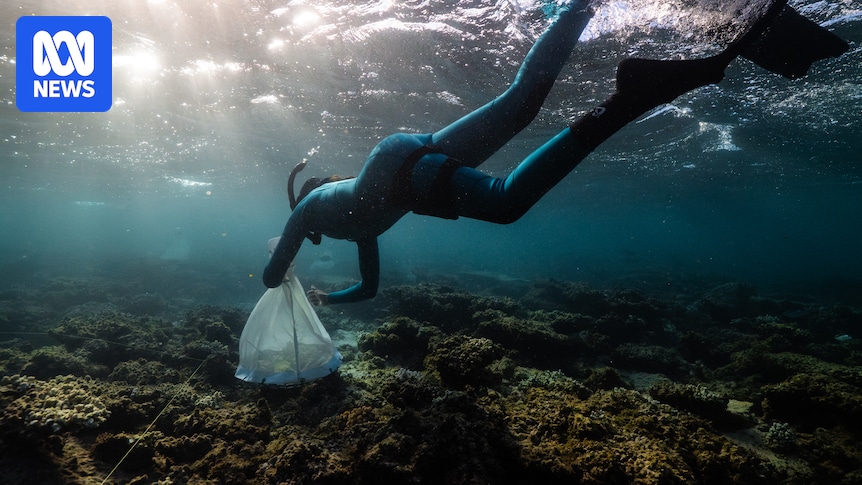
Researchers at the Western Australian Marine Science Institution (WAMSI) subsequently began a Ningaloo coral larval enhancement trial to restore the reef to its former glory by growing baby coral, or planula, on the reef.
When Cyclone Narelle hit the north-west coastline in April, they feared their efforts might have been lost, but instead they were “blown away” by the coral’s resilience.
“The cyclone basically tracked the reef at Exmouth where we had done all of the hard work,” chief executive Luke Twomey said.
“The scientists went back a couple of weeks after the cyclone and all of the little tiles with baby corals were still in place.”
Researchers from the Australian Institute of Marine Science, CSIRO, Southern Cross University and Department of Biodiversity, Conservation and Attractions collected planula across two mass spawning events in Exmouth and Coral Bay, about 1,250 kilometres north of Perth.
Marine researchers and scientists from various organisations collaborated on the project. (Supplied: Brooke Pyke)
These were then cultured in floating nursery pools before being released onto damaged sections of the reef.
“Mostly what we are doing is, we are giving nature a helping hand by collecting the coral spawn when it happens,” Dr Twomey said.
Protecting reef economy
Scientists say the survival of the coral reef is essential not just for the marine wildlife it attracts, but also for the local economy that relies on it.
Spawn cones were used to gather baby coral in Bundegi Reef. (Supplied: Brooke Pyke)
CSIRO marine ecologist Damian Thomson said projects like these were well supported by nearby residents, many of whom relied on the reef’s tourism economy.
“Local businesses and local operators recognise the benefits of maintaining a healthy reef,” Dr Thomson said.
Damian Thomson at Ningaloo Reef after it was bleached. (Supplied: Violeta J Brosig)
“Tourism in the region is largely dependant on people being able to see and experience healthy reef systems.”
Marine research and charter vessel business Pelagia Marine Services is one such business.
“There are many tourism operators that operate out of Exmouth by taking thousands of people out to the reef each year,” co-owner Jessica Strickland-Coe said.
“They are all relying on species that are supported by healthy coral reefs.
“So it is absolutely fundamental to the economy of Exmouth and Coral Bay, the residents that live here and the many businesses that the reef supports.“
Dr Strickland-Coe said many businesses were still feeling the effects of Cyclone Narelle and an unhealthy reef would only make that worse.
“Without a healthy Ningaloo Reef, it’s hard to say what the exact impacts will be down the line for many businesses,” she said.
“And we’re talking about businesses, not just tour operators that take people out to see the reef but others like tourism accommodations, tackle shops, camping shops, fuel supplies and other stores that rely on tourism.”
Jessica Strickland-Coe, pictured with Pelagi Marine Services co-owner Sam Coe, says many tourism operators rely on the reef. (Supplied)
Problem far from solved
While the baby corals were a sight of joy, scientists still fear the issue faced by the reef is far from solved.
Australian Institute of Marine Science researcher James Gilmour said the bleached coral reef was a confronting sight.
Widespread coral bleaching was observed at Ningaloo Reef last year. (Supplied: Brooke Pyke)
“We knew that bleaching and climate change had caught up with Western Australian reefs, and with carbon emissions continuing to increase, the bleaching will continue to increase,” Dr Gilmour said.
“The regeneration is really a way for us to slow the degradation and improve the condition of the reef until those causes are addressed.”
James Gilmour with Damian Thomson. (Supplied)
The coral reef, currently in its juvenile state, would require constant monitoring over the upcoming years.
Dr Thomson said they would be monitoring the success of the work being done and use it to inform future work.
“Corals grow very slowly so we need to be conducting the work over much larger spatial areas and repeat it year after year until it becomes cumulative,” he said.