







Coreflow is a little-known company, but its job ads promise eye-watering salaries.
Warning: This story includes a description of sexual violence and references to child abuse material.
The tech startup, based in Sydney, offers up to $450,000 a year for someone to join its “growth” team and help get its AI product to “hundreds of millions of users”.
For an engineer, it’s paying up to $800,000 a year.
In its ads, the company boasts of attaining 20 million users worldwide since launching last year, and staff call it “the Netflix of AI”.
The startup has serious ambition: to bring about a revolution in entertainment, where users don’t just consume but create their own highly personalised content.
What its job listings don’t mention is that the entertainment is pornography.
Coreflow is recruiting engineers to help run what’s been ranked as the biggest AI porn website on the internet, OurDream.
The website has strict prohibited content protocols and says it prioritises safety. It explicitly bans copyrighted characters, deepfakes, and — crucially — content depicting children.
OurDream’s site contains a page listing several categories of prohibited content. (Supplied)
One of the categories prohibited by the website relates to depictions of character under 18 years. (Supplied)
But when the ABC looked into the rapidly growing startup, it found its technology was producing disturbing results.
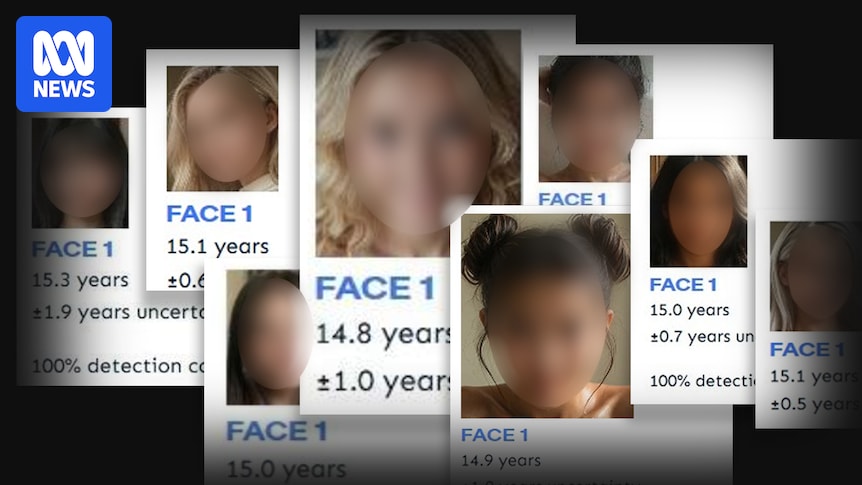
The ABC identified 11 female AI-generated “companions” on the site that appeared to be 15 years old or younger, according to age-estimation technology.
The adolescent-looking avatars aren’t real people.
But Colm Gannon from the International Centre for Missing and Exploited Children (ICMEC) said there was real harm in people engaging with them.
“They become familiarised with the childlike identity engaging in sexual talk, and then it actually can cause escalation in harmful behaviour,”
he said.
What started as a story about the rise of a new AI empire became an investigation into whether the website could be breaching laws against child sex abuse material.
Within weeks, police were at the ABC to investigate the material uncovered.
Videos on site ‘deeply unsettling’, user says
OurDream’s promise to customers is simple: use the power of artificial intelligence to bring your fantasies to life.
Its huge customer base has vaulted it into the top 50 AI sites globally, with the site generating more unique monthly visits in January than Google Labs and Meta AI.
The website is heavily advertised on social media and other pornography websites.
One user, Matt, a man in his 40s who lives in the US, says it “feels almost like a choose-your-own adventure novel”.
“I have a job and a life so this is for me to keep myself entertained,” he says.
Matt says he uses the website in the hour between when his family goes to bed and he does.
“It does what AI does … it engages you and so you can feel rather addicted to it,” he says.
“You can certainly spend a lot of your life on this if you really wanted to.”
Users can build their AI companions from scratch, choosing everything from their body to their backstory.
Or they can pick from a library of companions built by other users, and approved by OurDream.
The site carries character profiles with head shots, age, gender and backgrounds.
There’s a 55-year-old corrupt Democratic senator from the American south who “controls a web of dark money”, an elite Brazilian competitive swimmer chasing her Olympic dream, and a young woman who users supposedly meet at a Queensland McDonald’s.
For $170 a year, customers can generate explicit images, videos, and unlimited conversations with the AI companions.
Matt says the companions often look realistic, more like a photo of a real person than an AI image.
And that made it “deeply unsettling” when he noticed some user-generated videos seemed to breach the website’s rules against violent content.
He remembers seeing one in which an AI character was pepper sprayed.
“She was tied up and sprayed in the eyes, and then rather violently set upon,” he says.
He reported the content to moderators, but it “continued popping up for days”.
“I think the last time I sent in [a complaint] I just typed in the little comment box: ‘Who is making this? Why are they on this site?'” he says.
And when the ABC went digging through the website, it didn’t take long to find material that raised the question of whether police needed to be informed.
Age-estimation tool detects characters that appear underage
The first character was a female from the Philippines, whose image sat on OurDream’s public-facing home page, which features only fully clothed characters in non-explicit depictions.
It looks like a photo of a girl in her early teens.
The ABC showed the image to ICMEC’s Colm Gannon.
“Straight away there’s alarm bells ringing here,” he said.
Mr Gannon ran the picture through Rigr — an online age estimation tool used by governments and law enforcement in more than 20 countries to assess the ages of minors appearing in images.
Rigr assessed the OurDream character’s age to be 15.1 years old, with a margin of error of 1.1 years on either side.
“Straight away, that is a minor, that’s a person under the age of 18,” said Mr Gannon, who previously worked for Rigr.
OurDream’s site says it prohibits any sexual depictions of individuals under the age of 18.
“We do not host content depicting minors. Ever … This includes … any character that, in body proportions, reads as a minor regardless of stated age,” the website reads.
But after browsing the website for just one hour, the ABC found at least 16 other characters that Rigr deemed to be 15 years or younger, before taking into account the tool’s margin of error.
Even taking into account the upper limit of the error margin, 16 of the AI companions were assessed to be 16 or under, and the oldest was assessed to be 17.2 years at the most.
Australian Commonwealth law bans the depiction of children under the age of 18 in a sexual context.
All of the characters were found in the site’s hardcore pornography section, behind OurDream’s age verification page.
Most of them were in sexually explicit depictions and all of them were in sexualised situations.
Mr Gannon said it was “a massive red flag”.
“It’s actually for guardrails around the development of this — I would be having a serious talk about who’s actually the engineers,” he said.
“ If this is an AI companion that is actually tending to support or promote the sexual exploitation of children, it can actually cause people who are using the application to overcome the conscious barrier to actually sexually offending against children.”
The ABC considered the question of whether the website should be named in reporting. Mr Gannon said doing so was of public benefit, as naming a site could put pressure on it and others in the industry to combat the problem.
He said the growing prevalence of online child sexual abuse material had made it important to call out problems with major players in the porn industry.
As website grew, insider says moderation proved difficult
OurDream is the brainchild of four young tech entrepreneurs with impressive resumes.
Three of them — Justin Phu, Nishan Samarasinghe, and Scott Dommett — went to Sydney University, where they were high achievers. Their American co-founder, Mirza Azum Beg, graduated with highest honours from Duke University.
Together, they have worked across Meta, Mastercard, venture capital, and the Silicon Valley startup scene.
Their latest venture, reportedly drawing more than 48 million unique visits a month, is by that metric the world’s biggest AI porn site.
There is little in the public realm to connect OurDream to Coreflow.
But there are clues when people sign up to the site. The contract that users agree to mentions two companies — Dream Studio USA and a Cyprus-based company called Tektopia.
Company documents show Coreflow is owned by Dream Studio USA. As is Tektopia. Dream Studio USA’s company officer is Coreflow co-founder Mirza Azum Beg.
In response to questions the ABC directed to Coreflow, the group of companies says it is “proud of its Australian footprint and will continue to invest in recruiting and employing Australians in what is a fast-growing global industry”.
The Australian startup has 16 staff but it occupies a large office in North Sydney.
It began operating last year out of a $13 million house on the water in Neutral Bay, Sydney.
The property rents for just under $3,000 a week and has a private pool overlooking Sydney harbour.
James, who has knowledge of the company and spoke about its operations on condition of anonymity, says the founders lived there with their partners, and worked alongside staff in a “frat house” atmosphere.
The insider, who asked not to be identified by his real name, says the company discovered early on that some OurDream customers were using the site to generate child sex abuse material.
This involved characters, both “boys and girls”, that looked younger than 10 years, he says.
James says Coreflow “deleted a lot of material” but could not stop some users downloading images and videos of the characters they’d generated.
“The company was very aware of what was going on and it was very much trying to prevent generation [of underage characters],” James says.
“[But] by the time it was aware, the users potentially generated a lot more images than it thought.”
That means an unknown amount of potential child sexual abuse material already generated by users of OurDream could now be on the internet, according to James.
He says there were talks inside Coreflow about “moderation and steps to be put in place to try and prevent it”.
They included automated monitoring of user text prompts for alarming words or character settings, he says.
The company also relies on human moderators to vet content.
Some of those moderators are users of the site.
According to James, it means some characters are published on OurDream with the approval of people who are not fully vetted, paid or formally employed by Coreflow.
“Every character that went public, it’s passed through a series of moderators who would either approve or deny it … moderators who are just online anonymous people that are supportive of the website,” he says.
“There’s definitely things still going through the cracks, if you’re seeing it.”
At the same time, he said, business was booming.
“There were a lot of users and there were a lot of payments going through,” he says.
“As any startup, their main priority is generating more money.”
In the statement to the ABC, the group of companies said there had “always been a zero tolerance approach to unlawful content”.
“There are significant controls in place to prevent the generation of unlawful material, including [child sexual abuse material],” the group said.
“This include[s] external tools and software [and] proprietary systems.
“The group invests heavily in content moderation and takes reports of inappropriate content very seriously and expeditiously.
“These measures have been in place from the outset, and the group has never compromised them for revenue.”
‘That needs to be stopped’: Former anti-child abuse detective
The ABC’s age-estimation testing of OurDream characters indicates Coreflow is falling short of its promises regarding potentially unlawful content.
According to former Queensland detective Jon Rouse, the startup may also be breaking the law.
Mr Rouse set up and led Taskforce Argos, the world-renowned operation targeting online sex crimes against children.
()
In Australia, child sexual abuse material is defined as material that is likely to offend a reasonable adult, and is a sexualised depiction of a person, or a representation of a person, who is or appears to be a child.
In states like Queensland, that’s anyone who appears under the age of 16.
Under Commonwealth law, that’s anyone who appears under 18.
The material doesn’t need to show a real person. Cartoons, anime, and text conversations can break the law. Artificial intelligence has created a new category of material to prosecute, but the existing laws capture it.
The ABC couldn’t show Mr Rouse the sexually explicit images it found on OurDream — doing so could be unlawful in itself.
But, hearing the images described to him, Mr Rouse said he believed they were child sex abuse material.
“Based on what you’ve described, this would constitute a criminal offence at both a state and federal level,” he said.
“ If the user base is national, then you’d certainly look at probably applying Commonwealth law. And then this would obviously then require referrals to … probably to Interpol to coordinate a global investigation.”
()
Mr Rouse said that both the users of the site who had generated the images and the company could be criminally liable.
He said the ABC was legally obliged to report the images to police.
“Based on the scenario that you’re giving me here, you’ve got an application that can, at scale, potentially produce child sexual abuse material,” he said.
“That needs to be stopped, and the users that have done that need to be investigated.”
Police confirm ongoing investigation
The ABC spoke with senior officers at Taskforce Argos and made a formal report to Queensland police last month.
Days later, a detective arrived at the ABC office in Brisbane’s South Bank.
He left with a USB drive containing 17 images and videos depicting suspected underage AI characters that the ABC found on OurDream’s website.
“ I’ll have a look at it and I’ll do all of my assessment,” the detective said.
“Worst case scenario, if I go in there and I’m like, ‘Yes, there is something in there,’ I’ll put a referral package together.”
Later, in questions to the operators of OurDream, the ABC was able to include a link to one of the characters deemed underage by the Rigr age-estimation technology.
Within days, that character was removed from the site.
The group operating the site says it “understands and carefully considers its legal and ethical obligations, including with regard to reporting certain matters to relevant authorities”.
However, 15 of the characters found by the ABC and assessed to be underage by Rigr remained on the site.
The police investigation is ongoing.