






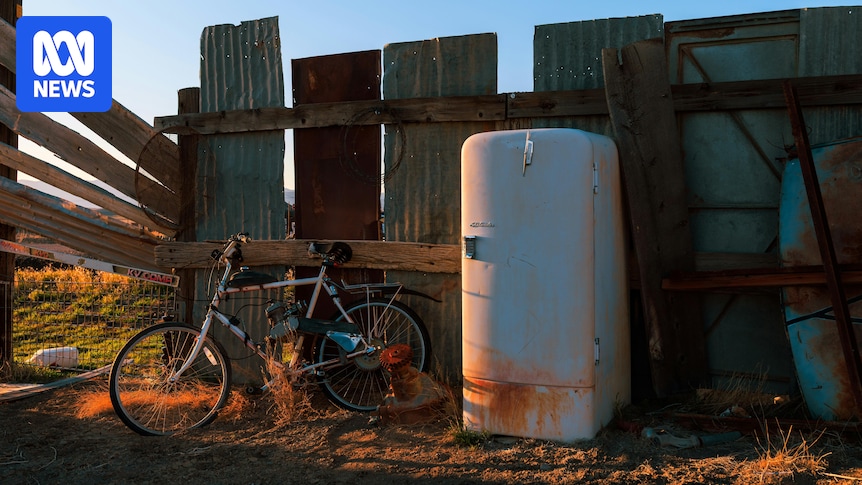
A few weeks ago, my mum asked me to help get rid of the “beer fridge” in her garage.
This old, yellowing piece of equipment was the first fridge my parents bought when they moved in 1998. Almost 30 years later, it seemed to still be going strong.
But this trusty fridge had an environmentally damaging secret.
Like many old fridges, it contained a cooling fluid made with hydrofluorocarbons (HFCs).
While HFCs can help keep your milk and cheese cold, they can also be a big problem for global warming as your fridge gets older and leakier.
Most people don’t really know it’s a problem with their refrigerators, according to chemical physicist Christopher Hansen at the University of New South Wales.
“The average well-meaning person probably has no idea the thing they’re throwing out is full of this very environmentally damaging gas,”
he said.
That means getting rid of an old fridge isn’t simply a case of dumping it in a landfill, but depending on where you live in Australia it’s not always simple to find an alternative option or a free one.
The rise of HFCs
Fridges and other white goods didn’t always contain HFCs.
They used to contain chloroflurocarbons (CFCs). But back in the 70s, it was discovered that CFCs were destroying our ozone layer.
These gases were banned internationally, and their concentration in the atmosphere has begun to decrease in recent years.
Manufacturers began using other synthetic refrigerants, eventually replacing CFCs with HFCs in the 1990s.
These shiny new HFC refrigerants were stable, they didn’t destroy the ozone layer, and, like CFCs, they mostly weren’t flammable — meaning they were still safe for technicians to use and install.
But it was discovered in the 2010s that HFCs were also potent greenhouse gases.
In 2016, an international agreement was made to phase down the production and use of HFCs. For the countries that agreed, there are increasing limitations on how much HFC-based refrigerant they can produce and, for countries like Australia, how much they can bulk-import.
But this only applies to in gas cylinders — under the agreement, countries don’t need to ban or limit the imports of equipment containing these refrigerants.
While many newer refrigerators use non-HFC gases like isobutane, some refrigerators on the market may still use HFCs.
Australia has begun to ban some appliances, such as small split air conditioners that use certain HFC-based refrigerants.
The agreement also doesn’t address what to do with appliances containing HFCs once they no longer work.
“If we didn’t do anything about [limiting HFC usage], we were going to increase the temperature of the world by between a quarter and half a degree this century, just from HFCs,” Dr Hansen said.
How do I know if my fridge contains HFCs?
If you want to know whether your beer fridge or a fridge you’re interested in purchasing uses HFCs, the appliance’s manual or online specifications will often list the refrigerant used.
On the fridge itself, these specification plates or stickers can be on the door, on the inside wall of the refrigerator, or at the back of the fridge, where it will list a refrigerant number beginning with “R”.
From there, you can find what’s inside the refrigerant by looking at the Department of Climate Change, Energy, the Environment, and Water’s hydrofluorocarbon refrigerants guide.
There are about 15 different HFC chemicals on the list, such as HFC-134a, and a further 70 or so HFC blends.
Look to see if your fridge uses non-HFCs listed in the guide, such as R-600a (isobutane), instead of HFC-134a.
Every ‘beer fridge’ counts
Even though new equipment is increasingly being manufactured without HFC refrigerants, HFCs are still being emitted from appliances that contain them today.
Take the refrigerant — HFC-134a — that was used in my mum’s old refrigerator and other appliances like air conditioners.
It’s the most abundant HFC in the atmosphere, according to Paul Krummel, an atmospheric scientist at the CSIRO.
“You can see it’s just skyrocketing,” he said.
Over the lifetime of an appliance, it will start to break down and leak, meaning that by the time it reaches its end of life, in about 15 to 20 years, only around 20 per cent of its refrigerant remains.
That 20 per cent can still be captured in a gas cylinder by qualified refrigerant technicians, without leaking into the atmosphere, if the appliance is disposed of correctly.
Australia does have a program — called the refrigerant gas product stewardship scheme — that aims to recover these refrigerants before they completely leak into the atmosphere.
The scheme is run by Refrigerant Reclaim Australia (RRA), and according to the group’s general manager Kylie Farrelley, it requires anyone seeking to profit from the sale of refrigerants to also facilitate their responsible capture.
“I suppose the loophole in that is equipment owners have no responsibility,”
Ms Farrelley said.
Equipment owners can be anyone: people like my mum, who owns domestic fridges, or companies that own property with big air conditioning systems.
How to dispose of fridges and air cons responsibly
In Australia, anyone decommissioning appliances containing HFCs must hold a Restricted Refrigerant Recoverer Licence (RRRL).
It means that, for consumers, there are only a few options and schemes available for the responsible disposal of refrigerant-containing white goods.
But Bronwyn Voyce, a stewardship program expert, says not all of these options are available across Australia.
“It’s not consistent [across states], it’s not harmonised, and it’s ultimately not funded,”
Ms Voyce said.
In the ACT, for example, there’s a refrigerator buyback scheme run by one of our local energy providers.
Under the scheme, you get a $30 credit toward your energy bill if you let the provider pick up your fridge so they can dispose of it properly.
Meaning, you get paid to let them take something that’s normally a pain to get rid of and is damaging to the environment.
Not every Australian has access to this paid-for service, but there are several options depending on where you live:
Recycling centres
Recycling centres are obligated to recover refrigerant before recycling.
However, it’s important to note that your local tip may just be a landfill, and not have a recycling centre.
The ACT, South Australia, Western Australia, and Victoria have banned electronic products from landfill, meaning you have to take white goods to a recycling centre that can dispose of them correctly.
It’s best to check with your local council to see where you can take your appliances.
Council bulk waste collection
If you can’t move your bulky fridge by yourself, councils often offer one or more bulky collection services a year as part of their rates.
However, placing white goods out for collection can often mean they get damaged or that scalpers will take metals from them and accidentally release gas.
Councils like the Lake Macquarie City Council in New South Wales, offer kerb-side pick up of white goods — but they need to be degassed by a licensed technician with the Australian Refrigeration Council first.
Check with your local council what is included in those services.
Energy-based take-back services
In the ACT, there is a buyback scheme from ActewAGL, which takes your old refrigerator and gives you credit, no matter if you’ve bought a new fridge.
Until this year, South Australians had a similar service available under the state’s Retailer Energy Productivity Scheme (REPS). There used to be a domestic refrigerator and freezer rebate that gave customers money for purchasing a new energy-efficient appliance, and providers would take the old appliance for proper disposal.
Retailer take-back services
When buying a new appliance, some major retailers will offer to take your old one for free or a fee.
It’s worth checking what services are available before you reach the check-out.
Ms Voyce believes that most consumers will probably choose what they deem the free option, like kerbside collection, which means councils have to pay for the recycling and transport of the whole appliance.
“It’s not no cost to dispose of the white good or the bulky product. Somebody’s got to pay,”
she said.
Ms Voyce says RRA provides a small rebate to cover some of the cost of gas recovery, but it doesn’t cover the costs beyond that.
She wants to see stewardship extend beyond just the refrigerants, and calls for a mandatory whole-of-appliance stewardship scheme on the Environment Minister’s product stewardship priority list.
“It means that funding up front is committed to the end-of-life management of some of these dangerous and harmful and hard-to-recycle products,” Ms Voyce said.