







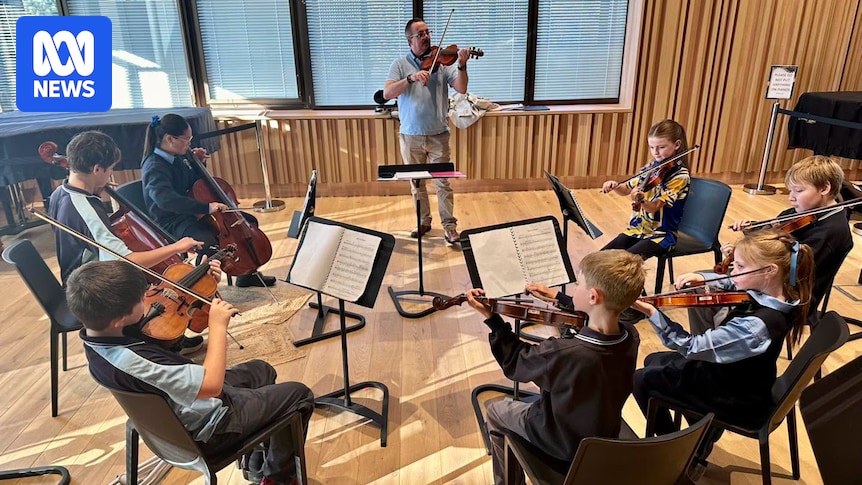
The talent pipeline for live music is drying up at the source with fewer people in regional areas receiving a musical education, a parliamentary inquiry has heard.
The third day of hearings for the state parliamentary inquiry into live music in NSW heard fewer students were learning music in regional NSW because it was simply “not accessible” for most families.
Riverina Conservatorium of Music director Hamish Tate said the system was “completely user-pays”, leaving thousands of students without access to an instrument, a teacher, or a stage.
“We are working in all, bar three, of the Wagga Wagga public schools, [but] we’re only scratching the surface in each of those schools, where maybe 40 maximum kids in a school of 500 students will be learning music and experiencing music,” he said.
“That’s very, very limited exposure.”
The Riverina Conservatorium of Music says there is a lack of music education in the school curriculum. (Supplied: Riverina Conservatorium of Music)
Southern Tablelands Arts board member Garth Prentice said part of the problem was where lessons were taught, with inadequate space in some schools leading to lessons “in the back of a broom cupboard sort of situation”.
There was also a lack of funding for trained music teachers.
Mr Prentice told the inquiry a primary school principal in Goulburn had shared how he had shifted to an online program instead.
“The kids sit in front of a screen and they write things about music, and then that’s their music education,” he said.
Regional conservatoriums say the issues will impact live music in NSW in future. (Supplied: Riverina Conservatorium of Music)
Witnesses said the skills shortage extended behind the scenes as well as on stage.
In Cowra, the shire council’s corporate services director Alan Dalton told the inquiry venues could not find sound and lighting technicians because regional TAFE courses in those trades had largely disappeared.
“It can be the case that a trainee, for example, may only be able to find a course that would be the other end of the state, which would have requirements of them travelling weekly to attend training,” Mr Dalton said.
“So there’s a real lost opportunity there in developing the skills that we need to put music on.“
The Young Regional Conservatorium hires out a cinema for student performances. (Supplied: Young Regional Conservatorium)
Sector without proper infrastructure
The education gap was one of four major themes to emerge from the evidence given by the regional conservatoriums, councils and venue operators from Newcastle, Cowra, Tamworth, Cobargo and Kangaroo Valley.
They described an industry surviving on goodwill rather than systemic support.
Witnesses said a lack of fit-for-purpose performance space was further compounding the education problem.
Young Regional Conservatorium CEO Wendy Brooks told the inquiry the organisation had to hire a cinema space to host a student concert.
“Currently, there’s no identified infrastructure funding pathway where we can address that need,” Dr Brooks said.
“Several conservatoriums are currently facing uncertainty around their tenure, around their occupancy costs and around their long-term access to facilities.“
The inquiry was told the Macquarie Conservatorium in Dubbo was among those facing a more immediate threat.
After 25 years on a “peppercorn lease” in a state government building, it has been told it will move to commercial rent.
Mr Tate said every dollar diverted to rent was a dollar that could not be spent on “live music performance” or employing regional musicians.
Peter “Smokie” Dawson has been busking at the Tamworth Country Music Festival since 2009. (ABC New England North West: Brigitte Murphy)
Funding and festivals that work
The inquiry heard from regional councils about a heavy reliance on grants to host events, and the importance of timely funding.
Cowra Shire Council said its inaugural Bell Beats Music and Arts Festival in Central West NSW lost money last year despite attracting 1,400 people, because late funding confirmation left little time to negotiate costs and run a competitive quote process.
Byron Bay’s Bluesfest was cancelled this year. (ABC News)
Byron Shire Council Mayor Sarah Ndiaye echoed this frustration, describing event funding as either “glacially slow” or rushed.
Both councils called for multi-year funding cycles of three to five years.
The inquiry also heard how Tamworth’s decentralised festival model for its Country Music Festival, in which more than 100 individual venue operators independently book acts, was credited with sustaining the festival for 55 years, unlike larger single-ticket festivals that have struggled or collapsed financially.
Tamworth Regional Council urged the inquiry committee to treat live music as essential infrastructure, noting its role in supporting wellbeing, economic development, tourism, and cultural identity in regional communities.