







The West Australian government says almost $700 million of total transition funding was not enough to re-employ 1,300 workers in the regional town of Collie, 200 kilometres south of Perth, before the coal industry shuts in 2030.
Now, WA Energy Minister Amber-Jade Sanderson is calling on the federal government to release funds from the $15-billion National Reconstruction Fund, as it did for the South Australian steelworkers of Whyalla.
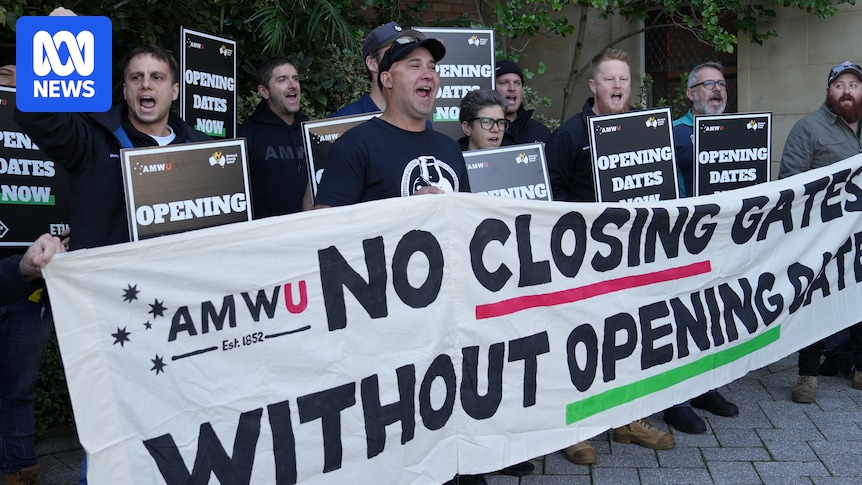
Protesters are calling for improved job security as the closure of Collie’s coal mines approaches. (ABC News: Nicolas Perpitch)
“Certainly we would be seeking several millions, if not tens of millions, to be able to support the infrastructure in the same way they support other struggling infrastructure in the eastern states,” Ms Sanderson told ABC South West Breakfast.
Ms Sanderson said she was frustrated the federal government had not contributed yet.
The ABC has contacted the prime minister’s office for comment.
Replacement jobs in the ‘ether’
Yesterday, coal miners and workers’ unions rallied out front of WA’s parliament calling for federal intervention to bring more heavy industry to town before the coal industry is shut in 2030.
Electrical Trades Union state secretary Adam Woodage said time was running out to build new heavy industries before state-owned coal mines and power stations close in less than four years.
“There’s a pipeline of projects that are in the ether, so to speak,” he said.
“We need to make sure that they can be financially stood up, and that is the process that we’re working through with several proponents that are out there.“
So far, the WA government’s $230-million Collie Industrial Transition Fund has laid the groundwork for several new industries, but few have reached a final investment decision.
The WA government-owned coal-fired power station is set to close by 2030. (ABC News: Anthony Pancia)
Major projects slated for Collie include Generation Steel’s green steel, International Graphite’s downstream processing facility, and Magnium Australia’s magnesium refinery.
The rest of the $700 million of funding will be put towards decommissioning state-owned power plants, providing workforce training for new industries and offering small grants to businesses in the local community.
The WA Energy Minister said she did not have figures on how many jobs had been created in Collie’s transition so far.
Collie-Preston Labor MP Jodie Hanns, told a local masthead about 140 ongoing roles had been created — well short of the 1,400 jobs soon to be lost.
Meanwhile, local job losses are mounting, with Premier Coal recently announcing job cuts understood to affect 70-100 workers.
Energy Minister Amber-Jade Sanderson said federal help was needed to secure investment and new job opportunities for local workers. (ABC News: Keane Bourke)
State government transition ‘failing’
WA’s opposition has seized on the unions and Cook government’s calls for federal help, labelling it as an admission that efforts to date have failed to create enough jobs.
Liberal Energy spokesperson Steve Thomas said it was now obvious that the plans to transition Collie away from coal were failing.
“In 2022 the McGowan government announced its first version of the Collie Transition Plan with a budget of $547.4 million, and since then the price tag has gone up to almost $700 million,” he said.
“What has not gone up, however, is employment in Collie, with just over a hundred contractors losing their jobs recently at Premier Coal.“
Chad Mitchell is a third-generation coal miner who has worked at Griffin Coal mine for 36 years.
He said the town needed more help.
Chad Mitchell is a third generation coal miner in the South West town of Collie. (ABC News: Nicolas Perpitch)
“We’ve come up here to ask the federal government to step up to the plate and help us out to get some industry in our town,” he said.
“We need Collie to survive.“
Transition an ‘expensive business’
The federal government’s National Reconstruction Fund has come to the rescue of other ailing industries and regional workforces over the years.
One of the most recent examples was up to $500 million made available to transform the struggling Whyalla Steelworks in South Australia.
An expert in workforce transitions said federal and state partnerships had been struck to retain critical infrastructure in other states, such as the Victorian-federal funds to prop up the car manufacturing sector.
The Premier Coal mine in Collie. (ABC News: Keane Bourke)
“We’ve seen this kind of partnership approach for many, many years, and I think that’s what the expectation is for state governments going forward,” Australia Industrial Transformation Institute former director John Spoehr said.
“Managing transitions is an expensive business.“
Dr Spoehr said the stakes were getting high across the country as privately-owned critical infrastructure was increasingly regarded as “strategic assets” for the nation.
In Collie’s case, the threat to that workforce was imminent.
Dr Spoehr said the federal government should have contributed sooner.
“The earlier the better is the rule of thumb, and this transition process has been on the cards for some time,” he said.
“Despite the best efforts at retraining, the alternative jobs are not there in the numbers they need to be to keep people in the region.”