




When Lyn Eather’s mother Olive was diagnosed with dementia, she was determined to keep her at home on the family farm for as long as possible.
Her father Peter, Olive’s husband, died in 2019, about a year after the diagnosis.
“Dad asked me to, ‘Be kind to your mother and look after her’ … and I’m doing my best,”
Lyn said.
Lyn Eather has become her mum’s primary carer. (ABC Capricornia: Jasmine Hines)
It has meant her mother has continued to enjoy the comforts of home and her small rural community of Baralaba in central Queensland, where she has lived for more than eight decades.
The ABC has interviewed Olive, with her family’s permission.
“All my life I have never left, I’ve been on the farm right from when I was a kid,” Olive reflected.
“I want to live here as long as I can, I know nearly everybody in town here, why would I want to leave?“
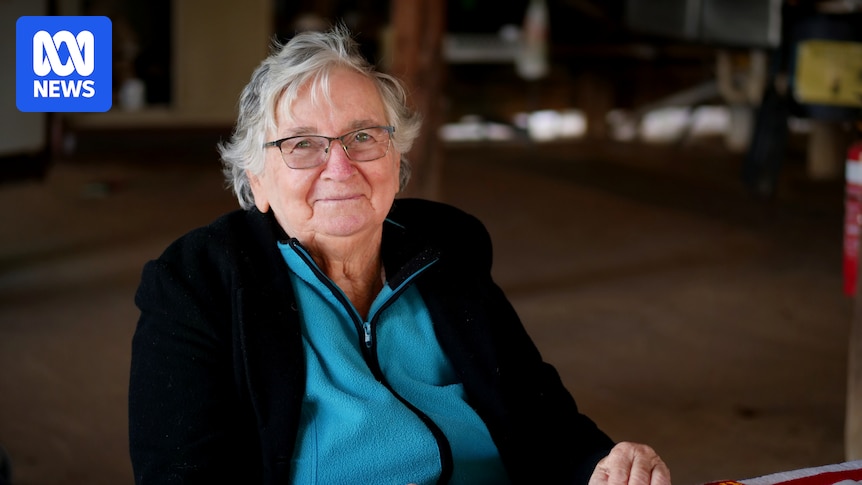
Olive and Lyn Eather share a close mother-daughter relationship. (ABC Capricornia: Jasmine Hines)
A forgotten game of cards, and a business shift
The 83-year-old was diagnosed in 2018 after a period of mood changes, but it was a forgotten game of cards that prompted her to get tested.
“She’s a very good card shark … we were playing a more complicated game and she’s like, ‘I’ve never played this before,'” Lyn said.
To keep her mother on the farm, Lyn and her partner Carl Hendrick shifted their property’s business model from a tourism farmstay to a regenerative beef trading operation.
Olive Eather is passionate about livestock and loves getting in the cattle yards. (Supplied: Lyn Eather)
It was Olive’s geriatrician who first suggested a tourism home-based business would not work.
“We’ve just stopped the holiday makers coming completely, so no camping, no tours, no activities, but people can still use our accommodation if they’re staying in the area for work,” Lyn said.
“It’s a big change, a bit of a loss for me, I’m losing my mum and I’ve lost my favourite business but that’s what happens.”
The Eathers’ picturesque property, Myella, is about 15km from Baralaba. (ABC News: Russel Talbot)
While their everyday home life is quieter now, the 55-year-old keeps her mother active.
“She likes to be useful and that’s where I have been able to help her,”
Lyn said.
Olive Eather’s flock of chooks keep watch. (Supplied: Lyn Eather)
Each day, Olive collects eggs from her chicken coop, while she still hangs out washing and irons the odd pillowcase.
“I try and give her three pillowcases a day and sometimes she goes, ‘No, I’ve got dementia, I can’t possibly work today’ … but at least they’re there,” Lyn said.
Facing the prospect of leaving her hometown
But life on the farm has become increasingly difficult.
“Mum’s deteriorated physically and mentally and it doesn’t take much, every time she gets a little bit sick, things get a little bit worse,” Lyn said.
Olive Eather loves living on the property, but knows she is on a waitlist for residential aged care. (ABC Capricornia: Jasmine Hines)
Her mother recently collapsed at home, scaring Lyn, who has had to come to terms that she cannot provide all the care Olive needs.
The family has decided residential aged care would be best for their mother, which may be a two-hour drive from the home she’s had for more than eight decades.
“Mum actually was offered a position [aged care bed] about three years ago, but we weren’t ready then and … you can just see her, she’s having the time of her life here.
“It wasn’t time and we haven’t had anything offered since then.”
Olive Eather with her affectionate pony Mr Big. (ABC Capricornia: Jasmine Hines)
Baralaba has a population of more than 300 and median age of 52, according to the Australian Bureau of Statistics.
Its hospital has four aged care beds, all of which are full and subject to a waiting list.
The Central Queensland Hospital and Health Service said the Baralaba facility was funded by state and federal governments to provide a small number of beds to support rural communities and was “not designed to meet the full demand for aged care services in the region”.
Baralaba is a rural community hundreds of kilometres from Brisbane. (ABC Capricornia: Jasmine Hines)
Lyn believed it was more likely her mother would be offered a position 95 kilometres away in Biloela or where her sister lives in Gladstone, 192km away.
A spokesperson for Federal Aged Care Minister Sam Rae said the government was spending $47 billion next year to deliver more aged care beds, but where they will go has not been announced.
Olive Eather and her family are unsure where she will live next as she waits for an aged care bed. (ABC Capricornia: Jasmine Hines)
The family has engaged the services of a local home aged care provider but has lodged a complaint with the Aged Care Quality and Safety Commission over issues including cancelled nursing visits, schedule changes and a reactive model of care.
In a statement to the ABC, charity Baralaba Community Aged Care said like many rural providers, it operated with workforce and resource constraints.
When its nurse is unavailable, it said clients and families could access support through the local hospital and GP clinic and its approach reflected “the reality of rural service delivery”.
Baralaba is served by a small hospital that has a limited number of aged care beds. (ABC News: Russel Talbot)
The country’s peak body for dementia said across Australia, a shortage of access to aged care support and delays in obtaining residential care were common.
“It ultimately means that a lot of people face the real challenge of having to move to a different location to be able to access support,” executive director Kaele Stokes said.
‘Mum was so proud’ after dementia walk
Dr Stokes called for greater investment in dementia care, including with a public campaign on brain health.
“By focusing on some of these risk factors, we can reduce the risk of developing dementia by up to 45 per cent,” she said.
After Olive’s diagnosis, she became an advocate for others also affected by the disease.
“It doesn’t worry me … If I do or say something wrong, who cares?” she said of her condition.
Olive Eather walked 3km around Baralaba to raise awareness and funds for dementia. (Supplied: Lyn Eather)
In 2022, the Eathers organised a walk in Baralaba, where Olive raised almost $11,000 for Dementia Australia.
“It was Mum’s way of saying ‘I have dementia’ … it helped us talk about it openly and it let other people know how to speak to her,” Lyn said.
“Mum was so proud. She said, ‘I want to help other people, if they want to know something, they could just ask me.'”
Olive and Lyn Eather are soaking up their time together on the property. (ABC Capricornia: Jasmine Hines)
While Lyn is unsure where Olive will soon live, they are making the most of their time together on the farm.
“When she goes to bed at night she says, ‘Thank you for looking after me.’
“That’s something I’m grateful for.”
Watch ABC TV’s Landline at 12:30pm AEST on Sunday or stream anytime on ABC iview.