






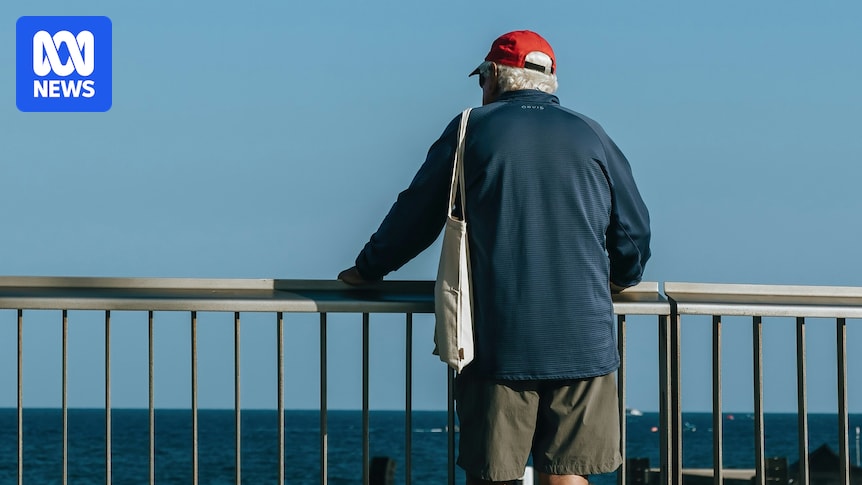
Ray Merlehan and his wife are thinking about moving to Malaysia, Spain or Greece when they retire.
Financially, it may be a better option for the couple than staying in Australia.
“I feel a little bit disappointed,” Mr Merlehan said.
“I never believed that our country would become as expensive as it has.“
The 64-year-old said he would need to keep working until he is 70.
He has a modest superannuation balance, which he will use to pay off his mortgage.
Each country will have its own visa requirements and rules around how long you can stay without residency. (ABC News: Patrick Williams)
With the high cost of insurance and utilities, Mr Merlehan believes his future in Australia is bleak.
The couple are considering selling and buying a modest house overseas for a “comfortable retirement”.
A “golden visa” programme in Greece, for example, offers residency in exchange for investments, primarily in real estate.
“They’ve got regional towns that are struggling to survive, where the government of Greece have offered golden visas to people who bring at least $250,000-plus into the country,” Mr Merlehan said.
But there are drawbacks to an overseas retirement.
Mr Merlehan and his wife are worried about moving away from their family.
They also have concerns about accessing health care overseas.
Access to healthcare, visa requirements and financial considerations vary between countries and should be carefully researched. (Reuters: Cathal McNaughton)
‘See how you feel after the holiday excitement wears off’
Australian Mark Rooney lives in Cambodia.
He says moving to South-East Asia can reduce costs “massively”.
Mark Rooney says people should consider how they’d manage if something goes wrong in a foreign country. (Supplied: Unsplash/Vanna Phon)
Mr Rooney says eating local food in Cambodia costs a maximum of about $15 a day, transport is cheap and beer can be as low as 90 cents Australian.
He says it’s not just about living more cheaply; many people are retiring overseas for reasons including warmer weather, a sense of community and a slower pace.
“I would not describe it as a simple trend of people ‘leaving Australia,'” Mr Rooney said.
“I would describe it more as Australians becoming more open-minded about how retirement can look.“
His advice is not to confuse a holiday with living somewhere.
“You need to understand the weather, healthcare, visas, banking, transport, language, internet, community, food, safety and how you would manage if something went wrong,” he said.
That could mean a try-before-you-buy approach.
Mr Rooney advised people to “stay outside the main tourist strips. Try and use local services”.
“See how you feel after the holiday excitement wears off,” he said.
He also recommends integrating into local communities.
“You are not just buying a cheaper lifestyle. You are entering someone else’s culture, community and way of life.“
Some countries have barriers to what foreigners can do with property. (Supplied: Flickr/Dirk Werdelmann)
Healthcare overseas
Mark Rooney says one of the biggest mistakes people make when retiring overseas is not having serious medical cover.
The federal government’s Smart Traveller website provides general advice on retiring overseas.
Standards of healthcare in some countries may not be the same as Australia’s.
And the cost of healthcare could be higher.
Medicare does not pay for medical treatment overseas, nor do Australian private healthcare providers.
Australia has reciprocal healthcare agreements with some countries, including New Zealand, Italy and the UK, but co-payments may be required.
Medical repatriation back to Australia can cost hundreds of thousands of dollars.
International health insurance may cover some healthcare and the cost of repatriation to Australia.
But it can be costly and may not cover pre-existing conditions.
Australians living overseas can access Medicare for treatment in Australia for up to five years after moving overseas.
Can I still access my age pension or superannuation overseas?
You can still get the age pension living overseas, but there are rules around it.
And it may be less than what you receive in Australia.
You should get expert financial advice before making arrangements to move overseas. (ABC News: Claire Moodie)
The pension supplement will drop to a basic rate and the energy supplement and rent assistance will stop.
The pensioner concession card will be cancelled.
Glen James. (Supplied: Glen James)
Superannuation income and lump-sum payments may have tax concessions in Australia, but could be taxed in other countries.
Glen James hosts a podcast on retirement and says he frequently gets questions about the financial implications of moving overseas, particularly when it comes to drawing on superannuation funds.
“If you are looking at a particular country, you really want to make sure that it’s not going to be a hindrance,” he said.
It is recommended that retirees seek expert financial advice.
Retirement visas generally require proof that you can support yourself financially. (Supplied: Unsplash/Mariana Jordan Gärtner)
Visa requirements
Each country will have its own visa requirements and rules for how long you can stay without residency.
“It is one of the areas of financial advice that is unique to the country you are going to; how long you will be there, how you are drawing an income,” Mr James said.
Retirement visas generally require proof that you can support yourself financially.
Thailand, for example, offers a retirement visa that requires about $35 000 in a bank account or a monthly income of about $2,800.
It must be renewed each year, or Australians who enter with higher incomes can obtain a 10-year visa.
A police check or medical certificate may be needed in some countries.
And some countries require visa applicants to have health insurance.
Visa conditions and costs can change.
“Some countries … might be a little more robust in how they treat people who overstay visas, compared to how things happen in Australia,” chief executive of National Seniors Australia, Chris Grice, said.
Dying overseas
It’s a morbid thought, but retirees who move overseas should make provisions in case they die.
You should have all your affairs in order in case you die overseas. (Supplied: Unsplash/Pourya Gohari)
Repatriation of remains to Australia can be complicated and costly.
Different countries have different laws around estate management if you have bought assets or property overseas.
It’s advised that you review your will and get legal advice before making significant purchases overseas.
And it is important to have up-to-date identification documents, should authorities need to contact your next of kin.
Being away from family and friends and other support is one of the big drawbacks of retiring overseas, especially during emergencies.
Chris Grice said it can be difficult to re-establish friendships and a sense of community in a foreign country, particularly when language barriers are present.
“It’s understandable that older Australians are certainly considering it [overseas retirement], but it is something that you need to go into with open eyes,” he said.
“Consider all of the aspects, not just ‘Oh, I can save a little bit of money on my rent’, or ‘I can save some money on meals.
“It’s these other considerations that you have to take into account.”