








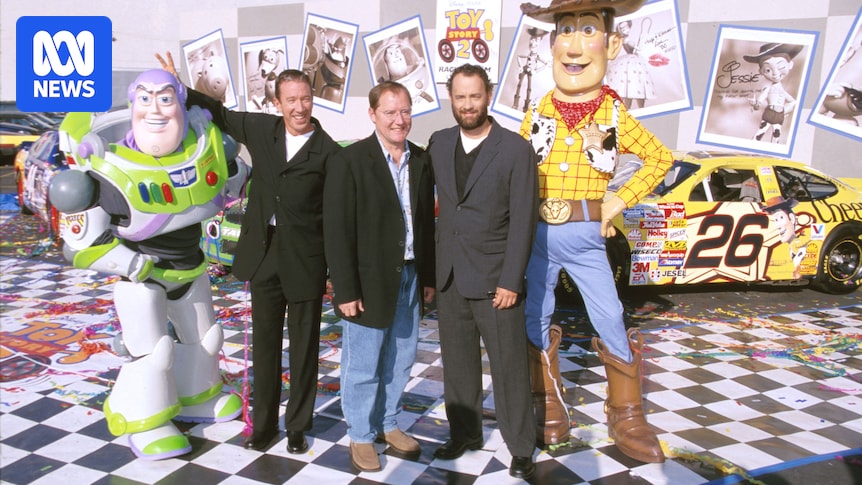
Welcome to Cheat Sheet, where we give you all the intel you need about iconic franchises! In honour of its fifth instalment heading to cinemas, this month we’re looking at landmark animated film series Toy Story.
Toy Story has led the way in computer-generated animation and modern storytelling for children since bursting onto screens more than 30 years ago.
More than six years have passed since we last caught up with Andy’s (now Bonnie’s) toys.
Buzz, Woody, Jessie and the gang are back for Toy Story 5, and now they’re taking on tech.
Here’s what you need to know before you head to the cinema.
The history of Toy Story
Back in the early 90s, Pixar wasn’t the powerhouse blockbuster maker we know today. The computer and animation company was an Oscar-winning, critically acclaimed money pit. Still years out from its first feature films, even changing hands from Lucasfilm to Apple CEO Steve Jobs didn’t make the innovative company turn a sizeable profit.
The animation landscape at the time was still in the grasp of predominantly 2D, hand-drawn movies dominated by industry leaders Disney, which had just managed to grasp a Best Picture nomination for 1991’s Beauty and the Beast — the first animated movie to achieve the feat.
But Pixar had something Disney wanted: director John Lasseter, a former Disney employee who created Pixar’s Tin Toy in 1988, which became the first computer-generated artwork to win the Academy Award for Best Short Film (Animated).
When Lasseter refused to return to his former workplace, Disney inked a $ US26 million deal with Pixar to produce three computer-generated films — the first of which would eventually become Toy Story.
With the deal signed in 1991, what followed was four years of too many cooks. Lasseter’s original idea for Toy Story, which involved a ventriloquist dummy lead, was formed into a script with Andrew Staton and Pete Docter.
It went through numerous rewrites before it resembled the buddy comedy we know today, with Disney eventually pulling screenwriters Joel Cohen and Alec Sokolow and, later, Joss Whedon onto the project.
It came to a head in 1993 when Tom Hanks, Tim Allen and other cast members started recording their lines. The first half of the movie was screened for Disney execs and admonished for being too serious, for painting Woody as too much of a jerk, and over the chemistry between leads being “awkward”.
With a ballooning budget and a creative team sent back to the storyboard, the future of Toy Story was in doubt. Lasseter and the team took three months to rewrite the script to tone down Woody’s tyrant leanings and include more scenes that would appeal to both adults and children.
On November 22, 1995, Toy Story was released in the US as the first entirely computer-generated feature film in cinema history.
The impact of Toy Story
The original release of Toy Story netted $US362 million at the box office, surpassing the expectations of Disney and Pixar.
Beyond the monetary success, audiences and critics were enthralled with the mature, thoughtful storytelling devoid of princesses and big musical numbers, as well as its groundbreaking use of computer-generated 3D animation. It was nominated for three Academy Awards the following year; two for its Randy Newman-penned soundtrack and one for Best Original Screenplay — the first animated film to achieve such a nomination.
Despite missing out on all three, Lasseter was honoured with a Special Achievement Academy Award for “the development and inspired application of techniques that have made possible the first feature-length computer-animated film”.
Talks for a sequel began soon after Toy Story’s release, but Disney pushed for a direct-to-video release after finding success with other DTVs like Aladdin sequel The Return of Jafar, which had made $US300 million on physical media alone.
It wasn’t until 1997 when Disney execs started to see the first reels out of production that the project was pivoted to a theatrical release.
The next year, with production well underway, an anonymous employee accidentally entered a deletion code on Pixar’s Toy Story 2 root folder, which wiped almost 90 per cent of the work done up until that date. The film was rescued when technical director Galyn Susman, who was working remotely while caring for her newborn, presented a back-up copy on her home computer, allowing Pixar to retrieve the work. The woman who saved what has become one of Pixar’s most beloved animated films was made redundant by Disney in 2023, along with about 7,000 other employees.
Released nearly four years to the day after the original, Toy Story 2 was praised as glowingly as its predecessor but far surpassed it at the box office, pulling in more than $US500 million internationally ($US1 billion in 2026).
By this time Pixar already had another critical and commercial hit in 1998’s A Bug’s Life, netting more than $US300 million.
It would be more than a decade before Pixar would return to the toy box, in which time they would pull off a historical run of commercially and critically successful CGI children’s films including; Monsters Inc (2001), Finding Nemo (2003), The Incredibles (2004), Cars (2006), Ratatouille (2007), Wall-E (2008) and Up (2009).
In the background, work had begun on the first version of Toy Story 3 which featured Buzz getting caught up in a product recall and the gang all travelling to Taiwan to sort it out. But in 2006, shortly after Disney bought Pixar, creatives from the first two films including Lasseter and eventual Pixar chief creative officer, Pete Docter, returned to fully rewrite the third instalment.
Costing $US200 million, Toy Story 3 remains one of the most expensive films ever made but Pixar’s investment returned five-fold. Released in June 2010, Toy Story 3 became the first animated film to cross the $US1 billion mark at the box office, remaining the highest-grossing animated film of all time until 2013 when it was knocked off by Frozen.
Beloved by critics, the film picked up two statues at the 83rd Academy Awards, and has the honour of being just the third animated film ever to be nominated for Best Picture.
It was another nine years before Toy Story 4 hit cinemas in June 2019. It handed the narrative to a new generation of kids as Andy’s story ended and new toddler Bonnie’s began. Like its predecessor, the fourth movie clicked over a $US1 billion box office and took home the Oscar for Best Animated Feature.
As of 2025, all four Toy Story movies have a combined gross box office taking of more than $US3.3 billion worldwide.
A brief recap of all four Toy Story’s and their emotional damage
Toy Story
Change is inevitable.
Cowboy toy Woody’s (Tom Hanks) comfortable life as the favourite play-thing of his kid Andy, and the unofficial leader of Andy’s other toys, is disrupted when Andy receives a Buzz Lightyear (Tim Allen) toy for his birthday. As Andy’s tastes shift from sheriff to spaceman, Woody’s jealousy makes him first try to fight his usurper before realising that they can reach their goal of making Andy happy by working together.
Buzz has a more ontological journey as he realises he’s not a real space ranger but instead a plastic toy.
Chances it’ll make you cry: 3/10, depending on how much a toy realising its control panel is a sticker breaks your heart.
Toy Story 2
Love doesn’t end, it transforms.
Just when Buzz and Woody find an easy harmony with the toy community in Andy’s room, a yard sale mix-up sees the sheriff (who’s actually a rare antique) stolen by collector Al McWhiggin. The scheming basement dweller has a master plan to sell the full suite of ‘Woody’s Round-Up’ toys to a museum for a hefty sum.
But his machinations are disrupted when Woody teams up with Jessie (Joan Cusack), the cowgirl to his cowboy who was scooped by Al after being abandoned by her kid (who actually just grew into an adult).
With the help of Buzz and his band of new-found brothers, Woody and Jessie escape from Al’s apartment while quelling their fears that Andy will outgrow toys.
Chances it’ll make you cry: 9/10, just a few notes of Sarah McLachlan is enough to get the waterworks going.
Toy Story 3
We all grow up some time.
Remember all that stuff about Andy not growing out of toys? Forget it! Andy’s heading off to college now and while he’s bringing Woody as a good luck keepsake, the rest of the toys are packed away in storage.
Mistakenly thinking they’re destined for the bin, Buzz and the toys make a break for it, ending up in the toddler room of Sunnyside Daycare, under the tyrannical Lotso — a purple bear twisted with a vendetta against the child who replaced him with new toys.
With the help of a stressed Woody, the toys must escape Lotso’s police-state day care to be reunited with Andy once more. But when they eventually do, Andy realises that he has to move on and gifts the toys to toddler Bonnie, starting a new generation of play time.
Chances it’ll make you cry: 10/10 (toys and furnaces do not mix).
Toy Story 4
Different is good.
As well as being the first edition without Andy, Toy Story 4 is the most existential of the bunch as Woody meets Forky, a “toy” Bonnie made from a spork that can’t reckon with his new-found sentience and consistently attempts to throw himself away like the trash he believes he is.
One night Forky’s flighty tendencies see him jump out Bonnie’s car window, sending Woody on a rescue mission through an antique store, a carnival and a group of “lost toys”. At the same time, Woody must grapple with his love, Bo Peep, pulling away in the aid of toys who have lost their way.
In the end, the group reconcile and Forky finds his worth (and a potential mate, who is made out of a plastic knife, of course), but Woody makes off with Bo Peep to help relocate lost toys.
Chances it’ll make you cry: 4/10, more likely to cry from laughter over Keegan-Michael Key and Jordan Peele’s hilarious inclusion as fuzzy plushes Ducky and Bunny.
What is Toy Story 5 about?
It’s 2026, which means it’s time for the toys to tackle technology. Woody is off saving lost toys with Bo Peep so he misses the new Lilypad tablet (voiced by Greta Lee) that turns the previously imaginative Bonnie into a gormless zombie.
Without Woody to fall back on, Jessie accidentally travels back to her original home (seen in Toy Story 2) and must get back to Bonnie with the help of other outdated tech toys.
Toy Story 5 is in cinemas now.