








Masked agents handcuff and arrest men with blurred faces in the video, as the iconic Pokémon theme song reaches its chorus: “Gotta catch ’em all.”
It is a United States Department of Homeland Security (DHS) post on social media, one of several using popular Japanese anime to promote the Trump administration’s messages — sometimes with dark irony.
“To arrest them is our real test. To deport them is our cause,” the DHS says in reply to a comment on its video, in a play on the theme song lyrics.
It is the kind of social media post that has attracted growing backlash from anime and manga fans, especially in Japan.
Japanese fan Nana Suzuki felt so angry when the White House used a clip from popular franchise “Yu-Gi-Oh!” in a video showing military strikes, she started a petition in March.
The petition objects to both US President Donald Trump’s and the White House’s use of images in “political or military contexts that may differ from the intentions of the original creators or rights holders”.
“Works that exist to bring people together were being used without permission as propaganda tools for the very opposite — militarism and political division,” she told the ABC.
Nana Suzuki is a lifelong anime and manga fan. (Supplied: Nana Suzuki via Change.org)
The petition on Change.org has gained nearly 25,000 signatures.
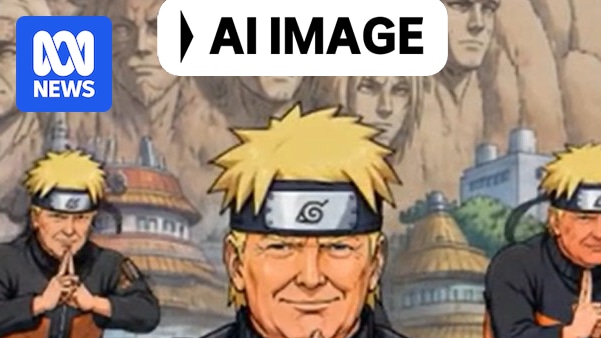
Thousands of supporters signed after she reopened it this month, when Donald Trump posted an apparent AI-generated video on Truth Social depicting him as ninja Naruto Uzumaki from the beloved anime and manga series “Naruto”.
“Watching fans around the world express the same frustration I felt on social media, I thought: We need somewhere to channel this — a tangible number that shows society how strongly fans feel,” Ms Suzuki said.
“The response has exceeded anything I imagined.”
Where anime differs from Trump
Ms Suzuki said most of the petition signatures had come from people in Japan.
Anime and manga are so embedded in the country’s daily life that measuring their fan base would be almost meaningless, says Kohki Watabe, assistant professor at the University of Tsukuba’s International and Advanced Japanese Studies Program.
It is seemingly everywhere, as people read manga on trains, Pokémon mascots appear at baseball matches, and theme songs from shows like “Astro Boy” play on train station PA systems.
Pokémon characters feature in Japan’s Nippon Professional Baseball matches. (AFP: Daisuke Tomita / The Yomiuri Shimbun)
“It is not a particular hobbyist group but a shared language that spans generation, gender, and class,” Dr Watabe said.
For Ms Suzuki, from Kanagawa prefecture, anime and manga are not just entertainment but “a bridge that connects people across language barriers”.
“As a shy child, I was able to make many friends through drawings I did of anime characters,” she said.
“The universal message carried by Japanese [boy’s] manga … of ‘effort, friendship and victory’ became the emotional anchor that kept me facing forward.”
Experts say they see little resemblance between the anime used in social media posts and the Trump administration’s actions.
Helen McCarthy, a scholar who has written encyclopedias and histories of anime and manga, said “Naruto”, “Yu-Gi-Oh!” and “Pokémon” shared themes of supporting, validating and celebrating all members of a community, not just those who fit “a set template”.
“Nowhere do they celebrate detention without charge or trial, [or] the imprisonment of children,” she said.
Donald Trump posted a video showing him as ninja Naruto Uzumaki. (Truth Social: realDonaldTrump)
Meanwhile, Ms McCarthy said Mr Trump seemed unlike Naruto Uzumaki, except for maybe the character’s initially noisy, boisterous and determined persona.
“He does not take revenge on those who formerly shunned him or now oppose him,” she said.
In a post last year, the White House controversially used an AI-generated, Studio Ghibli-style image of an immigration agent arresting a crying woman — a depiction of Virginia Basora-Gonzalez, who it said had been a fentanyl dealer.
However, Studio Ghibli films, including “The Wind Rises”, were the “exact opposite of Mr Trump’s ideology”, Dr Watabe said.
“It is not a simple anti-war film but a complex inquiry into peace, one that closely examines the complicity between dream and reality,” he said.
“There is no point of overlap with Trump’s political claims.“
The ABC sought comment from the White House, but it did not reply.
A Department of Homeland Security spokesperson told the ABC it would “reach people where they are with content they can relate to and understand, whether that be Halo, Pokémon, Lord of the Rings, or any other medium”.
“DHS remains laser-focused on bringing awareness to the flood of crime that criminal illegal aliens have inflicted on our country. We aren’t slowing down,” they said.
The manga and anime series “Naruto” is globally popular. (AFP: Stephane Mouchmouche / Hans Lucas)
Japan’s foreign ministry reportedly lodged a complaint with the US Embassy in Tokyo about the use of anime imagery earlier this year.
Japanese Minister for Intellectual Property Strategy Kimi Onoda addressed the issue again this week, saying public organisations must obtain permission from copyright holders.
“Even in cases that do not constitute clear copyright infringement, it is crucial to ensure that copyrighted works are not used in a manner contrary to the rights holder’s intentions, which could damage the work’s image and cause harm to the rights holder,” she said at a press conference.
Kimi Onoda speaks out against the use of works without obtaining permission from rights holders. (AFP: Kunihiko Miura / The Yomiuri Shimbun)
Japan’s government had expressed this to the US government multiple times through diplomatic channels, Ms Onoda said.
“We will continue to take appropriate measures, including communication with the US, to ensure that Japanese copyrights are handled appropriately,” she said.
Rights holders for “Naruto”, “Pokémon” and “Yu-Gi-Oh!” did not respond to the ABC’s requests for comment.
However, the official Japanese “Yu-Gi-Oh!” anime X account posted in March saying it did not authorise the White House’s use of footage on social media.
Pokémon Company International has also reportedly responded to White House posts, saying it had not given permission to use its imagery.
Anime as propaganda?
While anime is woven into daily life in Japan, it continues to gain more fans and cultural influence overseas.
Market research firm Grand View Research estimated the global anime market at US$38 billion ($54 billion) in 2025, growing 9 per cent a year.
Anime streaming service Crunchyroll has more than 21 million subscribers globally, and Netflix reports that more than half its subscribers watch anime, with annual views exceeding one billion.
Anime titles such as Crunchyroll’s Demon Slayer: Kimetsu No Yaiba Infinity Castle are increasingly a fixture in Hollywood. (AFP: Xavier Collin/Image Press Agency/NurPhoto)
In the US, more than 40 per cent of gen Z watched anime weekly and more than 40 per cent of those fans were female, one survey found.
“Anime has shifted from a ‘niche import’ to a common frame of reference for young people,” Dr Watabe said.
Those fans had diverse political views, and some were also part of internet subcultures known for making and sharing provocative, ironic and right-wing memes, he said.
“[Anime] fandom is not politically monolithic: Within it, or adjacent to it, a reactionary online culture has emerged,” he said.
“Trump’s operation appears to be targeting the latter group.”
The Trump administration’s official government accounts had adopted the style of social media posting once confined to fringe meme accounts, said Rodney Taveira, a United States Studies Centre senior lecturer in American studies.
Dr Taveira said posts such as the DHS Pokémon video “function as propaganda quite classically”.
“They are designed to shape perception of immigration enforcement as more than legitimate, as something sporting and fun,”
he said.
“Deploying anime is one of the tactics used to capture attention, control the discourse, and to assert, if not demonstrate, the impunity with which federal agencies can act.”
Dr Taveira said the posts were also partly a way of consolidating a group identity for Mr Trump’s loyal supporters.
Ms Suzuki said she was not asking Mr Trump to take down the social media posts, and the goal of the petition was not to simply vent frustrations.
“It’s to establish lasting protections for Japanese cultural works worldwide, and to put in place the kind of systemic safeguards that prevent this from happening again,” she said.
She had one other goal for the petition.
“I’m aiming for 40,000 signatures as the next milestone,” Ms Suzuki said.