








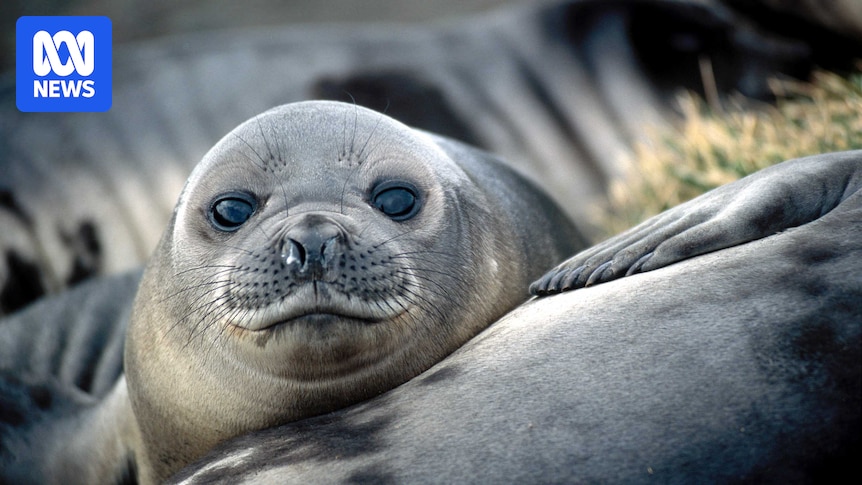
Research has revealed the devastating impact of bird flu on a remote Australian territory where more than 13,000 baby seals are now believed to have been killed by the virus.
Heard Island and McDonald Islands, located 4,000 kilometres south-west of mainland Australia, are a haven for breeding seals and seabirds in the Southern Ocean.
But in October last year, a research voyage uncovered evidence that H5 bird flu had reached the area — the first time an Australian external territory had been affected.
Heard Island is a hot spot for breeding seals. (Supplied: Julie McInnes)
At the time, scientists from the Australian Antarctic Program said hundreds of dead southern elephant seal pups had been found on Heard Island.
But analysis of data collected during a second voyage in January has painted a far more dire picture.
The researchers estimate 13,359 seal pups succumbed to the disease out of a total population of 17,364 — more than three-quarters of the cohort on Heard Island.
But they say the figure could be even worse because the mortality was ongoing when they completed their observations, and some seal harems were losing up to 97 per cent of pups.
The findings have been published in the scientific journal BioRxiv, but have not yet been peer reviewed.
‘Potentially catastrophic threat’ to wildlife
In addition to southern elephant seals, H5 bird flu was detected in king penguins, gentoo penguins and Antarctic fur seals, as well as a brown skua and a South Georgia diving petrel.
But among the six species, mass mortality was only observed in southern elephant seals, which were recently listed as “vulnerable” to extinction on the IUCN Red List of Threatened Species.
Elevated mortality was also seen among king penguins and gentoo penguins.
The researchers believe the virus, also known as highly pathogenic avian influenza (HPAI), reached Heard Island and McDonald Islands in August last year.
They say it likely made its way there via infected wildlife arriving from Crozet Islands, about 1,700 kilometres away.
Scientists have been investigating bird flu on Heard Island. (Australian Antarctic Division: Rowena Hannaford)
If the virus spreads to other parts of the sub-Antarctic, including Australia’s Macquarie Island, they say it could have “potentially catastrophic” impacts.
“The emergence of HPAI poses a severe and potentially catastrophic threat to the wildlife of the Southern Ocean and sub-Antarctic environments, where large, dense breeding and moulting aggregations of already vulnerable species, such as albatrosses, penguins, elephant seals and fur seals, create ideal conditions for rapid viral transmission,” the report states.
Drones provide crucial data to scientists
The researchers used a combination of drone surveys, ground searches and viral genome analysis to make their findings.
In total, 120 drone flights were completed, involving 54 hours of airtime and 1,600 kilometres of distance flown.
By comparison, ground searches were only able to cover 8.8 kilometres.
The researchers say the use of modern technologies allowed them to collect data from remote and inaccessible parts of the islands without impacting local wildlife.
“The combination of drones and molecular tools can be instrumental in increasing our capability to monitor HPAI movement and species-level impacts and support preparedness for future HPAI incursions,” the report states.
The H5 strain of bird flu has caused devastation among wildlife in many other parts of the world, leading to subsequent reductions in breeding numbers.
An outbreak in Argentina in 2022 left 96 per cent of southern elephant seal pups dead, with ongoing impacts apparent a year later, when only one third of seals returned to breed.
In South Georgia, there was a 47 per cent decrease in the number of breeding females between 2022 and 2024.
Heard Island is a remote Australian territory. (CSIRO: Pete Harmsen)
The report says elephant seals have been disproportionately affected by bird flu compared with other Southern Ocean species, likely because of their tendency to return to the same areas to breed in large, dense colonies.
“[They] are unlikely to abandon infected sites, potentially trapping successive generations in disease hotspots, facilitating sequential annual outbreaks if the virus persists locally,” it says.
“These mortality events are of conservation concern given that the majority of the global breeding southern elephant seal population is concentrated at four geographically separated regions.”
There is no evidence of the virus on the Australian mainland, including Tasmania.