








Australia’s top universities have surged in the latest global rankings over the past decade, but experts warn the results have little relevance to domestic students.
The QS World University Rankings 2027 come as the sector faces parliamentary scrutiny over governance, entrenched funding challenges and widespread staff discontent, with a new survey revealing just more than 40 per cent plan to stay in academia until retirement.
“Australia’s 2027 results point to a higher education system competing with real confidence on the world stage. With 21 universities improving their position, the sector continues to build momentum,” QS CEO Jessica Turner said.
“The rankings also highlight areas where further progress is needed. Compared with some of its global peers, Australia performs less strongly on teaching capacity and graduate outcomes.”
Australia’s large intensive research universities, known as the Group of 8 (Go8), dominated the list. (Reuters: Loren Elliott)
Australia’s large intensive research universities, known as the Group of 8 (Go8), dominated the list and its chief executive Vicki Thomson hailed the results as “historic”.
“This is an outstanding national result. Australia’s leading universities are performing at an elite global level and continue to compete with the very best in the world,” Ms Thomson said.
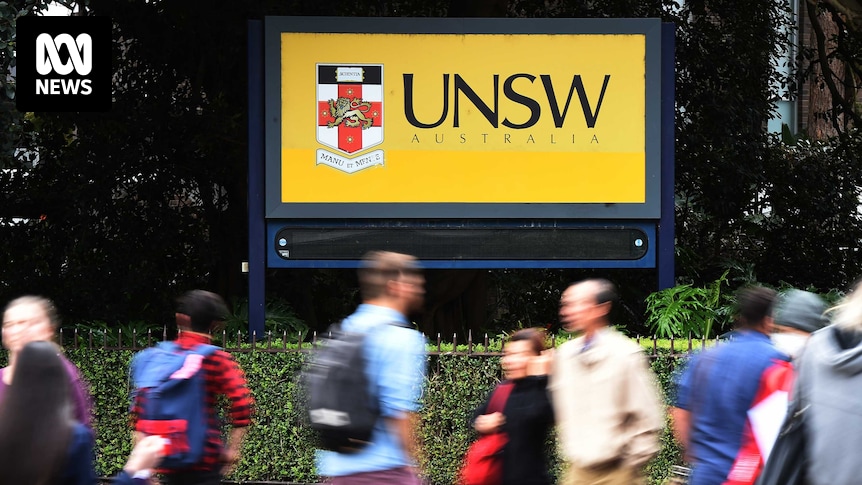
QS rated the University of New South Wales (UNSW) the country’s best and 19th worldwide.
“We are excited to be number one because it allows us to do more, have more impact, more influence and access to more networks,” UNSW Vice-Chancellor Attila Brungs said.
“It gives our talented staff and students even greater opportunities to have a positive impact on the world.”
While the rankings are being celebrated by university leaders, higher education experts have cautioned domestic students that the rankings are of little relevance to them.
“Domestic students should not pay much attention to rankings,” higher education policy professor Andrew Norton, from Monash University, said.
“None of them use local employment results or student satisfaction levels that are a better guide to the likely student experience.”
QS listed the metrics rankings as research (50 per cent), global employer reputation and graduate outcomes (20 per cent), learning experience (10 per cent), global engagement (15 per cent), and sustainability (5 per cent).
In a statement, QS acknowledged the rankings were originally designed to assist international students, but said they had “evolved” to also be relevant to domestic students.
Experts say the global rankings do not use local employment results or student satisfaction levels. (ABC News: Lucas Hill)
“For domestic students, local indicators such as student satisfaction and graduate employment data are especially valuable when comparing institutions within a single country,” the spokesperson said.
“Rankings add a different layer: a university’s global reputation, research strength, international networks and standing among employers worldwide.”
Andrew Norton says the rankings are more useful for international students. (Supplied)
Professor Norton said the ratings were most useful for universities marketing themselves to overseas students from China, which remained a crucial source of revenue.
A recent New South Wales auditor-general’s report found universities received less than it cost them to educate domestic students and were increasingly relying on international student revenue to meet operating shortfalls.
“Chinese students pay high fees to attend universities with a top 100 rank. Universities use international student fee revenue to increase research output, which in turn drives ranking results,” Professor Norton said.
“For these universities, rankings matter. Other international students are more price sensitive. Especially when they want a migration outcome, there is little benefit in attending an expensive top 100 university.”
‘The workload is killing me’
As universities increasingly pursued revenue while reducing costs through staff and course cuts, a new report released exclusively to ABC News reveals increasing staff discontent on campus.
Associate Professor Jess Harris has worked in universities for more than 25 years, and for the last 10 years has researched academia at the University of Newcastle’s School of Education.
Jess Harris has lead a report on staff perceptions of academic work in Australia. (Supplied)
She is the lead author of a new paper that surveyed 537 academic and professional staff from 31 of Australia’s 39 public universities.
“As far as I’m aware, this is the largest study of the perceptions of academic work in Australia,” Dr Harris said.
“We were blown away by the number of people who responded and the number of people who were willing to be interviewed confidentially to have a voice in what’s happening in Australia’s higher education.”
Dr Harris said responses included “the workload is killing me”, and staff reported needing to work 70-hour weeks to secure ongoing employment.
When asked about recommending academia as a career, one respondent bluntly replied: “Find something else.”
“We have seen this progressive acceleration of metrics and pressure on universities to increase the number of enrolments, while staffing and support for staff has been decreased in cost-cutting measures,” Dr Harris said.
The research found academics were largely satisfied with their remuneration and were highly motivated by their key tasks of teaching and research.
However, one quarter of staff were critical of the leadership, which has been scrutinised in state and federal government inquiries into university governance.
Dr Harris said many academics were concerned about an increasing “corporatisation” of Australian universities.
“It means doing more with less … and it means that academics are not seeing investment in teaching and research, and that’s a real challenge for them,” she said.
Last year, an estimated 3,500 university staff nationwide lost their jobs in the latest round of cuts.
Professor Norton said research findings were consistent with existing work.
“Many surveys of academic staff have found similar results,” Professor Norton said.
“Academics get satisfaction from their research and teaching, but are unhappy about their workload, career prospects and senior management at their university.”
Professor Norton said there was not a “realistic prospect” of staff views changing under the current funding model.
“In real terms, funding per domestic student has declined while costs have increased, including above-inflation wage deals, hiring more staff, and new regulatory burdens,” he said.
“At some universities, international students reduced the need for hard decisions, but their numbers have peaked.”
Professor Norton said staff viewed governance reform as a solution, but he was cautious about it improving life on campus.
“At some individual universities, that is probably true. But all universities face policy and financial constraints that will have significant effects, regardless of who runs them,” he said.