





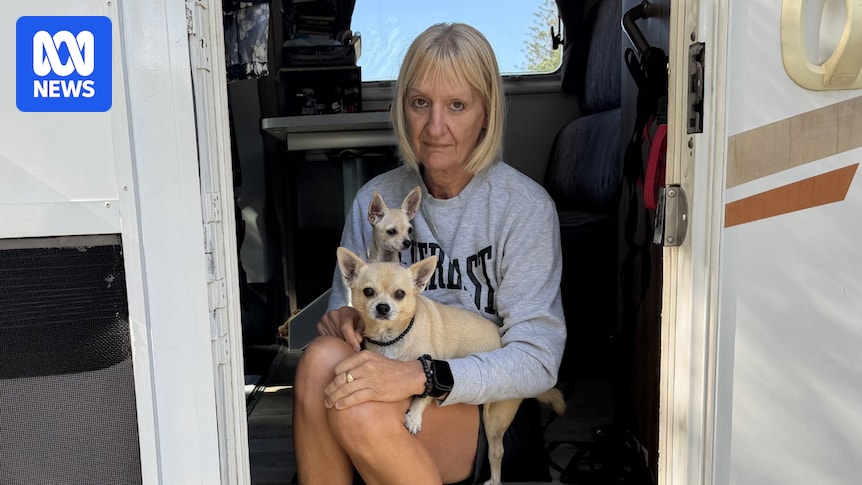
From the outside, Susan Morley appears to be living an enviable retirement travelling solo around Australia in a motorhome with her two dogs.
But, unlike people who choose van life, the 61-year-old is homeless.
Ms Morley has been living in her vehicle on the Gold Coast for the past three years while waiting for social housing after a series of setbacks changed the course of her life.
“I had my own business. I was actually a self-funded retiree and I lost all my properties,”
Ms Morley said.
Susan Morley and her two dogs keep each other company. (ABC Gold Coast: Danielle Mahe)
Riches to rags
Ms Morley said she had retired early at 40 and was living a comfortable lifestyle but lost her assets in 2016 after being a victim of fraud.
She was also involved in a serious car accident which left her with chronic pain and unable to work.
Despite her circumstances, she was able to keep her motorhome and now camps in public spaces across the Gold Coast because she cannot afford the city’s skyrocketing rents.
“Lucky, I had one at the time because I would have been sleeping in the park in a tent,”
she said.
During the day, she walks her dogs and mostly keeps to herself.
At night, she parks in well-lit public car parks, closes the blinds and locks herself and her pets inside until morning.
Although she did not plan to live this way, she said she felt safer there than living with strangers.
“I’m free to do what I like. I can eat whenever I want. I can go outside, compared to being in a house with other people,”
Ms Morley said.
Susan Morley says that, after years in her motorhome, she’s over it. (ABC Gold Coast: Danielle Mahe)
Homelessness a ‘growing crisis’
Her experience reflects what housing advocates describe as a growing crisis among older Australian women.
Teresa Reed, founder of The Forgotten Women charity, said women aged 55 and over were among the fastest-growing groups experiencing homelessness nationwide.
According to Ms Reed, many older women were being pushed into homelessness by a combination of limited superannuation, separation, widowhood and rising living costs.
While some women turned to shared housing, she said an increasing number were choosing to live in their vehicles while waiting for social housing.
“Many women don’t feel safe in shared housing, but rising rents mean they often can’t afford to live alone,”
she said.
“Rather than put themselves in an unsafe or uncomfortable situation, some choose to live in their cars instead.”
Concerns raised by locals
The sight of people camping in their cars in public spaces across the Gold Coast has sparked outrage from residents concerned about their safety, noise and environmental impacts.
In 2025, City of Gold Coast council received about 3,000 complaints related to people living in cars and vans.
People living in vehicles parked in public spaces is a common sight on the Gold Coast. (ABC Gold Coast: Danielle Mahe)
Ms Reed said it was unfair to view older women living in vehicles in the same way as those living on the street.
“This particular cohort is incredibly different,” she said.
“Many of the perceived things that might make people go, ‘Oh geez, I don’t want someone who’s got drug or alcohol issues in front of my house’, is not these women.
“Their financial disadvantage is what’s led to their homelessness.”
Nowhere to go
Homelessness Australia chief executive Kate Colvin said people living in vehicles were often there because they had no other options.
“We know that the rental market is just squeezing people out,” Ms Colvin said.
“People can’t evaporate. They exist and they have to be somewhere. And when the housing market fails, the reality is that tents and cars is where people end up.“
Kate Colvin says people end up in tents and cars when the housing market fails. (ABC News: Peter Healy)
She encouraged older women at risk of homelessness to seek support before reaching crisis point.
“I would really encourage people to reach out for financial counselling or homelessness support so that they can try and hang on to the housing that they have or make a transition into somewhere that’s more affordable,” Ms Colvin said.
“The earlier that you can get support, the better.“
It is estimated that more than 400 people are sleeping rough around the city.
A council spokesperson said people found sleeping in vehicles on roads or in parks were offered support and fines were only issued if move-on directions were ignored.
Ms Morley said while she understood residents’ concerns, living in the motorhome still gave her a sense of independence and control.
But, after years on the road, she admitted her patience was wearing thin and she hoped she would soon secure a permanent home.
“I can’t handle living the way I’m living, to be honest,”
she said.
“I know I’d love to have a house. Even for the dogs, you know what I mean? It’s not much of a life for them just in the van.”