





Derald Flamand remembers the bus driver yelling.
“He said, ‘hey, there’s an effing car coming at us. And that’s all I remember.”
Flamand woke up in the hospital with a fractured back and neck, and learned 22 young men on his Canadian Pacific Rail crew had been killed in the May 28, 1980, bus crash west of Swift Current, Sask.
He was one of just eight survivors.
“It just screwed me up,” Flamand, 64, said.
He’s blunt about the fact he spent the next 46 years drinking.
“I drank my sorrows away, so to speak.”
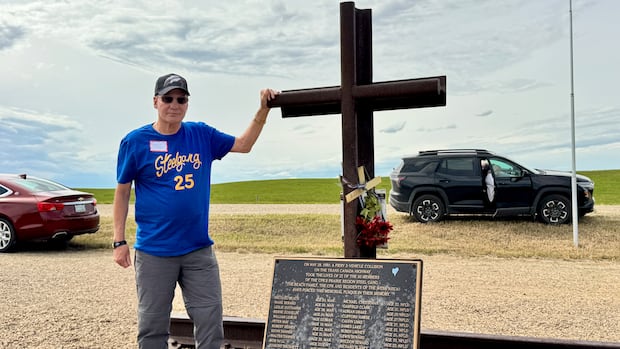
Flamand’s story of lingering trauma and the immeasurable ripple effects of a horrific crash were echoed by many who visited the crash site near Webb, 34 kilometres west of Swift Current, Tuesday afternoon to see a new plaque installed on a roadside memorial.
In what is still Saskatchewan’s deadliest crash, a school bus loaded with 30 young CPR workers was hit by a car in the wrong lane, and then struck by a tanker truck carrying hot asphalt oil. A fire erupted.
Of the 22 dead, 12 were from Newfoundland and Labrador, nine from Manitoba and one from Ontario.

This report aired on CBC’s The National on May 29, 1980.
‘A crushing blow’
First responders, families who lost loved ones in the crash and men who once worked on the CPR prairie steel gang came together to talk about the way the crash shaped their lives.
Flamand, who travelled from B.C. for the event, said he wasn’t offered any counselling after the crash.
“I didn’t get any help. I don’t know why,” he said. “I was just devastated all the time.”
On top of feeling survivor’s guilt and the pain of losing friends on the bus, he grieves two of his cousins, Wally and Kevin Tanner, who died in the crash.

Wally was a track star, Flamand said, and would go for long runs when the rest of the rail crew was drinking or sleeping.
He also saved Flamand’s life as a child after Flamand fell through the ice in his snowsuit.
“It was just a crushing blow to my psyche, I guess you could call it,” Flamand said.
Inspired to do good
Denis Fortier travelled from Manitoba to meet other people with connections to the crash. He worked on the steel gang replacing old rail as a summer job in 1980.
He was nearly on that bus.
He remembers the 93-member crew quit early that day due to rain, and the men loaded into three school buses to travel back to their bunks.
“My foot was on the second step of the second bus and Mike Beach, the driver, told me the bus is full,” he recalled. “And at the same time, my friend pulled my shirt and said, ‘That’s the second bus.'”
Fortier said everyone preferred the first bus because they were more likely to get hot showers. He ended up on the third bus, which came upon the crash scene.

At first, with the devastation so great, he didn’t realize the wreckage was the CPR bus. He ran to help the two men in the car.
Then, the gravity of what happened began to hit him.
“It was like it rained hard hats and boots. There were hard hats and boots littering the highway,” he said.
The next few hours are a blur, and some of it so traumatic he believes his brain blocked out the memories.

Fortier called his parents, visited survivors in the hospital, went to the temporary morgue at the hockey arena and then attended funerals back in Manitoba.
He remembers he and his friends, “trying to make sense of something that is senseless.”
Fortier went on to become a rural family doctor in Notre-Dame-de-Lourdes, southwest of Winnipeg. Today, he wrestles with how horrific crashes— the Humboldt Broncos bus crash, the Carberry bus crash— have ripple effects that could affect generations.
He said the crash shaped his desire to do “good in the world,” and perhaps his tendency to work too much in pursuit of that goal.

A new plaque on a roadside monument west of Swift Current, Sask., details a fiery three-vehicle crash that left 22 young men dead and eight injured on May 28, 1980. Derald Flamand, one of the survivors, travelled from B.C. for the plaque dedication.
Now six years sober, Flamand is slowly coming to terms with the past.
On his trip to Saskatchewan, he met a young man from Newfoundland and Labrador who was two years old when his father died on the bus. Flamand took comfort in being able to hug him and tell him his father was a good man.
Still, he knows every time he sees a school bus or a train, he’ll think of the crash.
“I’m reminded of it all the time.”