





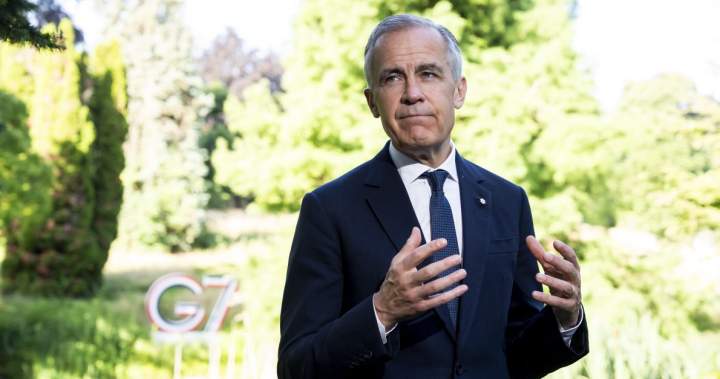
Canada and its “potential” to boost global energy supplies got a shoutout in the G7’s joint statement on geopolitical issues Wednesday, after a summit seized with finding solutions to the fallout from the Iran war.

The mention was included in a section on the Middle East, which touched on international efforts to reduce reliance on the vital Strait of Hormuz shipping lane. Iran’s closure of the strait, through which about one-fifth of the world’s oil flows, caused energy prices to spike around the globe.
“We commit to accelerate the diversification of energy supply routes in order to reduce global vulnerability to the Strait of Hormuz and to increase our energy stocks,” the G7 statement reads.
“We welcome the potential for Canada to deliver significant additional capacity to global markets in the coming years.”
Prime Minister Mark Carney has been looking to stimulate Canada’s economy by pitching the country as a reliable energy exporter, with efforts underway to fast-track new infrastructure and expand port capacity.
Carney brought that message to the G7 Summit in France this week, and told reporters Wednesday that Canada is ready to deliver what the world needs.
That includes diversifying energy infrastructure both in the Middle East and elsewhere, he said.
“Canada has the ability to do several things, and we’re on the path to do several things,” he said, such as increasing liquefied natural gas production and exports to Germany and other allies.

Get breaking National news
Get breaking Canada news delivered to your inbox as it happens so you won’t miss a trending story.
Statistics Canada said this month that Canada is exporting natural gas to countries other than the U.S. at record levels, with 57.6 million gigajoules shipped overseas in March — about 16 per cent of total exports.
Natural gas production rose 5.6 per cent year over year that same month, the report said, compared with an increase of just 0.2 per cent in crude oil production, the smallest increase in 10 months.

Carney added that an expansion of the existing Trans Mountain oil pipeline “will go ahead,” while discussions are progressing with Alberta on a new pipeline to the West Coast as part of a broader energy agreement between Ottawa and Edmonton.
Pipeline capacity is also being increased into the U.S. through projects like South Bow, which will revitalize parts of the previous Keystone XL pipeline.
“If you total those up, it’s a material amount of additional energy that Canada can provide,” Carney said, noting that those projects only account for what’s being built in Western Canada, with other infrastructure possibilities in the east as well.
“It’s quite substantial, and it’s important to our European partners, it’s important to our Asian partners, and it was raised with me in a number of bilaterals as well.”
A statement from the Prime Minister’s Office highlighting Carney’s work at the summit said France, Germany, Italy and South Korea “intend to partner with Canada to stockpile critical minerals, which will catalyse further energy partnerships.”
The summit came after U.S. President Donald Trump announced a deal with Iran that would lead to a 60-day ceasefire and reopen the Strait of Hormuz to global shipping, with further negotiations aimed at a permanent end to the war.
The G7 joint statement also mentioned the Iran deal and the Strait of Hormuz in a section on the war in Ukraine, with leaders committing to “increase the pressure on the Russian war economy.”
“In this context, we will strengthen our sanctions on the oil and gas sectors,” the statement says.
“We consider this the right moment to proceed with additional measures, as President Trump has delivered a deal that we support in reopening the Strait of Hormuz.”
The U.S. temporarily waived sanctions on Russian oil during the Iran conflict in a bid to ease energy prices, allowing global purchases that have funneled revenues into Moscow’s war machine.
© 2026 Global News, a division of Corus Entertainment Inc.