



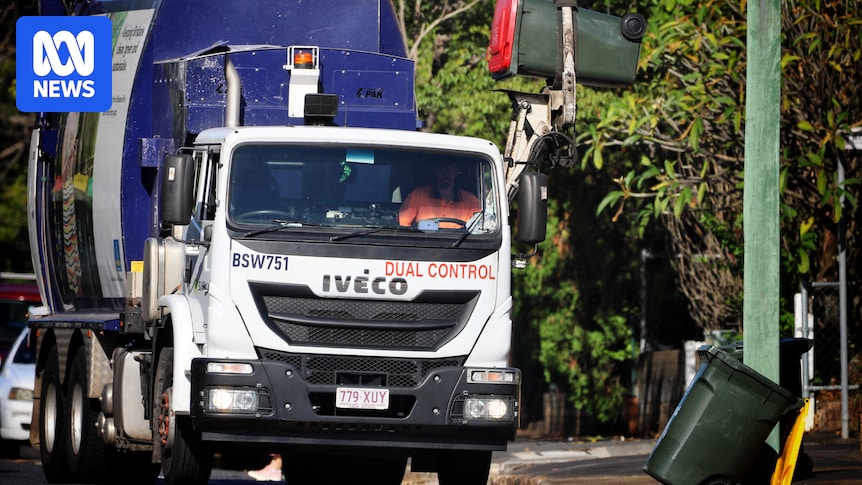
The Queensland government is rolling out a new recycling target and giving councils almost half a billion dollars in a bid to curb the amount of rubbish going to landfill.
Environment Minister Andrew Powell will unveil the government’s new waste strategy on Tuesday, which includes a statewide recycling target of 65 per cent by 2035.
The plan also calls for a 65 per cent reduction in waste to landfill over the next decade, compared with the baseline level in Queensland in 2019-20.
The amount of waste generated in Queensland increased 4.5 per cent last financial year. (ABC Gold Coast: Dominic Cansdale)
The move is accompanied by specific targets for the state’s south-east as well as major regional communities, including Cairns, Townsville, and Mackay.
In the south-east, the government wants waste sent to landfill to fall by 70 per cent over 10 years, while in the major regional hubs it wants a 50 per cent drop.
For the rest of the state, such as in rural and remote areas, the goal is to maintain the current amount of rubbish disposed of in landfill.
Waste rate jumps
Mr Powell said the government had developed targets that reflected the needs of communities across Queensland.
“This strategy is about doing what we said we would do; reducing landfill, increasing recycling and investing in the infrastructure Queensland needs for the future,” he said.
“The Crisafulli government knows that what works in south-east Queensland won’t always work in regional Queensland.”
Last financial year, Queensland generated almost 10.25 million tonnes of waste, a 4.5 per cent jump from the year before, outstripping population growth.
Andrew Powell says targets are different in the south-east and rural Queensland. (ABC News: Lucas Hill)
The new plan replaces a previous strategy from the former government, which aimed for 65 per cent of waste to be diverted from landfill by 2025.
The old plan also set a target to have recycling rates at 60 per cent by the same year.
According to the most recent waste survey for the 2024–25 financial year, Queensland’s resource recovery rate was sitting at about 58 per cent, which is short of that goal.
No goals beyond 2035
The old plan also included a long-term target to divert 90 per cent of waste from landfill by 2050 and a target to get recycling rates to 75 per cent over the same period.
Similar long-term targets beyond 2035 are not included in the government’s latest plan.
The new waste strategy also sets a target for 60 per cent of household rubbish to be recycled by 2035.
The plan says the current recycling rate for households is 28 per cent.
It says households throw away nearly 690 kilograms of general waste in their red bins every year.
Waste levy changes
The government also conducted a review of the waste levy in the past year, but it is yet to reveal what changes it could make to the charge.
The strategy notes it is underpinned by the levy, which is used to support a range of programs.
The government says it is giving councils $488 million over the next five years to offset the cost of the levy so it is not passed onto households.
In the south-east, the government wants waste to landfill to fall by 70 per cent over 10 years. (ABC Capricornia: Erin Semmler)
The plan also points to a number of “priority wastes” the government wants to tackle, including mattresses, batteries, and tyres.
For example, the plan estimates about 300,000 mattresses are dumped in Queensland landfills every year.
“Mattresses are bulky and take up space in landfill. This coupled with their slow decomposition contributes to the growing issue of landfill availability,” the plan said.
“Queensland’s regional areas in particular have difficulty managing disposed mattresses due to limitations in existing recycling supply chains.”
Initiatives listed to tackle mattress waste include establishing a joint taskforce and boosting investment in mattress dismantling infrastructure.
To cut down on rubbish, the government says it is spending $487 million over the next five years on a waste reduction and recycling activation fund.
The money is going to councils.
The first round of funding will support a range of projects, including a new surge pit to separate and divert dry and bulky waste from landfill in Brisbane.