





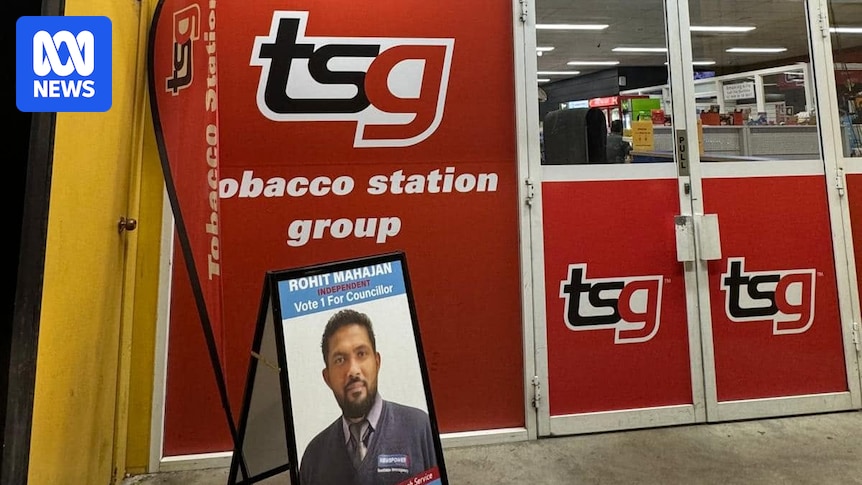
A New South Wales regional councillor is managing a tobacco shop, which the ABC has found sells illegal cigarettes.
Rohit Mahajan was elected as a councillor in the Upper Hunter town of Muswellbrook in 2024.
Council disclosure documents state he is the manager of TSG Muswellbrook.
The ABC was able to purchase illegal cigarettes from the shop for just $15 on April 30.
Rohit Mahajan has listed on council disclosure documents that he is also a manager at the TSG in Muswellbrook. (Picture: Supplied)
Asked by the ABC last month about the situation, Cr Mahajan said he had “no option” but to sell the illegal product.
“Definitely, we sell it,” he said.
“Too many shop [sic] is opening in that area. [What] we gonna do if we don’t sell that kind of cigarette? We can’t survive.”
Cr Mahajan backtracked on his comments a few days later, saying he had spoken in general terms about small businesses in Muswellbrook and insisted there were other managers at the store and that he was not a “decision maker”.
The TSG tobacco station in Muswellbrook is managed by Rohit Mahajan and owned by his brother-in-law. (ABC News: Alex Turner-Cohen)
Cr Mahajan told the ABC he became involved in politics because of his interest in the government’s tobacco excise policy, initially sending a few letters to ministers and members of parliament lamenting that it made it difficult for small businesses to thrive.
Despite only having about 16,000 residents, ABC News can reveal the town is home to at least six shops with a supply of illicit tobacco, after visiting each shop and walking away with a pack of cheap cigarettes.
Council not investigating
When the ABC contacted Muswellbrook Council, a spokesperson said that it was “not the regulatory authority” and suggested referring the matter to police.
Muswellbrook Council referred ABC News to its code of conduct, pointing out a line stating that it is the “personal responsibility” of council officials to behave appropriately, and declined to carry out its own investigation.
Cr Mahajan has also submitted plans to open a 100-place, $1.9 million childcare centre in Muswellbrook.
Experts say tobacco is becoming a bigger problem in regional NSW. (ABC News: Sean C Murphy)
He works at Muswellbrook TSG and also owns the building the shop is in.
The company’s owner is Canberra man Pankaj Monga, whom Cr Mahajan says is his brother-in-law.
Mr Monga is also listed as a committee member of the Australia India Business Council (AIBC). Prime Minister Anthony Albanese attended an AIBC event in Canberra last month.
The organisation said in a statement that Mr Monga had resigned and he “was not actively involved in committee activities”.
Pankaj Monga, the brother-in-law of Cr Mahajan, is also a committee member on the AIBC. (Picture: Supplied/AIBC)
Mr Monga was contacted for comment.
‘Utterly untenable’
State member for Upper Hunter, the Nationals’ Dave Layzell, said it was “unacceptable for anyone to engage in illegal behaviour. Therefore, someone who does so would be undermining those other small businesses in the town by running an illegal tobacco business”.
“And if they are openly admitting to it, that just goes to show that we have to have this crackdown,” he said.
He said there had been an “explosion” of tobacco shops in Muswellbrook, including one that had opened beside his old office in the town’s main street.
“That just goes to show how common these things are across our regional towns,” he said.
A faded green “Dave Layzell” sign marks the state MP’s old office, which now stands next to a tobacconist shop in Muswellbrook’s main street. (ABC News: Amelia Bernasconi)
Barnaby Joyce, One Nation federal member for New England, which encompasses Muswellbrook, said that if it was true that Cr Mahajan managed a shop that sold illegal tobacco, this was alarming behaviour for an elected councillor.
“Alleged activities such as that, of course, are totally and utterly untenable,” he said.
“If you want to hold a position in public life, it goes without saying it shouldn’t even need to be described [not to do that].“
Mr Joyce added that regional Australia was “easy pickings” for the illegal tobacco trade “because the resources to manage illegal cigarettes are less”.
A photo taken during a raid on an illegal tobacco operation. This was not any store in Muswellbrook. (Supplied: Australian Border Force)
Australia’s tobacco black market has exploded in recent years and is now estimated to be worth up to $7 billion annually, according to a report from the Illicit Tobacco & E-cigarette Commissioner.
A whopping 80 per cent of all nicotine consumption in 2025 came from “illicit sources”, according to Australian Bureau of Statistics data released last week.
Nicotine is the third-most popular recreational drug in the country after caffeine and alcohol, a survey from the Australian Institute of Health and Welfare (AIHW) found.
Nicotine is now worth more to criminals than cannabis, cocaine, heroin, and ecstasy combined, the Australian Institute of Criminology estimates, constituting about 40 per cent of Australia’s entire illicit drug economy.
Last month, the federal excise on tobacco rose a further 5 per cent on top of regular indexing.
At $1.53 per cigarette, Australia has one of the highest tobacco excises in the world, pushing the average price of cigarettes above $50 a pack and driving people into the black market.
The ABC visited six stores in Muswellbrook and was able to buy illegal cigarettes at each for between $15 and $20 a pack.
Dr James Martin says the black market tobacco trade is growing at an enormous rate. (Picture: ABC News: Danielle Bonica)
Dr James Martin, an associate professor of criminology at Deakin University, said a pack-a-day smoker was looking at a yearly bill of $15,000 if they didn’t turn to the black market.
That “is simply unaffordable, for most people, particularly lower socio-economic groups, which are disproportionately concentrated in regional areas”, he said.
“And also, we see the highest representation of smokers in those groups as well. So it’s not a surprise seeing this problem not just affecting the big urban centres, but rural centres as well.”
Regional communities continue to outpace cities in smoking rates, with an unnamed regional NSW wastewater site recording the highest nicotine consumption of any regional location in the country, according to the Australian Criminal Intelligence Commission.
The most recent data from the AIHW show that one in five people living in remote and very remote areas of Australia in 2022–2023 smoked daily.
The range of cheap and illegal smokes available to the residents of Muswellbrook. (ABC News: Alex Turner-Cohen)
A Senate inquiry into the illegal tobacco crisis last month heard from NSW business owners who claimed it was a crisis in the regions.
David Allen, who runs the Cobargo Hotel in south-east NSW, said the trade was destroying legitimate retailers and warned the legal cigarette market would be all but wiped out within two years.
“We have lost 85 per cent of the cigarette and tobacco trade in our bottle shop,” he told the inquiry.
“We can’t sustain that. That money is just going to criminals.“
‘Own goal’ on smoking rates
In 2023, Health Minister Mark Butler declared smoking rates had flatlined, vowing to do more to drive them down further.
But Dr Martin said the Australian government had achieved an “extraordinary own goal” with early evidence pointing to Australia’s smoking rate actually increasing for the first time.
Although there is no current large-scale data available to determine if smoking uptake is on the rise, Dr Martin referred to Roy Morgan polling last year that found more young people were smoking than the general population, with more young people smoking now than a decade ago.
Mr Butler referred the ABC to Assistant Minister for Customs Julian Hill, who said that enforcement measures were “having an effect on the illicit trade”.
“The government will not surrender our nation’s health policy to organised criminals or Big Tobacco, who just want to see a new generation of Australians hooked on nicotine,” he said.
Mr Hill pointed to the Queensland government’s response, saying there was “very early evidence” showing that strong closure powers and landlord penalties were making nicotine users “return to the legal market”.
“Other jurisdictions can learn from Queensland, where enforcement efforts have focused on shutting down 100 per cent of the dodgy shops in a town or region with long-term closure orders and on empowering landlords to terminate leases,” he said.
Several businesses in regional NSW have been slapped with closure orders under what the state government described as “tough new” powers introduced in November.
The new rules give NSW Health the power to issue short-term closure orders of up to 90 days against businesses caught selling tobacco illegally.
As of May 29, NSW Health had issued 294 short-term closure orders since the new powers came into effect, with 176 currently in force.
Several have been issued in regional NSW areas, including the Mid North Coast, Wagga, Armidale, and Upper Tweed Shire council areas, to name a few.
NSW Health conducted a blitz on the NSW Central Coast in April, closing 23 retailers, although the ABC reported that one tobacconist in Ettalong continued to trade.
Another blitz took out five retailers in Cessnock’s main streets recently and seized more than $260,000 worth of illicit tobacco and vapes.
No closure orders have been issued in Muswellbrook.
NSW Health responds
NSW Health declined to comment on individual cases and sent the ABC a statement that repeated information from previous media releases.
“Prosecutions for retailers who continue to trade [from] closed premises are underway,” the spokesperson also said.
“As a result of our enforcement operations, premises subject to comprehensive compliance measures often cease their illicit activities or remain permanently closed.
“New laws intended to target landlords who knowingly permit tenants to sell illicit tobacco and vaping goods from their premises passed parliament in May.”
The new offence can lead to a year in jail, a $165,000 fine, or both.
NSW Health Minister Ryan Park said those laws, due to come into effect soon, would make “doing the wrong thing even harder”.
“Landlords who knowingly allow tenants to sell illicit tobacco and illegal vapes from their premises are not only undermining legitimate business operations, they are also exposing their community to associated criminal activities and encouraging illegal activities,” he said in a statement.
NSW Police declined to comment and referred the ABC to NSW Health.