




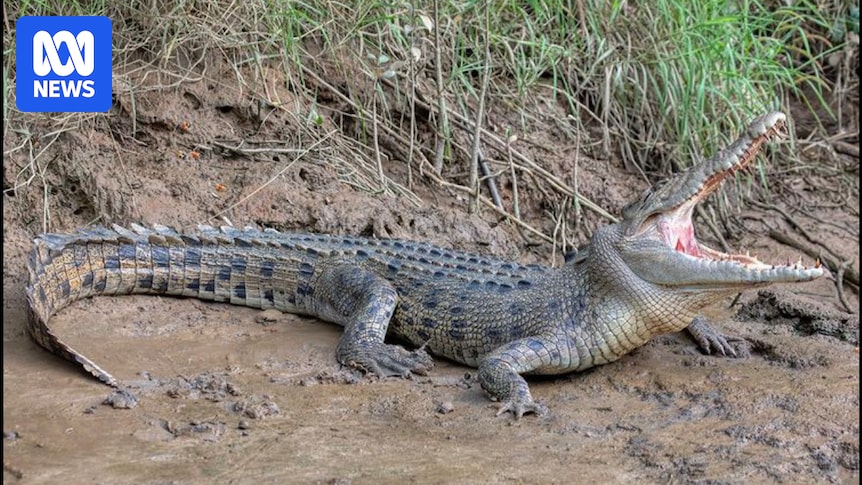
Reptile remains found dumped on the side of a road in suburban Adelaide have been confirmed to be from a saltwater crocodile, but how they came to be there remains a mystery.
In a statement, a Department for Environment and Water spokesperson said staff collected the remains which were found among other litter at Coleman Road, Waterloo Corner, in Adelaide’s north west in April.
The spokesperson said an analysis had been carried out and the remains were “determined to be those of a saltwater crocodile”.
“It is not known how the remains came to be at the Waterloo Corner site,” the spokesperson said.
A crocodile was found dismembered on an Adelaide roadside. (Facebook: Jess Adam)
The department has urged anyone with information about the unexpected discovery to contact CrimeStoppers on 1800 333 000 or by visiting the Call it Out wildlife crime portal on the CrimeStoppers website.
“There are no further updates at this stage,” the spokesperson said.
Both SA Police and the RSPCA said the matter was under investigation by the department.
Crocodiles are typically found in northern Australia, in the northern parts of Queensland, Northern Territory and Western Australia.
NT crocodile management stalwart Grahame Webb said the incident was a legal issue, not a conservation issue. (ABC News: Tristan Hooft)
Professor Grahame Webb, a crocodile expert and conservationist based at Crocydylus Park in Darwin, said the reptile would not have been killed in South Australia.
“It’s obviously come from up north somewhere and it’s just odd that it was cut up in such a strange way, straight away,” he said.
“It’s not someone trying to get the skin or something like that.
“It’s probably somebody that shot one (a crocodile) or caught one — quite a bit illegally — and put it in a chiller, or ice or something, and took it down and then decided they didn’t know what to do with it.”
Professor Webb said the NT’s saltwater crocodile population was “strong and robust”, but the killing was still against the law.
“They’ve probably taken it in the territory, illegally, and they’ve brought it into South Australia, illegally, and there’s a penalty for that and there should be,” he said.
According to the SA Department for Environment and Water’s website, crocodiles are considered “unsuitable” as pets, with the saltwater variety not allowed to be kept under a private permit in the state.
Penalties for killing or the incorrect keeping or releasing of crocodiles attract differing penalties around the country.
In other states, people have been prosecuted over the deaths of crocodiles, including a Queensland man who was fined in 2022 for beaching environmental laws after a 40-year-old saltwater crocodile was shot and buried on a cattle property.
Another Queensland man was fined in 2018 for fatally shooting a 5.2 metre crocodile — believed to be about 100 years old — near Rockhampton.