






Reserve Bank governor Michele Bullock is fond of saying that hiking the interest rate is only tool the RBA has to get inflation down.
But she does have another — her words.
After the RBA board decided, for the first time this year, not to use its principal tool, the board and its spokesperson-in-chief chose to put this secondary tool to good use.
It started with the post-meeting statement.
“The board is focused on its mandate to deliver price stability and full employment,” Bullock said.
“It will do what it considers necessary to achieve that outcome, including increasing the cash rate target further if required.”
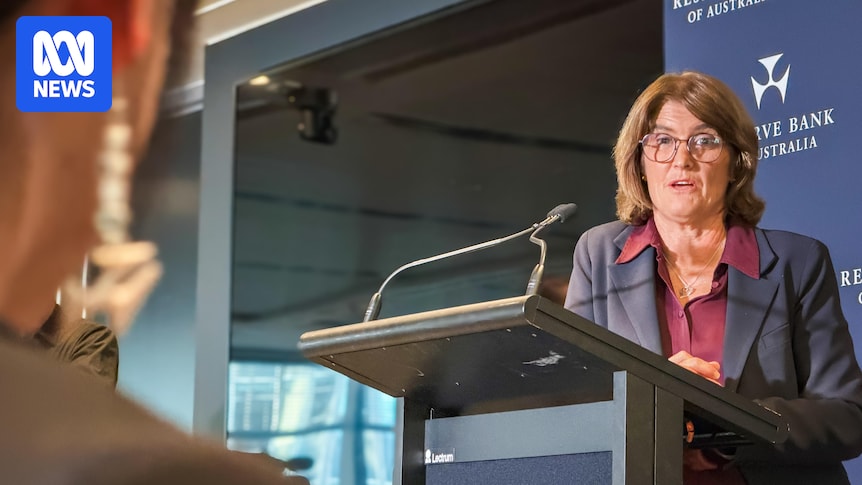
Michele Bullock said leaving the interest rate unchanged would give the RBA time to assess the effects of previous increases. (ABC News: Dan Irvine)
When she stepped up to the microphone, Bullock was at pains to jawbone those left with any doubt.
“Today’s decision does not rule out further tightening in monetary policy if that is what is required to bring inflation down,” she emphasised.
“In making its decisions, the board will be focused on the data and what that suggests about the outlook and risks.”
Between now and its next meeting in August, the Reserve Bank will receive another set of monthly inflation numbers, as well as the key June quarter consumer price data, and two more sets of unemployment figures to determine whether the recent spike to 4.5 per cent was an aberration or the start of a trend of lay-offs.
Bullock made the bank’s starting position well known.
“I want to be very clear that inflation remains too high,” she told reporters.
“Leaving rates on hold today will allow the board to assess how these previous increases are flowing through the economy.”
Michele Bullock’s announcement was in line with what was widely predicted. (ABC News: Dan Irvine)
Tough talk yet to sway the market
But, despite the tough talk, traders haven’t really changed their bets on further rate hikes.
From about 30 per cent before the meeting, the odds of an August rate rise have been sitting in the high-20s since the press conference.
The market has priced in basically a 50-50 call as to whether rates will rise any further at all.
That’s reflected among the major banks.
The Commonwealth Bank’s analysts have thought for several weeks that the RBA was done after its May rate hike and would likely be cutting rates next year.
It’s since been joined by ANZ and NAB, which expect two and three rate cuts respectively in 2027.
Westpac is the hold-out, though.
Its economics team, led by former RBA assistant governor Luci Ellis, still has two more rate hikes baked into its forecasts before cuts next year.
“We expect it will take a further unexpected weakening in the domestic economy — and a better inflation outlook — to entirely prevent further cash rate hikes from here,” she wrote after today’s decision.
Loading
Has the economy flipped into a downturn?
That’s exactly the reason that most economists aren’t expecting further rate hikes. They believe the economy has flipped and further weakening is more likely than not.
Not only are both consumer and business confidence in the toilet, but the housing market is starting to slow.
Loading…
Australia is a houses-and-holes economy and, while the RBA consistently denies targeting house prices, there’s no doubt they are one of the most immediate and powerful transmission mechanisms for monetary policy.
RBA research has consistently highlighted the significant effects rates have on property prices, and they also impact turnover in the market and the flow-on activity that stems from real estate sales and home moves.
Then there’s the wealth effect — when property prices are rising, existing owners feel richer and more able to borrow and spend.
If they see the value of their biggest asset falling, then their wallets are more likely to remain closed.
However, even if the RBA governor shared this view that the economy was already contracting, she’d never let on.
No sign of neutral stance, let alone easing bias … yet
Until the bank is sure that the inflation genie is well and truly on its way back into the bottle, RBA officials are likely to talk up the threat of further rate hikes.
They don’t want naughty consumers and businesses relaxing in anticipation of some rate relief, because that would mean the bank would actually need to raise the cash rate again.
After three rapid fire rate hikes, Bullock will hope her words do the rest of the work.
Perhaps in August, but more likely even later in the year, the bank will hope it can shift its language to a more “neutral” stance, where rate cuts become as likely as further hikes.
If the majority of major bank economists are right, by the end of the year or early next we may start to hear an “easing bias” where rate cuts become the alternative to holds.
It’s usually only after this point that mortgage borrowers can hope to see some actual relief in their regular repayments.