






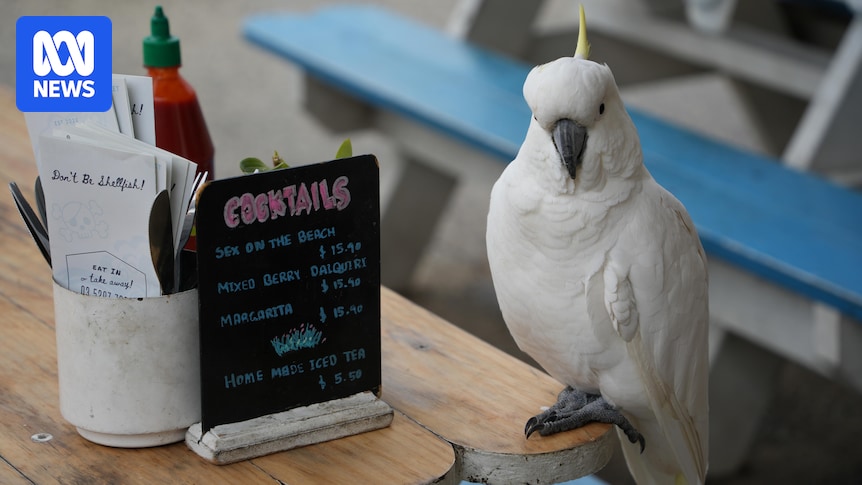
Residents of Lorne, on Victoria’s scenic Great Ocean Road, have been locked in a battle of wits for years now.
They’ve been fighting skirmishes with a large flock of increasingly intelligent sulphur-crested cockatoos that love lifting the lids of the town’s wheelie bins and spreading rubbish on the ground.
“When holiday-makers and Airbnbs, etc, leave on a Sunday, they put the bin out, overfill it, and the cockies just throw rubbish all over the road,” says Allan Walls from the Lorne and District Men’s Shed.
The birds have grown so dexterous they can now lift the lid on bins that aren’t overfilled and have shared that knowledge with other birds in their flock.
“It’s terrible. Every Monday morning, all of the streets are just riddled with refuse and rubbish all over the road,” says fellow men’s shed member Bob Sinclair.
But Mr Walls, who has been working on the problem with co-inventor Gary Fenton for more than five years, always believed there had to be a solution.
Of course, others have tried to solve the problem.
Backyard solutions include a piece of wood screwed underneath the lid to weigh it down, water bottles tied to the lid, and an assortment of bricks and rocks that the cockatoos have learnt to dislodge.
There have also been plastic bin locks and springs supplied by the local council and fitted to wheelie bins.
But nothing seemed to really do the trick. Until now.
“What began as a simple idea became a complex and demanding project,” Mr Walls, a retired caravan park broker, explains.
“It required hundreds of hours of research, numerous setbacks, and persistence from a dedicated group of volunteers.”
The inventors trialled rubber strips screwed to the bin lid to stop the birds being able to flick the lid open with their beaks.
The cockies chewed the rubber off and ended up getting the lid to open, but the team knew it was onto something.
“I thought, ‘What if we created something the cockies couldn’t grip, a kind of apron attached to the lid?'” Mr Walls says.
Made from recycled plastic at Horsham, in Victoria’s Wimmera region, the plastic frames are screwed or pop riveted to the wheelie bin lid to thwart entry.
Allan Walls lifts his invention onto a bin prototype. (ABC News: Jonathon Kendall)
The recycled plastic apron sits under the lid of the wheelie bin. (ABC News: Jonathon Kendall)
The frames are secured to the wheelie bin. (ABC News: Jonathon Kendall)
Surf Coast Shire has installed 500 of the aprons on bins in Lorne. (ABC News: Jonathon Kendall)
“The theory is you can’t lift what you’re standing on … and in the five years we’ve had them out testing them there hasn’t been a failure that I’m aware of,” Mr Walls says.
The design has been so successful that Surf Coast Shire has spent $50,000 to buy and install 500 of the aprons on Lorne residents’ bins for free.
That figure includes “the significant upfront investment required to establish manufacturing”, according to the council.
“This investment means future purchases of additional bin aprons will be more cost-effective,” the council says.
The council estimates it has spent nearly $500,000 on various devices to keep cockatoos out of bins in the past 15 years, as well as education campaigns encouraging people not to feed them.
In 2021, the council tried to limit the amount of time bins were left out. It brought in a local law that wheelie bins could only be placed on the kerb within 24 hours of collection and empty bins must be returned inside a property within 48 hours.
This caused consternation among holiday home owners who come and go, or those who provide short-stay accommodation.
Then in 2023, after growing fed up of cleaning up after the birds, Lorne’s Grayman Jonas started a company that connects holiday home owners with a resident who can take out and bring in their bins.
He says he wanted it to be the Uber of wheelie bins.
“When bins are left out, even for a minute, the cockies know how to open the bins. They can get through the locks that the council’s spent a fortune trying to design and install,” Mr Jonas says.
“And it was just a mess that needed a solution. So, I came up with the app.”
Mr Jonas says the app has been a hit in Lorne and surrounding areas, “but hasn’t really taken off in a huge way beyond that”.
He’s supporting the invention from the men’s shed.
Shed members think it’s something to squawk about.
“We’re constantly seeing social media stuff from right up and down the east coast about birds learning to get into bins,” says Lorne Men’s Shed committee member Rod Van Ingen.
“I think the sky’s the limit.”
Another fan of the bin apron is BirdLife Australia’s urban birds program coordinator, Christina Zdenik. She says it could be used in areas including Greater Sydney and Wollongong.
“I really do love this,” she says.
“It’s a great story of this challenge, innovation and persistence and environmentalism and the town getting together and community spirit and just the fact of them using local manufacturing to turn waste into a practical solution.
“Gosh, that’s just … chef’s kiss, cherry on top.”
Dr Zdenik wants humans to remember cockatoo habitat has been impacted by humans.
She says we need to be more tolerant of native wildlife.
“There’s a little bit of give and take here and we need to learn to coexist a bit better,” she says.
“We just need to take a deep breath when there’s any sort of negative interaction with wildlife and realise they are just trying to eke out a living in a highly modified landscape.”
Cockatoos versus cafes
For Lorne’s cafe owners, the solution isn’t quite as straightforward as a plastic apron.
“They’re terrible and they’re getting worse,” says owner of the Lorne Central cafe, Bryce Newcombe, of the cockies.
The cockatoos target diners and tourists who sometimes encourage a close encounter with native wildlife. But those encounters can turn nasty when the birds aggressively steal food.
“I’ve been here 20 years and at the start, they weren’t a pest. Now they’re absolutely shocking and they’ve learned now that people are scared of them. Now they’re taking food off plates,” Mr Newcombe says.
He says his business foots the bill for meals that are ruined by the birds, which can have a wingspan of up to a metre. And he and his staff are constantly cleaning up after them.
They have previously used water pistols to scare the birds away from the outdoor tables. Now, even that doesn’t work.
John Leontiadis owns the Louttit Bay Bakery a few doors down and is at his wits’ end.
“They’re such a nuisance. People can’t sit on our tables without being accosted by cockatoos. You lose food all the time. It’s a disaster down here.”
He uses weights to keep his cafe’s larger bins closed.
Barista at the Bottle of Milk, Philip Daly, grew up in the UK and loved to see the cockatoos when he first started in the job.
“They’re beautiful birds, they’re absolutely stunning. They’ve got a lot of character and they’re kind of cheeky birds, but if you work in hospitality, then it quickly wears thin,” he says.
“I’ve seen them be extremely cheeky, annoying, frustrating, very bold. They’re not afraid of coming right up to people and taking chips out of their hands but also we’ve seen people encourage that.”
Dr Zdenik says humans need to take responsibility for causing these problems.
“I would encourage the whole society and community to say we’re not going to feed birds and we want to discourage it.”