







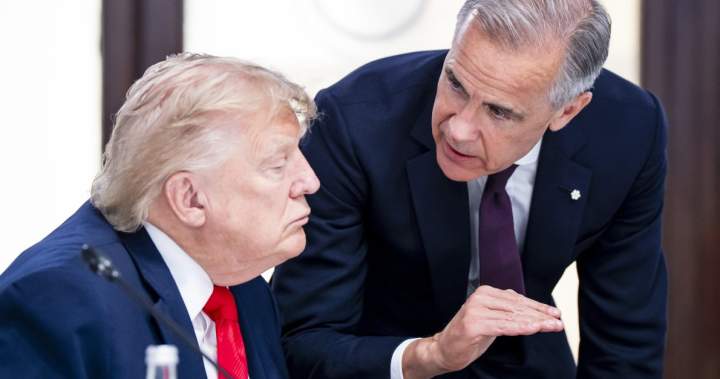
Prime Minister Mark Carney on Tuesday appeared to try and get U.S. President Donald Trump on board with Canada’s plan to import a limited number of Chinese electric vehicles during the G7 Summit in France.

Ahead of a working lunch between the world leaders, which was focused on overcoming global crises, Carney walked over to a seated Trump for a moment that was caught on a hot microphone.
At first, Carney appeared to notice a watch left on the table by French President Emmanuel Macron, whose seat was next to Trump at the roundtable, prompting Carney and Trump to joke about taking it.
“He’s left his watch here. We’ve got his watch,” Carney said, to which Trump replied: “Give me it if he left, gimmie.”
About 30 seconds later, the mic picked up Carney speaking about the deal with China, which will see Canada import up to 49,000 Chinese EVs at a lower tariff rate as part of a broader economic and strategic partnership agreement.
“Less than three per cent of our market, 49,000 cars,” Carney was heard saying. “It’s a cap, we capped, a hard line … I thought you’d actually like that.”

Get breaking National news
Get breaking Canada news delivered to your inbox as it happens so you won’t miss a trending story.
Trump was then heard saying, “That’s good, I like it,” before he turned away and Carney walked off.

The deal with China has raised concern within the Trump administration, with Trump himself threatening new tariffs and saying he won’t allow Canada to become a “drop-off port” for Chinese vehicles to enter the U.S.
The Canadian Vehicle Manufacturers Association, a group that represents the operations of Ford, General Motors and Stellantis in Canada, has urged Ottawa to scrap the Chinese deal altogether over fears it will hurt the North American auto industry.
China heavily subsidizes its EV industry, making the cars a more affordable option compared to EVs built in North America, Asia and Europe.
Concerns have also been raised about the technology employed by Chinese EVs and the possibility of China’s government accessing consumer data, prompting critics to dub the EVs “rolling spy vehicles.”
In May, two U.S. Democrats from Michigan announced legislation that would prevent Chinese-made cars from entering the U.S., calling them a national security concern and surveillance machines.
More than 2,900 Chinese EVs entered Canada in May, data from Global Affairs Canada shows, marking the first wave of imports under the new deal.
A federal government memo obtained through the Access to Information Act and first reported on by The Canadian Press urges Canadians to be cautious about the privacy risks of digital devices they buy and use.

© 2026 Global News, a division of Corus Entertainment Inc.