





Between December 2019 and December 2025, Canadian home insurance premiums spiked by 45 per cent, with passenger vehicle insurance premiums rising 23.9 per cent — and the reason is due to extreme weather claims, according to Statistics Canada.

A study conducted by the agency “examines the effects of the rising costs of extreme weather claims on Canada’s P&C [property and casualty] insurance sector,” finding that catastrophic claims reached $8.6 billion in 2024, surpassing the previous record of $6.2 billion set in 2016.
The third quarter of 2024 saw multiple cases of extreme and costly weather, with four major events within a 30-day window: the Calgary hailstorm ($3 billion), the Jasper wildfire ($1.1 billion), Quebec flooding ($2.7 billion) and Ontario flooding ($990 million).
This resulted in property and casualty insurers incurring more than $23 billion in catastrophic claims, according to Statistics Canada.
Each year from 2020 to 2025 ranked among the top 10 costliest years on record for extreme weather claims, since data tracking began in 1983. Home insurance was found to be “more impacted” by extreme weather claims compared with automobile insurance.
Rising repair costs, vehicle prices and thefts contribute to increase
While automobile insurance saw a lower percentage increase compared to homeowners’ insurance, expenses and premiums rose regardless.
“For drivers, auto insurance costs have been driven up by surging vehicle prices (especially during the pandemic), rising repair costs, and an uptick in auto thefts that peaked in 2023,” the study reads.

Get daily National news
Get daily Canada news delivered to your inbox so you’ll never miss the day’s top stories.
“Most insurers have both auto and homeowners’ operations and must manage both risks.”
Alberta sees larger increase in premiums
Alberta recorded the largest cumulative increase in homeowners’ insurance premiums among all provinces, rising 391.6 per cent across the 20-year period from December 2005 to December 2025.
In the most recent five-year period, Alberta (+55.8 per cent), Manitoba (+46.7 per cent), Nova Scotia (+43.1 per cent) and Saskatchewan (+40.9 per cent) all exceeded the national increase rate of 38.6 per cent.

Statistics Canada cites Alberta’s disproportionate numbers to the province’s “elevated risk of hailstorms, wildfires and convective storms, particularly in and around the Calgary region.”
Forestry and Parks Minister Todd Loewen said on May 4 that more than 550 firefighters have been hired for this year’s wildfire season, with hundreds more available upon request through contracts and mutual aid agreements.
The province is also introducing a mutual aid incentive pilot, offering municipalities up to $125,000 in wildfire response support.
“The goal is straightforward. Reduce immediate financial pressures. Remove barriers that may delay decision-making and improve wildfire outcomes through faster, co-ordinated response,” Loewen explained at a press conference.
“When the time comes, we want to make sure local governments are picking up the phones instead of checking their budgets,” he added.
96 active wildfires burning across Canada
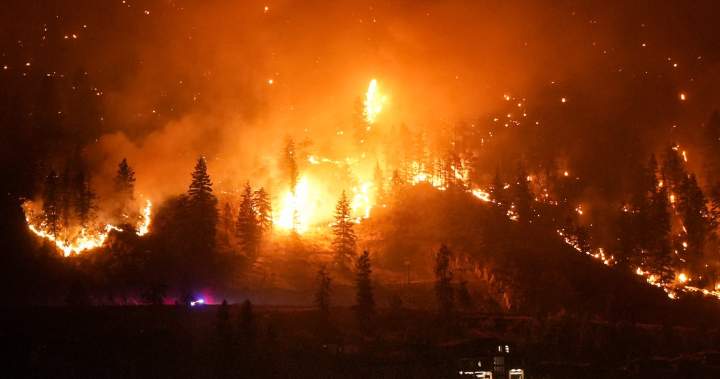
According to the Canadian Wildland Fire Information System, there are currently 96 active wildfires burning across Canada, eight of which are classified as out of control.
During the 2026 Canadian wildfire season outlook on May 28, Emergency Preparedness Minister Eleanor Olszewski said that “significant wildfire activity” in B.C. is especially expected in July.
“There are so many factors that can change how that forecast will come to be,” she said. “We should just be prepared for the worst.”

A government official said during a technical briefing that while the wildfire risk is unlikely to result in a record-breaking year like 2023 or 2025, the federal government is still anticipating above-average conditions as the 2026 season progresses.
The 2025 wildfire season is recognized as Canada’s second-worst on record, with nearly 90,000 square kilometres consumed as of September 2025 — an area larger than New Brunswick.
“We know obviously that hot and dry weather conditions increase the risk and above normal temperatures are expected across most regions of Canada over the next three months,” said Olszewski.
Environment Canada released its three-month summer forecast on June 5, warning that there is a high likelihood of temperatures exceeding averages this summer across Canada.
© 2026 Global News, a division of Corus Entertainment Inc.