







To follow and love football at its highest levels in the year 2026 is to willingly sign a certain nefarious contract with a certain nefarious creature.
By agreeing to the terms presented, the fan receives almost constant access to the most beloved game on earth, and its unique ability to provoke spontaneous joy. The kind created by Nestory Irankunda on Sunday, the kind every other game on earth has tried but mostly failed to replicate.
There is football available permanently these days, all over the world, and sometimes it is magical. Even when it is not, you engage anyway in the knowledge that at any moment, from any angle, it might become so.
But such a special thing comes at a cost. Perhaps it always has, and it is simply inflation that has brought the deal to a tipping point. Our love of football, then, has found itself mired in a cost-of-living crisis.
We put up with the aggressive commercialisation of every inch of the game, every thread on every jersey an advertisement. We have no choice but to grimly ignore when star players commit or are accused of horrible deeds, because the wheel keeps turning independently of our beaten-down morals.
We’ve copped the buzzkill of VAR, the broken financial pyramid that handicaps the European game, a World Cup in November, the FIFA Peace Prize, Gianni Infantino telling us to “chill”, mass corruption for mass corruption’s sake, and everything else in between.
Because the strains have all been at the margins, we’ve largely been able to keep hold of the core. But with one single initiative, one insulting and patronising concoction, we might finally have found the end of the world’s tether.
The hydration breaks.
Everyone knows what they are, and everyone knew what they were the second FIFA announced them. Even your mate who is still checking if gullible really is misspelled in the dictionary was quick to see through this cynical ploy immediately.
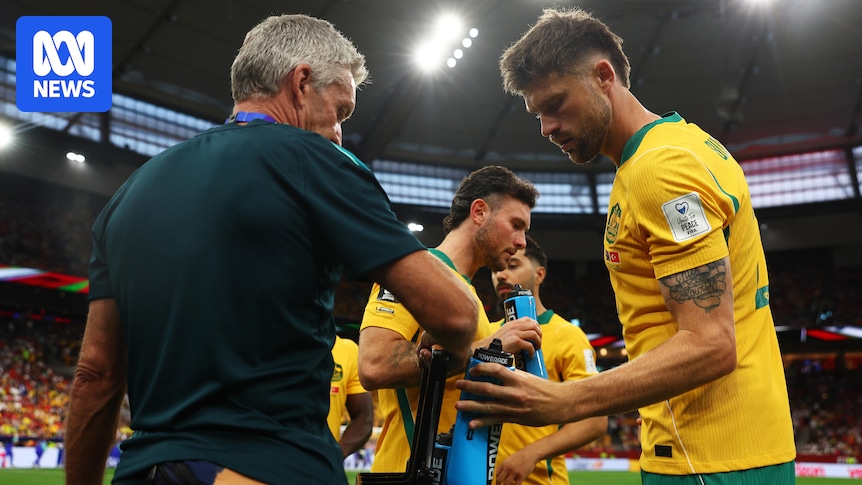
Managers and coaches are permitted to speak to players during the drinks breaks. (Getty Images: Jose Breton)
FIFA says these three-minute breaks, called at the referee’s discretion midway through each half, are purely to protect the players from the stifling North American heat of summer 2026.
But unlike the extreme heat policies introduced previously in football and in other sports, there is no temperature threshold that triggers these breaks. They’re here for every single game, no matter if it’s 23 degrees and raining or 33 degrees. Or in an air-conditioned stadium with the roof shut.
Their real purpose, as almost everyone has long-since deduced, is to effectively break the game up into quarters, providing broadcasters the chance to beam an extra batch of commercials to the billions watching around the world.
This latest, most gratuitous cash grab hurts most because it strikes at the heart of football’s most endearing quality: its natural cadence and tempo, the uninterrupted rhythm that means a goal could come for either team at any moment.
It is a fundamental difference between football and the other most popular ball sports around the world, but also may not be something you explicitly notice until it is taken away.
So when you get to somewhere around the 22nd minute of a game just starting to find its groove, its tactical mechanisations beginning to emerge and the legs of its players now free and firing, and it suddenly stops, and instead you are watching an ad for a gambling company or a fast food chain or a deodorant, it feels like a cold bucket of water on the head.
The breaks are tangibly impacting games, too. One of the stories of the World Cup was unfolding when Curaçao found an historic equaliser against Germany and briefly had the four-time champions on the ropes, only for the quarter-time break to completely alter the momentum of the match.
It feels so artificial and so unnatural, made worse by the shoddy pretence. There was no remit for this, and it’s unfathomable that a change this significant can be brought in on the whim of FIFA and its most scrutable leader.
Why does it matter? Because if they can sell off literal game time, the actual minutes when players should be running and jumping and kicking the ball, then there is nothing they can’t sell.
Socceroos players take a drink during the game against Türkiye. (Getty Images: Dean Mouhtaropoulos)
Our suspension of disbelief can only go so far. There is a point of no return, beyond which a portion of the watching world will grow tired of being conned and tune out.
Even so, they will likely never tune out in numbers great enough to slow the momentum of the game’s powerbrokers. There is no sport in which the disparity between the devotion of and care for its fans is greater than football.
The hope must be that this specific rort, ad breaks disguised as drinks breaks, does not permeate the club leagues we obsess over or the other international tournaments we savour.
US head coach Mauricio Pochettino has publicly expressed his distaste for the breaks, and his words may well carry more weight than those of the fans.
But even if hydration breaks do become a relic of this World Cup, a very American quirk within a very American tournament, there will always be another scheme. Another dollar to be made, another piece of the game’s essence to be hacked up and sold off in chunks.
Meanwhile, deep down the food chain, we cling on desperately to the remaining parts that still make us feel human, while resenting but inevitably succumbing to the ones that make us feel like mere customers.