







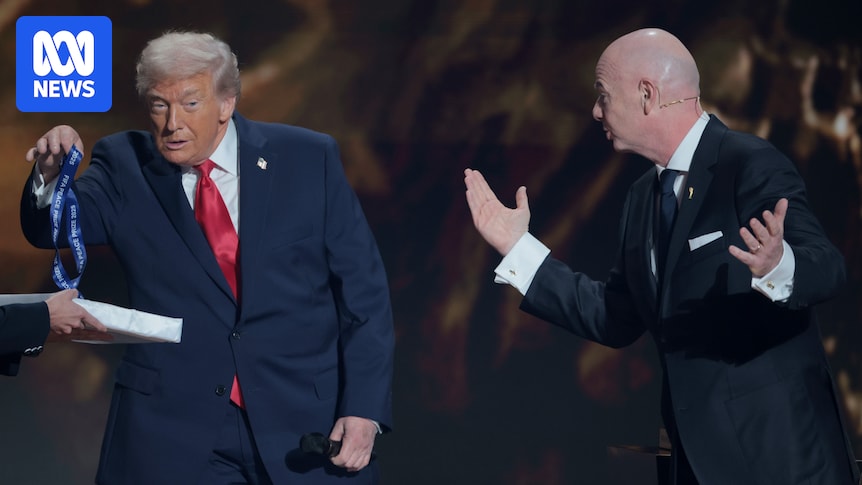
A FIFA Peace Prize, astronomical ticket prices, hiked train fares, threatened boycotts and a consumer complaint.
The build-up to the 2026 World Cup has been overshadowed by sociopolitical issues, which will continue to loom over the tournament.
A lot of the headlines have been generated by US President Donald Trump, who has made various threats and promises in the months leading up to the World Cup, which is being hosted in Mexico, the US and Canada — though almost all of the issues have been in the US.
But he’s far from alone in causing angst among soccer fans across the globe, even here in Australia.
While Australia prepares for the World Cup, controversy has come thick and fast for the tournament. (AAP Image/Rob Prezioso)
So, as 48 teams finalise their preparation for the largest World Cup in history, let’s unpick the long list of issues that have made headlines around the world.
Buckle up, it’s been a rocky ride to this tournament.
The FIFA Peace Prize
Never heard of it? Well, that’s not surprising, given it’s been awarded just once, in December last year, to Donald Trump.
The award, which FIFA described as being designated for a person who had “taken exceptional and extraordinary actions for peace” and “united people across the world”.
FIFA President Gianni Infantino presented Trump with the prize just a month after announcing its creation. Infantino had been a vocal supporter of the US president, even posting on Instagram that Trump should win the Nobel Prize.
Loading Instagram content
Australia midfielder Jackson Irvine hit out at the hypocrisy of the award when viewed alongside FIFA’s Human Rights Policy.
“As an organisation, you would have to say decisions like the one that we saw awarding this peace prize make a mockery of what they’re trying to do with the human rights charter and trying to use football as a global driving force for good and positive change in the world,” he told Reuters.
It also sparked a formal complaint from human rights nonprofit FairSquare, which requested an investigation into Infantino’s alleged breach of FIFA’s statutory duty to be politically neutral.
The US-Israel war with Iran
As it happens, while the war in the Middle East did nothing to ease tensions, Iran and the US were already engaged in a political battle over the World Cup.
As far back as December, Iran threatened to boycott the above-mentioned World Cup draw, citing issues with visas. The FFIRI (Iran’s football federation) applied for nine visas for the event, but was only granted four, with the organisation’s president, Mehdi Taj, one of those denied.
The issue stemmed, and continues to stem, from long-standing strict visa restrictions by the US on Iranians.
Iran is one of two countries competing at the World Cup, along with Haiti, that has a full ban on US travel. Ivory Coast and Senegal have partial restrictions.
The conflict in the Middle East has brought into sharp focus Iran’s participation in the World Cup. In March, Iran’s Minister of Sports and Youth, Ahmad Donyamli, said his country was not in a position to participate, following the killing of supreme leader Ayatollah Ali Khamenei.
Those comments also followed Australia providing humanitarian visas to seven members of Iran’s women’s side following the Asian Cup, though only two remained in the country.
Members of Iran’s women’s football team arrive at Kuala Lumpur International Airport in Sepang, Malaysia. (AP Photo/Azneal Ishak)
Trump responded to Donyamli’s comment by declaring Iran’s men’s national soccer team was welcome for the World Cup, but that it was not appropriate that they be there “for their own life and safety”.
Iran’s response to that comment was as expected — that the US should withdraw from the tournament. Iran had also asked FIFA to move its scheduled matches, two in Los Angeles and one in Seattle, to Mexico.
As you can see, there is a lot of back-and-forth from the US and Iran, but arguably the most left-field moment came when a top envoy to Trump asked FIFA to replace Iran with Italy at the tournament.
Italy failed to qualify for the World Cup for a third straight tournament after losing to Bosnia and Herzegovina in a penalty shootout.
That was quickly dismissed. Italy’s Sports Minister Luciano Buonfiglio said he would be offended if Italy were parachuted into the tournament.
This saga has rolled right up to the start of the tournament. Iran was seeking guarantees over visas as recently as the middle of May, according to the BBC.
Iran’s participation at the 2026 World Cup has been under a shadow since the beginning of the US-Israel conflict with Iran. (Reuters: West Asia News Agency/Majid Asgaripour)
Those guarantees included that all players, staff and officials receive visas, regardless of whether they had served in Iran’s Revolutionary Guard Corps. The group is listed as a terrorist organisation in Canada and the USA, so you can see the issue here.
FIFA also approved Iran’s request to move its training camp from Tuscon, Arizona to Tijuana in Mexico.
Only time will tell how the US and Iran manage these disputes as the tournament kicks off.
How much is a ticket!?
Let’s set aside the sociopolitical turmoil for a moment and get down to dollars and cents.
An overarching issue for this tournament has been ticket prices — both the face value and resale value.
For Australian fans, ticket availability became an issue in February, when FIFA’s third-round ballot resulted in many fans only getting a portion of the tickets they applied for, or missed out entirely.
Ticket prices have been higher than any other World Cup, and have been exacerbated by FIFA’s resale platform. (Getty Images: Dan Mullan)
FIFA boasted early this year that more than half a billion (BILLION!) applications had been received during the Random Selection Draw phase of ticket sales.
Adding insult to injury is the resale market, operated through FIFA’s own Marketplace platform, which saw prices skyrocket.
FIFA also takes a 30-per-cent cut of resale tickets.
The exception to this is Toronto, which passed a ‘Putting Fans First Act’ that only allows tickets to be resold at their original purchase price.
The incredible prices being charged on the resale platform included tickets behind the goals for the final in New Jersey being listed for more than $US2 million ($2.83 million).
In December, FIFA introduced a small number of tickets for $US60 ($85) for all 104 matches following widespread criticism of its pricing structure.
That criticism included a formal complaint to the European Commission by Football Supporters Europe over “excessive ticket prices”, and accused FIFA of abusing its monopoly position.
Even the attorneys-general of New York and New Jersey are investigating the soaring ticket prices.
FIFA President Gianni Infantino has defended the use of dynamic pricing, which sees prices move depending on demand, and has said prices for the tournament are in line with other sports in the United States.
The pricing strategy is a departure from previous tournaments, where tickets across all games were at a flat rate, regardless of who was playing. The US-Mexico-Canada edition has been priced according to the popularity of the sides playing.
Going to a game? Catch a train, and pay!
If ticket prices weren’t enough to get you hot and bothered under the collar, the decision to crank up public transport costs may well do the trick.
In April, New Jersey transport officials revealed a 15-minute round trip from New York City to New Jersey’s MetLife Stadium would cost $US150 ($209). That is nearly 11-times the price of a ticket to an NFL game, which the stadium also hosts.
Transport prices for World Cup games have caused consternation among fans already paying high prices for tickets. (AP: Seth Wenig)
Officials predicted around 40,000 fans would use public transit for each game at the venue, with no on-site parking available during the tournament.
NJ Transit president and chief executive Kris Kolluri said at the time the increased prices were necessary to cover the expected $US86 million ($122 million) cost of transporting fans.
“This isn’t price gouging,” he said. “We’re literally trying to recoup our costs.”
In Massachusetts, tickets for express buses to the home of the New England Patriots, Boston Stadium, were also priced at $US132 ($187), while a train ticket will be $US111 ($157).
FIFA bristled at suggestions it should cover the costs, pointing to agreements with host cities that called for free transportation.
Since the backlash, prices have dropped. New Jersey Governor Mikie Sherril took to social media to announce prices will be lowered to $US98 ($139).
Some cities are playing ball with fans. Atlanta, Houston and Seattle are charging regular transit prices, Kansas City is running $US15 ($21) shuttles, fans in Miami will get free shuttles to and from the stadium, while Philadelphia will provide free transport back from games.
The anything but ‘United’ bid
“UNITED, AS ONE” — Those were the words used in the World Cup bid book put forward by Canada, USA and Mexico as it pitched to host the 2026 edition of the tournament.
That was in Trump’s first term as president, but since his return to the White House, it’s hard to reconcile that language with his relationship with Mexico and Canada.
The United26 bid promised unity between the three countries, but relations have soured since Trump took office for a second time.
He’s since referred to Canada as the 51st state of the US, imposed tariffs on all imports except oil and energy, and traded barbs with former Canadian prime minister Justin Trudeau and current PM Mark Carney.
As for Mexico, he’s threatened to use the US military to target cartels in the country, as he tries to crack down on the flow of fentanyl across the border.
Suggestions of US military action in Mexico have been met with rejection from President Claudia Sheinbaum.
Mexico has also been hit by tariffs from the US.
So, united by name, but perhaps not in nature.
Closer to home — Fed Square outrage
The Melbourne Arts Precinct Corporation outraged soccer fans and Football Australia by banning the screening of World Cup matches at Federation Square in Melbourne.
In revealing its decision, the corporation said previous events had been marred by “antisocial” and “dangerous” behaviour.
Federation Square has hosted many live viewings of sporting events, but the behaviour of some attendees has caused concern. (AAP Image)
In 2023, fans took flares to the site for a Matildas Women’s World Cup game, which resulted in chaos when they were ignited.
Last year, a planned free concert by the band Amyl and the Sniffers was cancelled at the last minute after overeager punters started breaking through fences set up to prevent crowd crushes.
But after enormous public outcry, Victorian Premier Jacinta Allan overturned the ban and promised there would be police and security at the site.
“There’s always a risk of bad behaviour from a few dickheads at every public gathering, but police and security will be on site,”
she said.
“There’ll be zero tolerance for it.”
Pride Match
Before the official fixtures were released, a local group in Seattle had organised a Pride Match to coincide with the city’s annual Pride Parade and two days before the anniversary of the 1969 Stonewall Riots in New York.
But once the games were revealed, the proposed celebration came into sharp focus. The June 26 match was fixtured between Egypt and Iran, with both sides petitioning FIFA to intervene.
Those requests have raised the ire of organisers, who point to FIFA’s rhetoric around Qatar where it said that players who wore the OneLove armband in support of LGBTQ+ people would receive yellow cards.
Both Iran and Egypt have laws that suppress the LGBTQ+ community.
Only a few more, I promise
Let’s rattle through a few that came and went, and never really threatened to ruin the World Cup for fans, either in North America or around the globe.
Let’s start with the first official song of the tournament.
It’s called Lighter and it’s by US country megastar Jelly Roll, Mexican singer Carin Leon, and Canadian producer Cirkut.
Loading Instagram content
And reactions have been … brutal.
It’s been described as a “cheap bourbon hangover”, while one X user wrote “Cancel the whole damn tournament” in response to the song.
Luckily, Colombian star Shakira bobbed up with her fourth World Cup song — 16 years after ‘Waka Waka’ became synonymous with the 2010 edition in South Africa.
It’s fair to say her song ‘Dai Dai’ was far more warmly received.
Loading Instagram content
Music aside, it’s school children in Mexico who should feel aggrieved — with their parents. In May, the Mexican government floated plans to end the school year a month early to ease traffic during the World Cup.
The backlash was fierce, and less than a week after that plan became public, it was abandoned.
Another one from the US president — his threat to move games from cities he thinks are unsafe.
This was probably never a real chance of happening, considering the logistical challenge of rescheduling matches, but it did create headlines.
What fans can expect at matches, though, is the strong presence of Immigration and Customs Enforcement agents as part of stadium security.
The agency is set to be a “key part of the overall security apparatus” for the tournament. How involved ICE agents will be in the general security of venues remains to be seen.
And lucky last — HYDRATION BREAKS. That’s right — twice during every one of the 104 World Cup matches, players will be given a three-minute drinks break.
Oh, that’s nice, you might be thinking. Looking out for player welfare, you might say. But it is hard to see it as anything other than a cash grab, with broadcasters allowed to play ads during those breaks, instead of just at half-time.
That’s not to say the players won’t enjoy the drink. In Dallas, for example, daytime temperatures can get to the mid 30s, and nights don’t drop below 20 degrees Celsius.